

Remote support for athletes during post-injury recovery: the possibilities and limitations of online training
Authors
Opekunova Ekaterina

Share
Annotation
This article discusses the prospects for remote support of athletes during post-traumatic recovery. It describes the stages of athletes' return to physical and athletic activity, as well as various forms of remote interaction with specialists and the potential of digital technologies in this process. Special attention is paid to the use of mobile platforms, motion sensors, and remote monitoring of functional indicators. The research results show that digital technologies can help increase commitment to the recovery program and more effectively monitor the dynamics of the condition. However, despite all the advantages, online training has some limitations. They are associated with the lack of direct supervision by a specialist, the risk of incorrect exercise performance, the difficulty of assessing pain, technical conditions, and the need for a face-to-face examination at certain stages of recovery.
Keywords
Authors
Opekunova Ekaterina
Share
Relevance of the study
Due to the development of remote technologies and their widespread introduction into the field of sports rehabilitation, the relevance of this topic is increasing. After an injury, an athlete needs regular monitoring of his condition, individual selection of loads and a gradual return to training. Online support opens up new horizons, allowing you to keep in touch with a specialist, monitor exercise performance, and adjust the recovery program without the need for constant personal presence.
However, it should be noted that the remote format has its limitations: it is impossible to conduct a full-fledged physical examination, accurately assess individual functional indicators and monitor movement technique. Therefore, it is especially important to identify the conditions under which online training can be a safe and effective tool for post-traumatic recovery of athletes.
Thus, the relevance of this study is determined by the need to assess the advantages and disadvantages of remote support and determine its place in the sports rehabilitation system.
The purpose of the study
The purpose of the study is to examine the possibilities and limitations of online training for the remote support of athletes during the recovery period after injuries, and to identify the main conditions for its effective and safe use.
Materials and research methods
The research materials consisted of scientific publications on the post-traumatic recovery of athletes, telehealthcare, and the use of mobile devices, digital technologies, and remote monitoring in the rehabilitation process. The paper examined the results of studies involving the use of mobile assistance after the reconstruction of the anterior cruciate ligament, digital motion sensors, and remote rehabilitation programs.
During the work, methods such as analyzing and summarizing scientific literature, comparing research findings, and organizing data on the potential and limitations of remote assistance for athletes were employed.
The results of the study
The post-traumatic recovery process for an athlete is a continuous journey of returning to both physical and athletic activities. The international consensus on returning to sports, published in 2016, views this as a continuous process that includes three stages: returning to sports participation, returning directly to sport, and returning to previous levels of athletic performance [4]. These stages are illustrated in Table 1 below.
Table 1
Stages of an athlete's return to athletic activity after injury
|
Stage |
Main content |
|
Return to participation |
Individual training and sports activities |
|
Return to sports |
Resumption of the relevant sport |
|
Returning to performance |
Achieving a previous or higher level of athletic performance |
A source: [4].
At the stage of returning to training, athletes are already performing some elements of training, but they are not yet ready for full-fledged sporting activities. Returning to sport means resuming training, although the level of performance may be lower than the initial level. A return to performance involves achieving a previous or higher level of athletic achievement.
When assessing an athlete's fitness, not only his physical condition is taken into account, but also his functional capabilities, psychological fitness, the requirements of a particular sport, and the risk of repeated injury. Therefore, the decision to resume training should be based on a combination of factors, and not just on the time that has passed since the injury [3, p. 151].
Special assessment criteria have been developed for certain sports injuries. Therefore, the 2021 international consensus on returning to sports after an ankle sprain recommends the PAASS system, which includes an evaluation of pain, the state of the ankle joint, the athlete's perception of their condition, sensorimotor control, and athletic and functional abilities [9].
Therefore, recovery from an injury involves gradually restoring functions and gradually increasing specific sports loads. The transition between stages should be based on the athlete's current condition and the results of functional assessments.
Remote support is based on the use of information and communication technologies to enable an athlete to interact with a specialist. This type of organization of rehabilitation care has been described in the scientific literature as telerehabilitation. This can include video consultations, remote monitoring, the transmission of exercise programs, monitoring of their completion, and receiving feedback [5].
Synchronous and asynchronous formats are used in remote training. Synchronous interaction involves direct video communication between a trainee and a trainer, where exercises are performed under real-time supervision. In the asynchronous format, the trainee receives a program and performs tasks independently, then transmits data or video recordings for later evaluation by the trainer.
Digital technologies allow us to complement these forms of interaction with motion sensors, digital platforms, and tools for recording exercise results. Researchers have used sensory technologies to record motor tasks and transfer the information for further analysis in the study of telerehabilitation systems [8].
Remote assessment can be used to monitor various parameters of the musculoskeletal system, such as pain, range of motion, balance, and walking. Telerehabilitation studies have explored the possibility of remotely assessing these indicators. However, the accuracy and applicability of these methods depend on the specific indicator being studied and the evaluation conditions.
To provide remote support, a reliable digital platform is essential. The World Health Organization and the International Telecommunication Union published a global standard for telemedicine accessibility in 2022. This standard provides recommendations for organizing and using digital platforms for telehealth services [10].
The use of digital technologies in sports makes it possible to complement the recovery process with regular monitoring of exercise performance and recording results. The studies conducted after the reconstruction of the anterior cruciate ligament of the knee joint are especially valuable, since this injury is often found in active people and requires a long recovery.
A study conducted by Y. Guo and his colleagues enrolled 125 patients who underwent a recovery program after anterior cruciate ligament reconstruction. 62 of them additionally received support via a mobile platform, while 63 completed a home program following the usual written instructions (Table 2). After six weeks, the knee joint movement volume in the mobile support group averaged 126.6°, while in the control group it was 118.1°. In addition, in the digitally assisted group, there were fewer differences in hip circumference and less pain when bending the knee. Commitment to the rehabilitation program was also statistically higher.
Table 2
Results of mobile support in the first six weeks after anterior cruciate ligament reconstruction
|
The indicator after 6 weeks |
Mobile support |
The usual home program |
Statistical significance |
|
Number of participants |
62 |
63 |
– |
|
The amount of movement in the knee joint |
126,6 ± 20,5° |
118,1 ± 20,5° |
p = 0.011 |
|
Hip circumference difference |
2.5 cm |
3.0 cm |
p < 0.001 |
|
Pain when bending on the Visual Analogue Scale |
2.5 points |
3.0 points |
p < 0.05 |
|
Commitment to rehabilitation |
higher in the mobile support group |
below |
p = 0.047 |
A source: [7].
Motion sensors offer even more possibilities. In the study [8], a digital device for knee joint repair was developed, which included a motion sensor, a mobile application, instructions, and functional tests. As part of this study, 10,311 measurements obtained from 604 users were analyzed. The system allowed recording the volume of movements, coordination, as well as strength and speed indicators. The results were displayed in the application, which enabled specialists to make decisions about the future content of the program. The figure shows the general scheme of the device.
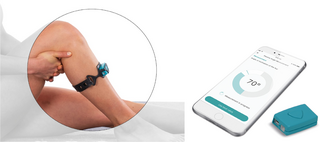
Fig. An example of a digital medical device and a mobile application for monitoring knee joint recovery [8]
In the controlled part of the same study, adherence to recovery recommendations was 86% among digital device users and 74% in the control group (p < 0.05). Users of the digital system also performed independent exercises with a higher declared intensity: a median of 8.0 points versus 5.5 points in the standard management group. 13 out of 17 users noted that observing the recovery results provided positive feedback and promoted motivation.
The ability to continue observing during breaks between face-to-face classes is also of practical importance. In the TRAK-ACL study, the digital system offered patients who underwent anterior cruciate ligament reconstruction individual exercise programs, informational materials, and long-distance physical therapist support. Of the 51 participants, 26 were included in the TRAK-ACL group, and 25 were included in the conventional treatment group. After six months, data was obtained from 88% of the participants in the digital group and from 68% of the participants in the conventional treatment group. The authors concluded that this format is suitable for conducting larger-scale research [6].
Thus, the most promising online training opportunities are to support self-study, register the completion of tasks, monitor the dynamics of individual functional indicators, and increase commitment to the program. Digital tools provide the specialist with the opportunity to receive additional information about the recovery process between face-to-face visits, which allows him to make timely changes to the content of home exercises.
Remote support of athletes during rehabilitation after injuries has its limitations, mainly due to the lack of direct contact with a specialist. In online mode, it is difficult to fully assess the condition of the injured area, the correctness of movements, amplitude, joint stability, muscle strength, and the body's response to stress. In some cases, an in-person examination and special functional tests are necessary for an objective assessment.
One of the main risks of remote support is improper performance of recovery exercises. Without proper control, an athlete may make technical errors, exceed the permissible intensity of loads, or, conversely, perform exercises in insufficient volume. This can slow down the recovery process, increase pain, or create the conditions for repeated damage [1, p. 243].
Pain assessment is a challenging process, especially when working remotely. The specialist relies heavily on the athlete's subjective feelings, but athletes are not always able to accurately determine if the pain they experience is an acceptable response to stress or a sign of injury. This makes it essential for the specialist to carefully increase the volume and intensity of exercise when working remotely.
The success of online training also depends on the athlete's commitment. A specialist cannot always control the regularity of training, the accuracy of the program, or the implementation of recommendations. If the athlete is unmotivated or inconsistent, the effectiveness of distance learning can be significantly reduced.
A separate group of challenges includes technical factors. Poor internet connection, an inconvenient camera position, limited space for exercise, and a lack of necessary equipment can all make it difficult to hold classes and monitor movements. Additionally, using sensors and mobile applications requires good hardware and the ability to properly interact with digital devices.
In addition, the remote format does not allow for procedures that require the direct participation of a specialist. These procedures include some types of manual therapy, palpation, individual measurements, and clinical tests. Therefore, online support may not always be a complete substitute for full-time work.
The effectiveness of online training depends on how accurately the recovery stages and permissible loads are determined. The program should take into account the nature of the injury, the athlete's physical condition, the specifics of the sport and the dynamics of recovery [2, p. 10].
For effective recovery, athletes need regular feedback from a specialist, monitoring of exercise technique and timely load adjustment. The safest approach is considered a combination of distance learning with periodic face-to-face monitoring.
The development of mobile applications, wearable sensors, and motion analysis systems opens up new horizons for remote tracking. These technologies allow you to track exercise performance, physical activity, and recovery dynamics, which gives athletes a more accurate and individual approach to their process.
The most promising is the mixed model, which combines face-to-face examination and remote work. Its development can significantly increase the availability and quality of support, as well as provide individual monitoring of the athlete's condition during the recovery process.
Conclusions
Remote support can be an effective addition to the traditional methods of post-traumatic recovery of athletes. With the help of mobile apps, motion sensors, and remote communications, athletes can practice on their own, while coaches can monitor exercise performance and track the dynamics of the recovery process. The research presented in the article demonstrates the positive results of using digital technologies in rehabilitation. In particular, it shows that the use of such technologies helps to increase athletes' commitment to recovery programs.
However, it is worth noting that online workouts cannot completely replace personal presence, as they have their limitations in assessing the condition of the damaged area, monitoring movement techniques, and conducting certain examinations and procedures. Therefore, the most effective solution is to combine distance learning with periodic face-to-face supervision by a specialist. The success of this approach depends on proper load selection, regular feedback, and consideration of the nature of the injury and the athlete's current condition.
References:
- Makhonin E.V. Application of recovery means in the training system // Actual problems of natural science education, environmental protection and human health. – 2016. – Vol. 2, No. 2. – pp. 241-246.
- Pankov V.A., Trishin S.E., Nasevich S.V. Application of recovery means in the modern system of athletes' training // Bulletin of sports science. – 2009. – No. 6. – pp. 9-11.
- Finochenko V.A., Bukata I.P., Inyutin N.V., Sviridov R.K. Recovery and rehabilitation of athletes after injuries // Transactions of the Rostov State Transport University. – 2023. – No. 2 (63). – pp. 150-155.
- Ardern C.L. Consensus statement on return to sport from the First World Congress in Sports Physical Therapy, Bern / C. L. Ardern, P. Glasgow, A. Schneiders [et al.] // British Journal of Sports Medicine. – 2016. – Vol. 50, No. 14. – pp. 853-864. – DOI: 10.1136/bjsports-2016-096278. – URL: https://bjsm.bmj.com/content/50/14/853.
- Cottrell M.A. Telehealth for musculoskeletal physiotherapy / M.A. Cottrell, T.G. Russell // Musculoskeletal Science and Practice. – 2020. – Vol. 48. – Art. 102193. – DOI: 10.1016/j.msksp.2020.102193. – URL: https://pmc.ncbi.nlm.nih.gov/articles/PMC7261082/.
- Dunphy E. Feasibility of randomized controlled trial comparing TRAK-ACL digital rehabilitation intervention plus treatment as usual versus treatment as usual for patients following anterior cruciate ligament reconstruction / E. Dunphy, K. Button, F. Hamilton, J. Williams, I. Spasic, E. Murray // BMJ Open Sport & Exercise Medicine. – 2021. – Vol. 7, No. 2. – Art. e001002. – DOI: 10.1136/bmjsem-2020-001002. – URL: https://bmjopensem.bmj.com/content/7/2/e001002.
- Guo Y. Mobile health-based home rehabilitation education improving early outcomes after anterior cruciate ligament reconstruction: a randomized controlled clinical trial / Y. Guo, D. Li, Y.-B. Wu, X. Sun, X.-Y. Sun, Y.-P. Yang // Frontiers in Public Health. – 2023. – Vol. 10. – Art. 1042167. – DOI: 10.3389/fpubh.2022.1042167. – URL: https://www.frontiersin.org/journals/public-health/articles/10.3389/fpubh.2022.1042167/full.
- Höher J. Sensor-based telerehabilitation system increases patient adherence after knee surgery / J. Höher, B. Lischke, W. Petersen [et al.] // PLOS Digital Health. – 2023. – Vol. 2, No. 2. – Art. e0000175. – DOI: 10.1371/journal.pdig.0000175. – URL: https://pmc.ncbi.nlm.nih.gov/articles/PMC9937459/.
- Smith M.D. Return to sport decisions after an acute lateral ankle sprain injury: introducing the PAASS framework – an international multidisciplinary consensus / M. D. Smith, B. Vicenzino, R. Bahr [et al.] // British Journal of Sports Medicine. – 2021. – Vol. 55, No. 22. – pp. 1270-1276. – DOI: 10.1136/bjsports-2021-104087. – URL: https://bjsm.bmj.com/content/55/22/1270.
- World Health Organization. WHO-ITU global standard for accessibility of telehealth services. – Geneva: World Health Organization, 2022. – p. 36 – ISBN 978-92-4-005046-4. – URL: https://www.who.int/publications/i/item/9789240050464.
Other articles of the issue