

Formation of the competence model of an architectural engineer in the context of end-to-end management of the software development lifecycle
Authors
Izripov Iusup

Share
Annotation
The article considers the issue of forming a competence model of an architectural engineer in the context of end-to-end management of the software development lifecycle. It is argued that a modern architectural engineer should have not only knowledge in the field of programming and technology, but also a number of other important competencies: analytical, architectural design, documentation, control and evaluation, and organizational and communicative. Special attention is paid to the relationship between the stages of the software product lifecycle and the professional requirements for a specialist. The competence model developed in the article can be used for personnel training, qualification assessment, project activities, and internal training of specialists.
Keywords
Authors
Izripov Iusup
Share
Relevance of the study
The relevance of the research topic is due to the growing importance of software in various fields: economics, public administration, industry, education, and many others. Modern software systems are becoming an integral part of complex organizational and production processes, which makes their development a task requiring not only technical skills, but also deep knowledge in the field of architectural design, requirements analysis, reliability, security and product maintenance [2, p. 39].
Special attention is paid to end-to-end management of the software development lifecycle, which includes requirements analysis, design, development, testing, implementation, and subsequent maintenance. Under these conditions, an architectural engineer must have a deep understanding of the software system at all stages of its creation and development, make informed architectural decisions, and ensure their compliance with the project objectives [1, p. 466].
The relevance of the study is also due to the need to rethink the approach to training engineering and IT specialists. A modern architectural engineer should possess not only professional and digital skills, but also deep analytical, organizational, and communication abilities. Therefore, the formation of the competence model of such a specialist becomes a priority task to improve the quality of education and training of personnel capable of meeting the high requirements of modern software engineering.
The purpose of the study
The purpose of this study is to determine the structure and practical significance of the competence model of an architectural engineer in the context of end-to-end management of the software development lifecycle.
Materials and research methods
The research is based on open professional and regulatory sources, the provisions of the professional standard of a software architect, as well as scientific approaches to training specialists in the field of software engineering.
In the course of the work, methods of analysis, generalization, systematization, comparison and structuring of professional competencies were used.
The results of the study
A competency-based approach to training an architectural engineer should focus not on a simple list of academic subjects, but on specific learning outcomes: what the graduate should know and be able to do, and what professional challenges they can solve.
For an architectural engineer, programming knowledge is not the only important thing. It is also essential to have the ability to approach problems systematically, analyze information, work as part of a team, and participate in project activities. These skills are already reflected in the Federal State Educational Standard, which includes universal competencies such as system and critical thinking, project development and implementation, teamwork, and business communication. In addition, general professional competencies include the application of engineering knowledge and information technology, as well as the development of algorithms and programming skills, and participation in the creation of technical documentation [9].
End-to-end management of the software development lifecycle means considering a software product during not only the code writing stage, but also at all other stages. From requirements and design to implementation, operation, maintenance, and modification, every aspect of the process is taken into account. This approach is defined in GOST R ISO/IEC 12207-2010, which outlines the general structure of software development processes. The standard emphasizes the importance of processes such as agreement, organizational support for the project, technical processes, implementation of software, support, and reuse [8].
For an architectural engineer, this means that his professional requirements become more diverse. The architectural solution should not only be technically correct, but also suitable for subsequent maintenance, integration, changes and quality control. Therefore, the specialist must be able to relate the customer's requirements, the structure of the software system, and the limitations of the project, technical documentation, testing and operation. The professional standard for software architects clearly defines such functions as the selection and modeling of architectural solutions, the development of architectural documentation sections, as well as the control of software implementation and testing from an architectural point of view.
The figure below shows the relationship between the software lifecycle and the competencies of an architectural engineer.
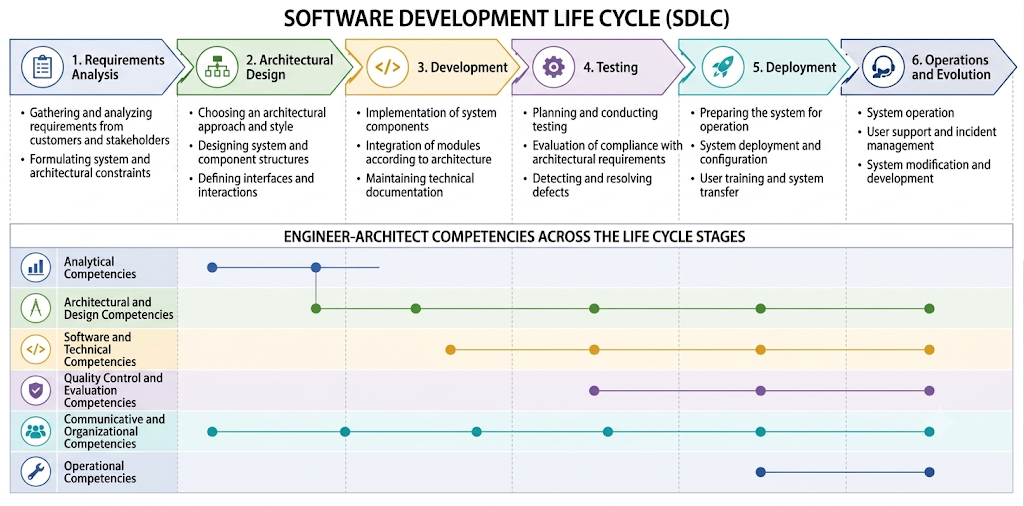
Fig. The relationship of the software lifecycle with the competencies of an architectural engineer (author's development)
Each stage of the life cycle of an architectural project requires a different set of skills from the architect (Table 1). During the requirements phase, analytical and communication skills are essential. During the design phase, knowledge of architectural techniques and modeling methods is crucial. During development and integration, an understanding of implementation technologies is necessary. During testing, the ability to evaluate the conformity of the result to the architectural solution is important. And during maintenance, the ability to analyze changes and ensure the stability of the software system is essential.
Table 1
The impact of life cycle stages on requirements for an architectural engineer
|
Life cycle stage |
What an architectural engineer should consider |
What kind of competence is being formed |
|
Requirements analysis |
Customer's goals, limitations, and system functions |
Analytical and communication |
|
Architectural design |
System structure, components, connections, integration methods |
Architectural and design |
|
Development |
Compliance of the software implementation with the chosen architecture |
Software and technical |
|
Testing |
Verification of the result in terms of architecture and quality |
Control and evaluation |
|
Integration |
Compatibility with infrastructure and operating conditions |
Engineering and Technology |
|
Escort |
Changes, incidents, software system development |
Organizational and operational |
A source: author's development
The structure of the competence model for an architectural engineer should reflect the actual directions of their professional activity, including requirements analysis, the selection of an architectural solution, the description of the architecture, the implementation control, the verification of the compliance of the software system with the architectural requirements, and system maintenance and development. In the professional standard "Software Architect," the main purpose of this type of work is defined as the design, monitoring, and control of the software architecture [10].
It would be beneficial to include several interconnected components in the model, as shown in Table 2.
Table 2
The structure of the competence model of an architectural engineer
|
Competence Block |
The content of the block |
Importance for professional activity |
|
Analytical |
Requirements analysis, identification of limitations, clarification of system goals |
Allows you to link the architecture to the customer's tasks |
|
Architectural and design |
Choosing an architectural solution, defining components and relationships |
Forms the basis of a future software system |
|
Software and technical |
Understanding development, integration, and testing technologies |
Provides realistic architectural solutions |
|
Documentation |
Architecture description, preparation of technical materials |
Allows you to capture decisions and pass them on to the team |
|
Control and evaluation |
Checking the compliance of the software system with the architecture |
Reduces the risk of development deviation from design solutions |
|
Organizational and communicative |
Interaction with the team, the customer and the project participants |
Ensures consistency of actions during the development process |
A source: author's development
The formation of the competence model of an architectural engineer should be based on an in-depth analysis of the professional tasks that he solves during the design and maintenance of software systems. The professional standard specifies specific work activities that a specialist performs: identifying and coordinating architectural requirements for a software system, describing them, selecting a suitable architectural solution, and monitoring its implementation. This approach allows you to create a model based on the real actions of an engineer, and not on abstract ideas [6, p. 5].
There are several methodological approaches to the formation of the competence model of an architectural engineer. One of them, functional– involves the distribution of competencies according to the main work functions of a specialist: requirements analysis, architectural design, documentation, and implementation control and system maintenance. This approach is convenient for scientific articles, as it clearly demonstrates the relationship between competencies and the content of professional activity [5, p. 210].
The second approach is project-oriented. He assumes that the learning process will include practical tasks related to the development of a software system architecture. As part of these tasks, it is necessary to describe the requirements, build a component model, define interfaces, prepare architectural documentation, and protect the chosen solution. This approach allows us to evaluate not only theoretical knowledge, but also the ability to apply it in practice [4, p. 401].
The third approach is interdisciplinary. An architectural engineer performs tasks that lie at the intersection of various disciplines: analysis, software engineering, design, management, and communication. Therefore, his competence model should include both technical and analytical, organizational and communication skills. Special attention should be paid to the ability to take into account the changes that may occur in the software system after its implementation. The architecture must remain stable during refinement, integration of new components, and product development.
The practical application of the competence model of an architectural engineer is presented in Table 3.
Table 3
Practical application of the competence model of an architectural engineer
|
Scope of application |
Practical significance of the model |
Expected result |
|
Specialist training |
Determining the necessary knowledge, skills, and professional actions |
A more accurate link between learning and real-world development tasks |
|
Assessment of qualifications |
Verifying the ability to analyze requirements, design architecture, and monitor implementation |
Objective assessment of a specialist's readiness |
|
Employer's work |
Formation of the position profile and candidate requirements |
Reduction of errors in the selection of IT personnel |
|
Project activities |
, Distribution of roles between analysts, developers, testers, and architect |
Improving team consistency |
|
Internal training |
Determining employee competence deficits |
Building individual development programs |
A source: author's development
The main difficulty of implementing the competence model of an architectural engineer lies in the rapid development of software development technologies. Architectural solutions depend on the platforms used, integration methods, security requirements, performance, reliability, and scalability. Therefore, the model cannot remain unchanged – it must be updated regularly to reflect changes in software engineering and employer practices.
The second problem is related to the difficulties of assessing architectural competencies. Knowledge of technology alone is not a sufficient condition for successful work as an architectural engineer. A specialist should be able to justify the choice of a solution, take into account the limitations of the project, coordinate the interests of the participants, describe the structure of the system and monitor its implementation. The assessment should include not only testing, but also analysis of design assignments, architectural documentation, case studies, and protection of a technical solution.
The third problem is related to the lack of qualified specialists who could train future architectural engineers. The growing demand for specialists in the field of information and communication technologies and the presence of tens of thousands of open vacancies indicate that the market needs not only more personnel, but also employees capable of performing complex project tasks. This is especially true for architectural positions, where a combination of technical experience, analytical skills and the ability for managerial interaction is required [3, p. 168].
The prospects for the implementation of the competence model are linked to the transition from a formal description of knowledge to the assessment of professional actions. To develop the model, it is most advisable to use practical projects, a portfolio of architectural solutions, team development, expert evaluation of documentation, and protection of design solutions. This approach allows us to determine whether a specialist can not only name a technology but also apply it in an effective architectural solution.
In the future, the competence model can serve as a basis for the professional development of an architectural engineer, from participating in individual project tasks to managing the architecture of complex software systems. Its implementation promises to benefit organizations that develop, implement, and maintain software products by systematically training specialists, reducing project risks, and improving the quality of architectural decisions [7, p. 44].
Conclusions
Thus, the formation of a competence model for an architectural engineer is of great theoretical and practical significance, as it allows us to define the requirements for a specialist working at all stages of the software development lifecycle. This model should include analytical, architectural, design, software, technical, documentation, control, evaluation, and organizational communication blocks. Implementing this model helps to improve the quality of training for IT personnel, more accurately assess the professional readiness of specialists, and reduce risks in developing, implementing, and maintaining software systems. The prospects for further development of this model lie in its regular updating to take into account changes in technology, employer demands, and software engineering practices.
References:
Zaporozhchenko A.E., Pankova D.A. Training IT personnel for the digital economy: labor market requirements // Transformation of business and public institutions in the context of digitalization of the economy: Collection of scientific papers of the V National (Russian) scientific and practical conference. – 2023. – pp. 464-470.
Lavrishcheva E.M. On the definition of the theoretical foundations of software engineering // Web of Scholar. – 2016. – No. 4 (4). – pp. 36-44.
Mashkin D.O. Problems of training personnel in the field of information and communication technologies in institutions of higher professional education // Scientific and methodological electronic journal "Concept". – 2016. – No. T2. – pp. 166-170.
Memetova F.S. Components of a Software Engineering Teaching Methodology // Global Scientific Research and Development in the Digital Age: Collection of Articles from the XV International Scientific and Practical Conference. – 2021. – pp. 398-404.
Naykhanova L.V., Evdokimova I.S., Dorzhieva E.Ts. Stages of Developing an Educational Program Taking into Account the Professional Standard // Digital University: Improving the Organization of Training and the Strategy for the Development of Education in the Context of Digitalization: Proceedings of the All-Russian Scientific and Methodological Conference with International Participation. – 2023. – pp. 208-214.
Pustovoy N., Zima E. Formation of Competencies of a Modern Engineer in the Context of the Transition to a Two-Tier System // Higher Education in Russia. – 2008. – No. 10. – pp. 3-7.
Firsova S.A., Ryabukhina E.A., Pimashev V.A. Application of group project activities in the educational process of students majoring in software engineering // International Journal of Experimental Education. – 2022. – No. 6. – pp. 41-50.
GOST R ISO/IEC 12207-2010. Information technology. Systems and software engineering. Software life cycle processes [Electronic resource] // Electronic fund of legal and regulatory documents. – Introduced. 2012-03-01. – URL: https://docs.cntd.ru/document/1200082859.
Order of the Ministry of Education and Science of Russia dated September 19, 2017 No. 920 "On approval of the federal state educational standard of higher education - bachelor's degree in the field of training 09.03.04 Software Engineering": registered with the Ministry of Justice of Russia on October 16, 2017 No. 48546: amended on February 8, 2021 [Electronic resource] // FSES. – URL: https://fgos.ru/fgos/fgos-09-03-04-programmnaya-inzheneriya-920/.
Order of the Ministry of Labor of Russia dated August 30, 2021 No. 579n "On approval of the professional standard "Software Architect": registered in the Ministry of Justice of Russia on October 5, 2021 No. 65296 [Electronic resource] // ConsultantPlus. – URL: https://www.consultant.ru/document/cons_doc_LAW_397127/d4e49eb77ecb0d67f3f7df705ec8a6086077609b/.
Other articles of the issue