

Virality and monetization of attention in digital media
Authors
Ramberdiyev Ramazan Bahytjanuly

Share
Annotation
The article analyzes the relationship between the virality and monetization of attention in digital media, in the context of the shift from information scarcity to attention deficit. It shows that, in the digital age, user attention has become a key economic resource upon which social networks, video hosting, and streaming services build their business models. Based on statistical data about the prevalence of social media and the average time users spend online, the article reveals the scale of the competition for attention and the role of platforms as infrastructure for information flows. It examines the mechanisms behind viral content creation, drawing on cognitive psychology, communication sociology, and platform research. The article also explores the influence of emotional factors, social stimuli, and algorithmic distribution on viral content. The main monetization models based on viral content and audience engagement, such as advertising, subscription, and hybrid, are analyzed. The risks of the attention economy, including manipulation of user behavior, misinformation, effects on mental health, threats to privacy, and opacity of algorithms, are also discussed. Special attention is given to regulatory and ethical aspects and practical recommendations for creating a more sustainable and responsible digital media environment for platforms, brands, and content creators.
Keywords
Authors
Ramberdiyev Ramazan Bahytjanuly
Share
Relevance of the study
The relevance of the research stems from the fact that, in the context of digitalization, user attention has become a scarce and crucial resource. Business models for platforms, brands, and independent creators are being shaped around it, while algorithmic feeds from social media and video hosting platforms intensify competition for audience engagement. Under these circumstances, the ability of content to rapidly and widely spread (virality) has become one of the primary determinants of media and commercial success.
Viral content has an impact not only on media consumption, but also on marketing, politics, and culture. It is used to promote goods and services, shape public opinion, and set the agenda. At the same time, there is a lack of research on the relationship between virality and monetization in the scientific literature. The mechanisms that underpin this relationship are not well understood, including how content characteristics, platform algorithms, and user behavior combine to generate widespread coverage and financial success. Different monetization models may produce varying levels of stability.
Additional relevance to the topic is provided by the growth of social and ethical risks, such as the spread of clickbait and polarizing materials, the manipulation of attention, information overload, and dependence on platforms. Additionally, there are discussions around the regulation of targeted advertising and the use of personal data. In this context, a comprehensive analysis of the "virality-attention-monetization" link is essential for the development of theories in mass communication and media economics. This analysis will also help to develop practical recommendations for platforms, brands, authors, and regulators who are interested in creating a more sustainable and responsible digital media environment.
The purpose of the study
The aim of this research is to conduct a comprehensive analysis of the correlation between content virality and attention monetization in digital media. This includes identifying the theoretical and methodological underpinnings of the attention economy, exploring the mechanisms that contribute to viral content creation, examining the main models for attention monetization on digital platforms, and assessing the key risks, ethical considerations, and regulatory implications associated with the intensification of competition for users' attention.
Materials and research methods
The research materials consisted of open statistical data and analytical reports on the global usage of social networks, the structure of advertising expenditures and revenues of digital platforms, as well as information on the average time users spend on social media and video services in different regions of the world.
The methodology of the study included a theoretical analysis and synthesis of academic literature, a second analysis of statistical indicators, a comparison of regional and platform-specific trends in digital content consumption, and a structural and functional approach to understanding attention monetization models. Additionally, we presented risks and regulatory responses to these models in tabular format.
The results of the study
The theoretical and methodological foundations of virality and attention economy in digital media are linked to the transition from information scarcity to attention deficit. George Simon also noted that in an "information-saturated world, the abundance of information creates a lack of attention" and the need for its rational allocation [1]. In the digital world, user attention has become a valuable and scarce resource, around which the business models of social media, video hosting, and streaming platforms are built. This attention economy refers to a market in which platforms compete for users' limited time and cognitive capacity, and the value of content depends not only on its quality but also on its ability to capture and maintain attention.
International research suggests that by 2025, approximately 63.9% of the global population will be using social media platforms, with the average user spending about 2 hours and 21 minutes per day on these platforms. This indicates that a significant portion of our daily communication and media consumption takes place within digital spaces, which act as both an infrastructure and a regulator of attention flow [4].
At the level of the media economy, attention is monetized primarily through advertising. Digital channels dominate: in 2024, online advertising accounted for about 72.7% of global advertising spending, with a total volume exceeding 790 billion US dollars [6].
Table 1 shows average daily usage times for social networks in different regions, reflecting territorial differences in attention distribution.
Table 1
Average daily usage time of social networks by region
|
Region |
Hours/minutes per day |
Minutes per day (rounded) |
|
Latin America |
3 hours 32 minutes |
212 |
|
Middle East and Africa |
3 hours 10 minutes |
190 |
|
Asia-Pacific |
2 hours 16 minutes |
136 |
|
North America |
2 hours 13 minutes |
133 |
|
Europe |
2 hours 10 minutes |
130 |
|
Global average |
2 hours 21 minutes |
141 |
A source: [2].
These data demonstrate that users' attention is not only limited but also significantly focused in the digital environment. This reinforces the importance of the theoretical concept of attention economy for the analysis of modern media.
The mechanisms of viral content creation in digital media are explored at the intersection of cognitive psychology, communication sociology, and platform research. Emotional elements play a significant role in content creation: empirical studies have shown that materials that evoke strong emotions (such as delight, surprise, anger, or anxiety) are shared more often than neutral or less emotional content. It is not just the valence (whether the emotion is positive or negative) that matters, but also the intensity of the emotion: content that generates high levels of arousal is more likely to be shared by users. Table 2 summarizes research findings on the relationship between emotion type and content sharing behavior.
Table 2
Emotional characteristics of the content and the propensity of users to distribute it (generalization of empirical research)
|
The type of emotions in the content |
Examples of emotions |
The level of physiological arousal |
The propensity to repost is (generally) |
|
Positive, highly activating |
Admiration, delight, humor
|
Tall |
Above average |
|
Negative, highly activating |
Anger, anxiety, indignation
|
Tall |
Above average |
|
Positive, low-activating |
A quiet pleasure
|
Low |
Average |
|
Negative, low-activating |
Sadness, disappointment
|
Low |
Below average |
|
Neutral |
Lack of expressed emotions
|
Low/Medium |
Low |
A source: author's development
In addition to emotions, social stimuli play a crucial role in the spread of content. Virality increases when content distribution increases a user's social status, demonstrating their awareness or belonging to a particular group. Platform mechanisms can enhance or weaken these factors' effects. Recommendation algorithms for social media and video platforms rank content based on early engagement indicators, such as clicks, views, interaction time, and shares. Research shows that average daily usage time on social media consistently exceeds two hours, with some platforms like TikTok and YouTube recording particularly high session durations and viewing depths, creating favorable conditions for individual videos and trends to go viral. As a result, virality is not only determined by content quality but also by early "uptake" by algorithms, which then scale it to a wider audience.
The structural characteristics of a message can also affect its potential for going viral. Analysis of successful campaigns and popular content shows that short formats, adaptability for mobile viewing, clear visual dominance, and the presence of recognizable elements (memes, templates, soundtracks) can increase the likelihood of widespread distribution. For many platforms, short videos have become the preferred format, with virality enhanced by automatic playback and continuous streaming.
The stages of creating and promoting content can be visualized in a diagram of the content creation process (Figure 1).
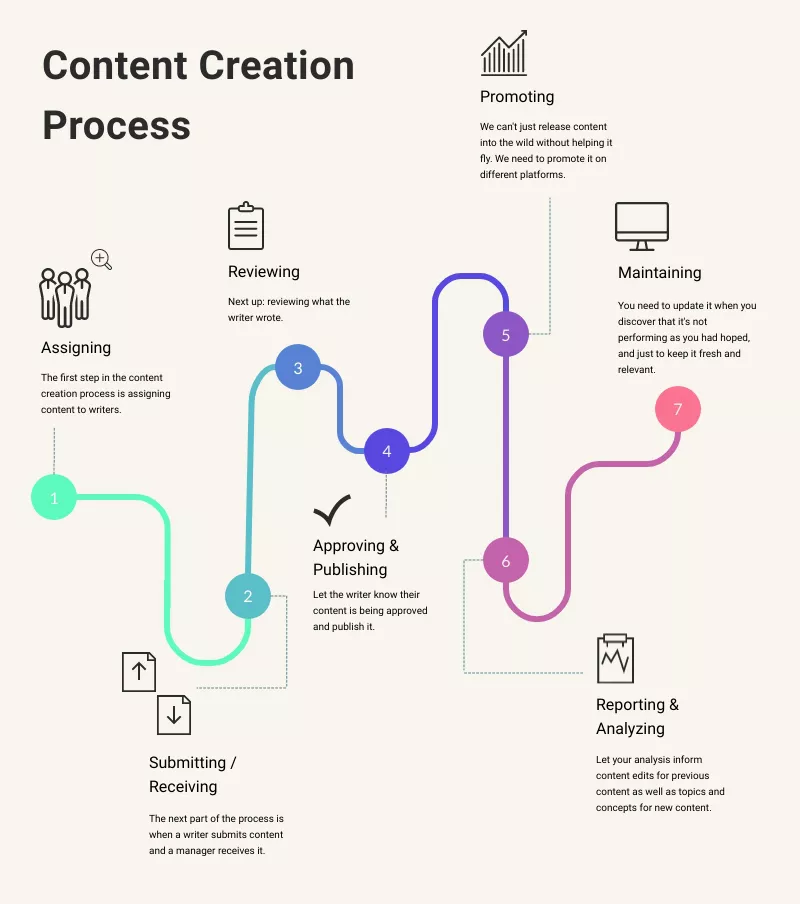
Fig. 1. The process of creating and promoting content: from setting a task to analyzing and updating materials [3]
Monetization of attention in digital media relies on converting time and user engagement into predictable monetary flows. The biggest platforms build their business models around advertising revenues, subscriptions, and a portion of content creators' earnings. For example, Alphabet's YouTube reported advertising revenue of $31.7 billion in 2023, confirming the stability of its advertising-driven model [8].
Meanwhile, shorter-form platforms are experiencing rapid growth. According to WARC estimates, TikTok generated approximately $15.2 billion in advertising revenue in 2023 despite a slowing overall digital advertising market [7].
At the level of monetization strategies, attention is a point of convergence for the interests of platforms, brands, and content creators. Platforms aim to maximize user engagement and retention, while brands seek to increase contact with their target audience and drive conversions. Creators strive to generate sustainable income by diversifying revenue streams through advertising, partnerships, subscription models, and donations.
Visually, the variety of digital business models that rely on attention as a monetization strategy can be represented by a circular model, where users' attention is the centerpiece around which different value extraction methods converge (Figure 2).
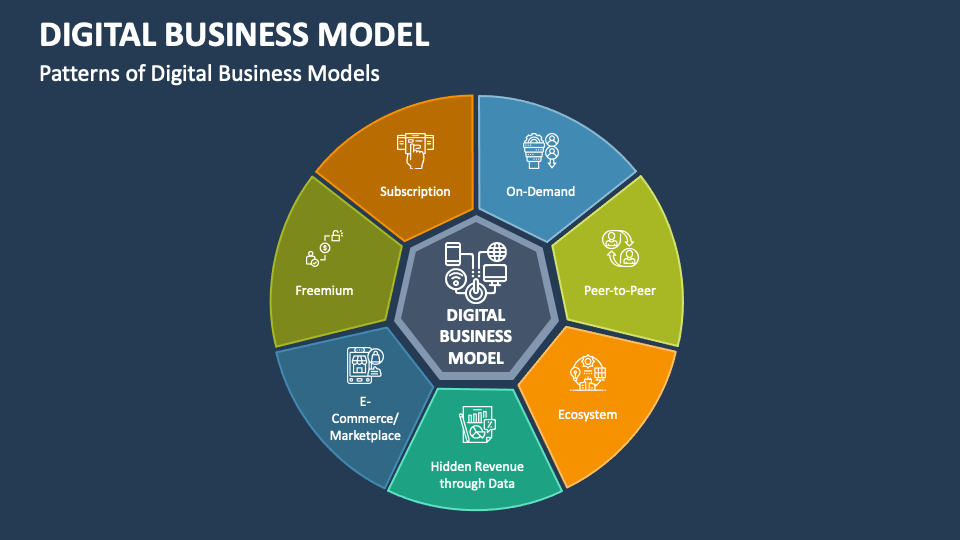
Figure 2. Schematic representation of the main digital business models (based on user engagement [5]
Collectively, the monetization of attention in digital media relies on a combination of advertising, subscription, and hybrid models. These models also form the basis of a creative economy, where viral content acts as an entry point for long-term and diverse revenue streams. However, increased competition for users' attention and the complexity of monetization models come with a range of risks that need to be ethically assessed and legally regulated (Table 3).
Table 3
Risks, ethical and regulatory aspects of the attention economy in digital media
|
Aspect |
The essence of the risk/problem |
The ethical dimension |
Regulatory and institutional responses |
|
Attention manipulation and "sticky" design |
Algorithms and interfaces are designed to maximize user engagement, using endless tape mechanics, automatic playback, and push notifications.
|
The limitation of user autonomy, decreased awareness, and the development of dependent behavior. |
Recommendations on responsible design, requirements for user risk assessment, and the development of principles for "designing for wellbeing". |
|
Disinformation and clickbait |
The promotion of emotionally charged, controversial, and sensational content, which holds attention well but degrades the quality of the information environment. |
Undermining trust in the media, dividing society, and influencing public opinion. |
The duty to moderate harmful and intentionally false content, the development of platform accountability standards, and collaboration with fact-checkers. |
|
Impact on mental health, especially in children and adolescents |
Prolonged exposure to social media, comparison with others, and exposure to harmful content. |
Increased anxiety, stress, risk of addictive behavior, and vulnerability of minors. |
Special standards for the protection of children online, including age restrictions, default settings, and recommendations for healthy use of digital media.
|
|
Violation of privacy and user profiling |
The collection and analysis of personal data to create targeted advertising and recommend products and services. |
The threat to privacy, the lack of transparency in profiling, and the potential for discrimination. |
Laws on personal data protection, restrictions on the use of sensitive data categories and targeted advertising, requirements for consent and information.
|
|
Opacity of algorithms and monetization practices |
People are often confused about why they see specific content and ads, and how their information is used. |
Violation of the principles of fairness and informed choice, as well as the asymmetry of power between platforms and their audience. |
Obligations to disclose the logic behind recommendation systems and advertising provide alternative ways of displaying content, and report on major platforms.
|
|
Market concentration and the power of large platforms |
Focusing attention, data, and advertising budgets in the hands of a small number of companies. |
Increased dependence of creators and brands on platforms, the risk of abuse of a dominant position. |
Antitrust measures, regulation of "systemically important" platforms, promotion of competition and interoperability of services.
|
A source: author's development
For platforms, the priority should be on designing algorithms and interfaces that take into account the digital well-being of users. This includes limiting excessively sticky mechanics, providing transparent settings for recommendations and advertising, offering separate modes and increased protection for minors, and regularly assessing risks to mental health and privacy rights.
Brands should shift their focus away from short-term viral success and towards long-term audience trust. This means using honest and labeled native advertising, avoiding manipulative clickbait, relying on verifiable data, and focusing on socially responsible topics. Brands should also build sustainable partnerships with content creators. It is essential for content creators to strike a balance between the desire for viral content and a responsible approach. They should create meaningful materials that do not take advantage of audience vulnerabilities, respect copyrights and platform guidelines, and diversify their sources of income. This includes advertising, subscriptions, and donations, as well as building a more sustainable model for monetizing attention without relying solely on algorithmic manipulation.
Conclusions
Thus, the virality and monetization of attention in digital media form a single link that defines the logic of the development of modern platforms and the creative economy. User attention is a valuable resource around which advertising, subscription-based models, and hybrid approaches are formed. Viral content serves as a key mechanism for attracting and engaging an audience, while virality is determined by a combination of emotional content, social incentives, and algorithmic distribution. Monetization enhances platforms and brands' interest in maximizing user engagement.
At the same time, the increasing focus on the attention economy has brought with it an increase in risks. This includes the use of manipulative techniques, the spread of clickbait and misinformation, negative effects on mental health, particularly among children and adolescents, and threats to privacy due to the opacity of algorithms. Regulators are taking steps to protect users and limit problematic targeting and profiling practices, setting a new standard for digital businesses.
In this context, the long-term sustainability of the digital media landscape depends on a shift in strategies for platforms, brands, and content creators. These strategies should prioritize responsible attention from users, balancing economic goals with the well-being of digital users, and ensuring compliance with ethical and legal standards.
References:
- Attention economy – Wikipedia [Electronic resource]. – Access mode: https://en.wikipedia.org/wiki/Attention_economy.
- Average Daily Time Spent on Social Media (Latest 2024 Data) – BroadbandSearch [Electronic resource]. – Access mode: https://www.broadbandsearch.net/blog/average-daily-time-on-social-media.
- Content Creation Process: How to Speed up Your Workflow [Electronic resource]. – Access mode: https://kr.pinterest.com/pin/563018694912157/.
- Digital 2025: global advertising trends – DataReportal – Global Digital Insights [Electronic resource]. – Access mode: https://datareportal.com/reports/digital-2025-sub-section-global-advertising-trends.
- Digital Business Model PowerPoint and Google Slides Template – PPT Slides [Electronic resource]. – Access mode: https://www.collidu.com/presentation-digital-business-model.
- Global social media statistics research summary 2025 [Electronic resource]. – Access mode: https://www.smartinsights.com/social-media-marketing/social-media-strategy/new-global-social-media-research/.
- TikTok’s global advertising revenue to reach $15.2bn in 2023 defying a digital ad market slowdown – European Business & Finance Magazine [Electronic resource]. – Access mode: https://europeanbusinessmagazine.com/business/tiktoks-global-advertising-revenue-to-reach-15-2bn-in-2023-defying-a-digital-ad-market-slowdown/.
YouTube – Wikipedia [Electronic resource]. – Access mode: https://en.wikipedia.org/wiki/YouTube
Other articles of the issue