

IMPROVING AND SPEEDING UP THE RELOADING PROCESS
Authors
Pavlikhin Andrey

Share
Annotation
The article discusses the theoretical, technological, and practical aspects of improving cargo transfer operations in seaports in the Russian Federation. Based on an analysis of international and domestic practices, a site-level engineering solution is proposed to increase productivity and sustainability in logistics processes. The focus of the study is on the process of loading bulk cargo in big bags into containers at the Novorossiysk port. The paper justifies the effectiveness of using roller forks for loaders as an alternative to standard metal forks, which can damage containers and slow down operations. A technological map for the reloading process without fork prongs is presented, and the principles for integrating the solution with the digital terminal management system are explained. The environmental, energy, and organizational benefits of implementation are also evaluated. It has been shown that the modernization of port equipment contributes to the creation of a sustainable, safe, and resource-efficient model of port logistics, without the need for significant capital investment in infrastructure.
Keywords
Authors
Pavlikhin Andrey
Share
With the constant increase in maritime traffic and the growing complexity of logistics chains, the efficiency of port operations has become a crucial factor in the competitiveness of terminals. This is particularly true for the Novorossiysk port, which handles a significant portion of export flows consisting of bulk cargoes transported in big bags and universal soft containers for various bulk materials, such as mineral fertilizers, grains, coal, pea, sulfur, and others.
One area of port logistics that requires special attention is the reloading operation - the transfer of cargo from one transportation unit or container to another, for example, during transitions between sea, rail, and road modes. This process often involves downtime, duplication of operations, and loss of valuable time.
In modern ports, berthing time, container handling speed, and minimizing delays are all important factors in determining competitiveness. Research has shown that the operational efficiency of port terminals greatly influences their ability to handle overloads and peak volumes [9].
However, in Russian ports and ports in the CIS (Commonwealth of Independent States), the issues of accelerating reloading processes have not been thoroughly explored. There is a lack of data and models that are tailored to specific conditions, such as climate, infrastructure, regulations, and available technologies.
Therefore, finding engineering solutions that can accelerate reloading while ensuring safety without the use of pallets is a top priority for developers of port equipment and terminal operators.
Theoretical foundations of the organization of the re-fitting process
The theoretical foundations of the reloading process organization in port logistics are based on the idea of reloading as a process of transferring cargo from one transportation unit to another, such as from a container to a wagon, car, or package, in order to connect different modes of transportation, optimize the logistics chain, and reduce overall delivery costs. In practical terms, reloading is interpreted as the direct transfer of cargo between transportation units during multimodal transportation. This interpretation is widely used in industry practice, as well as in the reference materials and explanatory documents of shipping companies and freight forwarders, which describe typical cases and technical limitations related to reloading, such as requirements for location, safety, and packaging [3].
In the Russian context, the background of this issue is the growth in container turnover. According to the Association of Commercial Seaports of the Russian Federation, the container turnover of Russian ports reached 5.63 million TEUs in 2021, an increase of 6.2% from 2020. This increase objectively creates an increased demand for technological areas where containers are reloaded and stored, especially during peak periods of ship arrivals and train formation [1].
Review and training materials on RFID technology until 2021 revealed the typical architecture of the system, including an accounting computer, a reader, and antennas. These materials showed how automated recognition of storage units can reduce matching errors and speed up confirmation of stages, without the need for operator involvement. This theoretically shortens the cycle of overloading and improves the observability of the process for dispatchers [4].
To illustrate the link between technological configuration and its effect on reloading, a comparative table is provided, summarizing open materials from suppliers and engineering consultants.
Table 1 - Technological tools applicable to the reloading site and their theoretical roles
|
Technology / solution |
The key function in the reloading area |
Performance Commentary |
|
Automated Stacking Cranes (ASC/ARMG) |
Automated container movement between storage positions and the transfer point |
Regulates flow, reduces the number of idle and collision, increases storage density and slot availability, creating a temporary buffer for reset operations. |
|
RMG/RTG and richstackers |
Flexible handling of storage units in cramped spaces |
Combined RTG and richstacker schemes continue to be relevant, with limited CAPEX (capital expenditure) and flexible cargo nomenclature. |
|
RFID identification of containers/containers |
Contactless identification and automatic confirmation of the operation stages |
Minimizes manual data entry, speeds up approval/release processes and compliance monitoring, and improves traceability for TMS/ERP systems. |
Source: author's development.
From an engineering perspective, the efficiency of reloading operations is determined not only by digital control tools, but also by the physical parameters of the equipment involved in the process - the shape, strength, speed, and accuracy of the loading units. Local technological improvements, such as modifications to attachments, can ensure a significant increase in productivity without the need for constructing new berths or introducing expensive robotic systems. In this work, we focus on the development and testing of a mechanical solution at the site level - roller forks for the loader - which accelerate the reloading cycle for big bags, reduce damage to containers, and eliminate the need for pallets.
Analysis of the current state of reloading processes in ports of the Russian Federation and abroad
For an objective assessment of the state and dynamics of reloading processes, it is important to compare real indicators of container turnover in the largest ports of the world and in Russia, which reflect the level of technological maturity, automation, and organization of terminal operations. These data allow us to determine benchmarks and identify the relationship between transfer rate and the scale of container flow, degree of digitalization, and level of mechanized systems implementation. Table 2 presents key indicators of container turnover at the end of 2021, based on statistics from UNCTAD, the Association of Seaports of Russia, and official reports from port operators. These indicators form an empirical basis for analyzing operations' effectiveness and developing models for accelerated reloading.
Table 2 – Key guidelines for container turnover and context for assessing the rate of reloading
|
Port / System |
2021, million TEU |
Commentary on the organization and impact on the reshuffle |
|
Shanghai |
>47,0 |
The leader in volume and automation (Yangshan, ASC/AGV), stable yard operation at large tidal windows reduces repetitions of permutations before overloading [13] |
|
Singapore (PSA) |
37,2 |
Deep automation (AGV, ARMG, introduction of new DTQCS), emphasis on end–to-end identification and planning of "gate - yard – quay" slots [12] |
|
Rotterdam |
15,3 |
Using Maasvlakte II as a "buffer" to equalize peak yard loads, which reduces conflicts during overloading [11] |
|
Los Angeles |
10,68 |
A record year against the background of overloading of ground infrastructure; reloading requires close synchronization with export /import [6] |
|
Long Beach |
9,38 |
Historical maximum; official data emphasize the impact of import and turnover of "empty" on intra-terminal operations [10] |
|
Ports of the Russian Federation (collectively) |
5,63 |
Increased demand for retargeting during the restructuring of destinations; strengthening the role of the Far East and Novorossiysk [1] |
|
VMTP (Vladivostok) |
0,757 |
Growth of +13% YoY; expansion of warehouse space and IT tracking services [7] |
|
NUTEP (Novorossiysk) |
0,546 |
Growth of +12% YoY; bet on equipment upgrades and yard storage density [2] |
|
Global Ports (consolidation of the Russian Federation) |
1,576 |
Growth +2.8% YoY; multidirectional dynamics across basins [8] |
Source: author's development based on existing research.
To visually represent the level of technological development in global container terminals, we have an example from Yangshan (Shanghai, China). This is one of the largest and most modern deep-water ports in the world, and it is a benchmark for integrating robotic crane systems, automated guided vehicles (AGVs), and intelligent digital control platforms. The complex demonstrates the optimal use of space to speed up container transfer and reloading, as well as implementing the principles of the "smart port" concept. This concept combines mechanization, automation, and digital dispatch of processes to optimize operations.
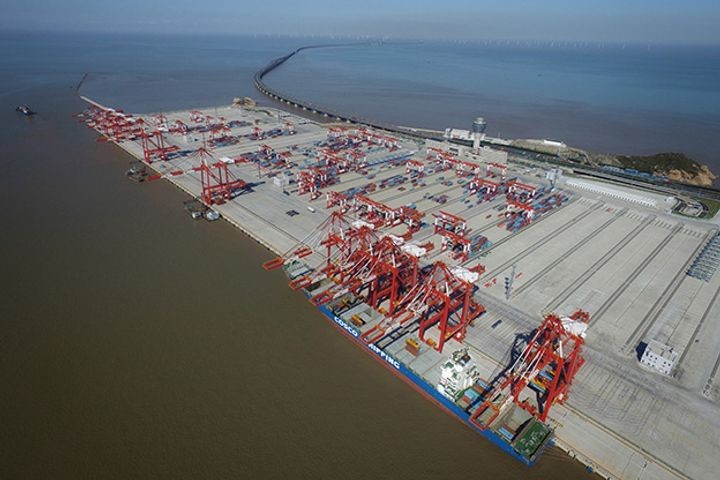
Fig. Yangshan Automated Section (Shanghai, China) [14]
Site-level engineering solution: roller forks for used vehicles as a driver of replaceable performance
The development and implementation of engineering solutions at the loader attachment level can be an effective tool for optimizing intra-port operations without the need for significant capital investments in infrastructure. This is particularly relevant when it comes to upgrading standard metal forks on a loader by installing roller forks. This design is designed for accurate and fast handling of soft containers such as big bags (BBs).
In export flows at the Novorossiysk hub, a significant proportion of cargo is transported in big bags, including NPK, nitroammophoska, coal, and grain. The typical operation involves transferring cargo from wagons to trucks and then into containers. Using standard steel forks can lead to damage to the containers, spills, and irregular cycles, including downtime for changing bags, the use of pallets, and fumigation. This increases the weight of "dead" containers and can lead to higher costs and longer shift cycles.
The use of non-damaging pallets reduces these risks, but it also increases direct costs. Therefore, it is important to consider the trade-offs between efficiency and cost-effectiveness when deciding on the best approach for handling cargo in big bags.
The use of roller forks, which have wide, plastic rollers and rounded edges, allows you to carefully wrap them for second-hand use. They can be used without pallets and safety stacked in two tiers, stabilizing the rolling operation. This mechanical improvement reduces damage to containers, even out the cycle time, and provides a "smooth" flow at the site level, without the need for expensive automation.
Technological map:
1) Inspection of the rollers/edges.
2) Positioning under the b/w slings at an angle of less than 10°.
3) Smooth approach to ⅔ bag length.
4) Lifting with center of mass retention.
5) Packing in a container (bottom row), then the upper 2nd tier.
6) Roll-out with controlled slope.
7) Visual integrity monitoring.
8) Fixing/sealing doors.
9) Marking the fact in the TMS.
10) Cleaning the workplace.
Critical points: Bag slip, misalignment, and sling snagging are mitigated by speed limits, rounded radii, and control stops.
To clarify, the key changes in operation parameters during the transition to roller forks are summarized in Table 3.
Table 3 – Comparative indicators of the container loading production process before and after the introduction of roller forks
|
Indicator |
Up to (steel forks) |
After (roller forks) |
|
Container loading time, min |
~60 |
~20 |
|
Productivity per forklift per shift, cont. |
~10 |
~25-30 |
|
Palletization/fumigation requirement |
Required |
Not required |
|
Big bag damage rate, % |
Higher (up to 5-7%) |
Below (≤ 2%) |
Source: production practice, author's calculations based on equipment testing data at the Novorossiysk port.
As can be seen from Table 3, the introduction of roller fork lifts not only increases shift productivity by almost three times, but also stabilizes the process. This directly affects the performance of PCS/TMS and the overall energy efficiency of the terminal.
At the level of digital port platforms (PCS and TMS), the use of roller forklifts reduces the variation in the duration of container loading operations. This leads to more accurate calculation of ship arrival and departure times, as well as improved synchronization with land transport and mooring windows. In the digital port model, this solution helps to smooth out "bottlenecks" and increase the efficiency of schedules in simulation modeling.
From an energy perspective, uneven power consumption has been reduced. From an environmental perspective, the use of pallets has been eliminated and fumigation has been recorded, as well as a decrease in packaging damage. All of these indicators are included directly in the sustainability reports of marine logistics companies.
Environmental and energy assessment of the solution
The introduction of roller forks into the rewinding process has a positive impact not only on production efficiency, but also on environmental and energy parameters at the port terminal. The engineering modernization at the attachment level allows for a significant reduction in the overall environmental impact of operations, without the need for additional capital construction or infrastructure changes.
1. Reducing material consumption and waste
By eliminating the use of wooden pallets when handling large bags, we can reduce the consumption of raw wood materials and the generation of waste associated with the repair and disposal of pallets. Considering the average weight of a pallet at 18-22 kg and its standard service life up to 10 cycles, annual wood savings during processing 10,000 containers would be about 180-200 tons, corresponding to the preservation of approximately 300 coniferous trees.
Additionally, reducing damage to containers to less than 2% will minimize the amount of polyethylene and polypropylene waste generated previously as a result of burst bags and product spills.
2. Elimination of fumigation processes.
Pallet-free operations eliminate the need for the fumigation of cargo and containers. This eliminates the use of toxic chemicals such as methyl bromide, which are used to disinfect wooden surfaces. This reduces risks to the health of workers and prevents the release of harmful substances into the air. This is especially important in ports located in urban areas and near coastal ecosystems.
3. Energy Efficiency of the Process
By reducing the loading cycle time from 60 minutes to 20 minutes, we can significantly reduce the overall operating time of the loading equipment, and consequently, the fuel or electricity consumed per operation. Assuming an average diesel fuel consumption of 4 liters per hour, the savings per container amount to approximately 2.7 liters, equivalent to reducing CO2 emissions by 7-8 kilograms. For a yearly volume of 10,000 containers, this translates to up to 70-80 tons of CO2 prevented from entering the atmosphere.
Moreover, electric loaders help stabilize the energy profile of internal power grids by reducing peak loads, which also contributes to extending battery life.
4. Improving Industrial Safety and Ergonomics
The use of roller forks reduces the likelihood of sudden jerks and snags when lifting and moving loads, which helps to prevent accidents and personal injuries. This is because the even weight distribution and smoother movement reduce vibration and noise, improving working conditions for operators. By modernizing the equipment in this way, we are ensuring compliance with industrial safety standards such as ISO 45001.
Conclusion
The study confirmed that improving port operations' efficiency is possible not only through large-scale digital or infrastructure solutions but also through local engineering improvements based on an analysis of real production processes. For example, we can consider the improvement of equipment for reloading - the replacement of standard metal forkloaders with roller ones, which ensures careful handling of soft containers and a stable technological cycle.
This engineering solution has made it possible to create a more stable and secure loading system, reduce unproductive downtime, eliminate the need for pallets, and reduce the risk of cargo damage. It demonstrates that optimizing even one link in the logistics chain can significantly improve the efficiency of the entire terminal and the reliability of planning, as well as the rhythm of operations.
The mechanical enhancement seamlessly integrates into the digital port management architecture, complementing TMS (Transport and Management System) and ERP (Enterprise Resource Planning) systems and increasing the accuracy of operational data. This approach forms the basis for a unified engineering and information circuit, where physical and digital solutions interact at the process level, rather than just at the indicator level.
In addition to its technological impact, the modernization of equipment also has significant environmental and energy benefits. The use of wooden pallets and fumigation chemicals is eliminated, reducing the load on power systems and improving industrial safety. The solution aligns with modern principles of sustainability and the requirements for environmental responsibility in transport and logistics companies.
Thus, the results indicate that the development of port logistics requires a combination of engineering thinking and digital analytics. These solutions form a new level of technological culture in Russian ports and set the direction for future research in mechatronics, ergonomics, and digital modeling of port operations.
References:
Container turnover of Russian ports increased by 6.2% in 2021 [Electronic resource]. – Access mode: https://www.infranews.ru/logistika/more/59287-kontejnerooborot-portov-rossii-v-2021-godu-vyros-na-62/.
Operational results of DeloPorts for 2021 [Electronic resource]. – Access mode: https://www.delo-group.ru/news/761/.
Cargo reloading – what is it? We are dealing with the reloading of cargo [Electronic resource]. – Access mode: https://ecoshp.ru/blog/chto-takoe-peretarka-gruza/.
What is RFID? Description of RFID technology, principle of operation and fields of application [Electronic resource]. – Access mode:
https://nvgn.ru/blog/rfid-vse-o-technologii-radiochastotnoy-identifikacii/.
Container Port Automation (EN) [Electronic resource]. – Access mode: https://www.oecd.org/content/dam/oecd/en/publications/reports/2021/10/container-port-automation_98f01599/8db18610-en.pdf.
Container Statistics | Port of Los Angeles [Electronic resource]. – Access mode: https://www.portoflosangeles.org/business/statistics/container-statistics.
Financial and operating results of FESCO Transportation Group for 2021 [Electronic resource]. – Access mode: https://tr.fesco.com/tr/press-center/news/financial-and-operating-results-of-fesco-transportation-group-for-2021/.
Global Ports 2021 Annual Report [Electronic resource]. – Access mode: https://ar2021.globalports.com/.
Optimizing Port Operations to Cope with Shipping Congestion in South American Countries | ORMS Today [Electronic resource]. – Access mode: https://pubsonline.informs.org/do/10.1287/orms.2022.02.09/full/.
Port of Long Beach Sets Annual Record With 9.38 Million TEUs – Port of Long Beach [Electronic resource]. – Access mode: https://polb.com/port-info/news-and-press/port-of-long-beach-sets-annual-record-with-9-38-million-teus-01-19-2022/.
Port of Rotterdam– 2021 [Electronic resource]. – Access mode: https://www.portofrotterdam.com/sites/default/files/2022-02/port-of-rotterdam-throughput-2021.pdf.
PSAI Annual Report – 2021 [Electronic resource]. – Access mode: https://www.globalpsa.com/wp-content/uploads/PSAI-Annual-Report-2021.pdf.
Shanghai port continues to rank first in container throughput worldwide-Xinhua [Electronic resource]. – Access mode: https://english.news.cn/20220102/ccf5adaab3454fe4828ba7a34a32a12a/c.html.
Shanghai Yangshan Port Kicks off Project to Become World's Largest Automatic Deep-Water Container Terminal [Electronic resource]. – Access mode: https://www.yicaiglobal.com/news/shanghai-yangshan-port-kicks-off-project-to-become-world-largest-automatic-deep-water-container-terminal?utm_medium=organic&utm_source=yandexsmartcamera.
Terminal Operating System (TOS) Market Overview – Thetius [Electronic resource]. – Access mode: https://thetius.com/terminal-operating-system-tos-market-overview/.
Other articles of the issue