

Cost structure optimization methodology for increasing the efficiency of technological enterprises
Authors
Azatyan Maria
Share
Annotation
This article discusses the development of a method for optimizing cost structures in order to improve the operational and financial performance of technological companies. In today's highly competitive market, detailed cost analysis and management have become crucial for sustainable development. The proposed method integrates strategic cost analysis, process-based approach, and modern digital tools to identify key cost drivers, segment costs, benchmark against competitors, develop and implement optimization measures, and monitor and control results. Special attention is given to the specific needs of technological companies, such as heavy investments in research and development, rapid product cycles, and the need to adapt to innovation. Examples of successful implementations and their impact on competitiveness and profitability are provided in the article.
Keywords
Authors
Azatyan Maria
Share
In today's rapidly changing global market, where competition is fierce, technological advancements are rapid, and consumer demands are ever-growing, effective cost management has become a critical component of the success of any business. This is especially true for technology companies, whose activities involve intensive research and development, frequent product line updates, and the need for continuous investment in innovation. These factors contribute to a significant portion of variable and fixed costs, making the cost structure of these companies complex and susceptible to external and internal fluctuations.
Inefficient cost management can lead to a reduction in competitiveness, a loss of market share, decreased profitability, and, ultimately, stagnation or even bankruptcy. On the other hand, a systematic and strategic approach to cost optimization not only reduces costs but also frees up resources for innovation, product quality improvements, expansion into new markets, and strengthening the company's position. This helps increase operational efficiency, improves the financial condition, and ensures sustainable growth in the long run.
Despite the obvious importance of cost optimization, many technology companies face challenges in implementing comprehensive programs. This is due to a lack of adequate methodologies, industry-specific challenges, resistance to change, and difficulty measuring the true impact of implemented measures. Therefore, the development and implementation of a targeted approach to optimizing the cost structure, tailored to the unique needs of the technology industry, is an urgent priority.
Any company has its own expenses, and there are many of them. Some companies have more expenses than others do. However, all companies try to find ways to minimize their expenses as much as possible. To this end, companies develop and implement various measures to reduce costs. High-quality cost management in a company is impossible without careful analysis of expenses. Cost analysis involves comparing planned and actual expenses, identifying deviations, and taking steps to correct them [2]. In order to control costs, companies need to implement systems that monitor and reduce expenses. These systems can be seen in Table 1.
Table 1 - Stages of cost optimization at the enterprise
|
№ |
Stage |
Characteristic |
|
1 |
Current cost analysis |
Data collection: systematization of financial information about current expenses. |
|
2 |
Identifying key costs |
Classification: division of costs into fixed, variable and semi-variable. |
|
3 |
Strategy development |
Identification: identification of the main items of expenditure that have the greatest impact on total costs. |
|
4 |
Implementing changes |
Priorities: identify the most relevant costs. |
|
5 |
Monitoring and control |
Objectives: setting specific optimization goals (reducing costs by a certain percentage, reducing process execution time, etc.). |
|
6 |
Training and development |
Employee training: conducting trainings for employees on new methods and technologies. |
|
7 |
Effectiveness assessment |
Culture of optimization: the introduction of a culture of continuous improvement at all levels of the enterprise. |
The history of cost management is closely linked to the development of industrial relations, economic growth, and business processes. In the pre-industrial era, cost management was intuitive and focused on minimizing material and labor expenses.
However, with the advent of the Industrial Revolution, larger factories required a more systematic approach to cost management. Order-based and process-based cost accounting methods emerged, focusing on production costs and product pricing. These methods formed the basis for cost accounting, although their analytical capabilities were still limited.
Frederick Winslow Taylor and his followers laid the groundwork for scientific management. Their work centered on optimizing production processes, standardizing operations, and discovering the most efficient methods of work, which directly influenced reducing labor costs and boosting productivity. The concept of standard costing emerged, proposing the establishment of standard costs per unit of production and analyzing deviations from the standards' actual costs. This allowed managers to identify inefficiencies and manage costs. During this time, the first budgeting techniques also emerged [1].
After World War II, as competition increased and enterprise structures became more complex, traditional cost accounting methods started to show their limitations. The proportion of indirect costs, which were difficult to assign to specific products, increased. In the 1960s and 1970s, approaches such as:
- Activity-Based Costing (ABC) was developed to more accurately allocate indirect costs to products or services.
- Direct costing is a method that only includes variable costs in the calculation of product costs and considers fixed costs as period expenses. This approach simplifies break-even analysis and assists in making short-term pricing decisions.
With the development of information technology and the globalization of markets, cost management has become increasingly strategic. New approaches have emerged, including:
- Kaizen costing is a Japanese method that focuses on continuous, gradual reduction of costs throughout the product life cycle, starting from development. It is linked to the philosophy of lean manufacturing.
- Target costing is a process in which the target cost for a product is determined by the desired market price and required profit margin, guiding the development process to ensure that costs do not exceed the set threshold.
- Strategic cost management integrates cost control into the overall company strategy, considering costs as both a control object and a source of competitive advantage. This includes value chain analysis, market positioning, and managing costs throughout the entire product life cycle.
- Benchmarking – comparing your own costs, processes, and productivity with the industry's best practices.
- Outsourcing and offshoring – strategies to reduce costs by transferring certain functions to external suppliers or moving production facilities to regions with lower labor costs.
It should be noted that modern technology companies, in their efforts to increase efficiency and stay competitive, are actively adopting advanced technologies to streamline their operations. One of the main areas of focus is the automation and robotization of production processes.
This includes the use of industrial robots on assembly lines as well as robotic process automation (RPA) for office tasks that can be repetitive and time-consuming. This significantly reduces labor costs, eliminates errors, and speeds up operations.
Additionally, the use of artificial intelligence (AI) and machine learning is playing a crucial role in demand forecasting, inventory optimization, and logistics management. This helps companies avoid unnecessary purchases and storage costs by accurately predicting demand and adjusting inventory levels accordingly. AI is also being used for predictive maintenance, reducing unplanned downtime and expensive emergency repairs [3].
Digital twins – virtual models of physical objects or processes – allow simulations and optimization of production operations without affecting the real system, identifying potential sources of inefficiency and opportunities to reduce costs even at the design stage or before implementing changes.
The Internet of Things (IoT) provides the collection of a huge amount of data on the operation of equipment, resource consumption and environmental conditions. Real-time analysis of this data allows you to quickly identify deviations, optimize energy consumption, control product quality and reduce losses. Cloud computing and SaaS solutions (Software as a Service) significantly reduce the capital costs of acquiring and maintaining your own IT infrastructure by providing access to powerful computing resources and subscription software. It also contributes to the flexibility and scalability of operational activities.
Blockchain technology, although still in its early stages of adoption in this field, has the potential to improve transparency and security in supply chains, reduce administrative costs, and minimize fraud risks.
Finally, Big Data Analytics forms the basis of all the above approaches. It allows us to identify hidden patterns, optimize procurement, resource management, and production schedules. This leads to a significant reduction in operating costs and an increase in overall enterprise efficiency. The integrated application of these technologies enables technology enterprises to not only reduce costs, but also create a more flexible and adaptive environment. This, in turn, makes them more competitive (Fig. 1).
The main method of cost optimization at a company during a crisis is to ration all expenses, strictly control compliance with established standards, and motivate employees to reduce costs. This approach may not be revolutionary, but it can bring significant results and help keep costs at a certain level. Within these optimization areas, several procedures are carried out, such as budgeting, analyzing outsourcing opportunities, optimizing technological processes, and rational cost management.
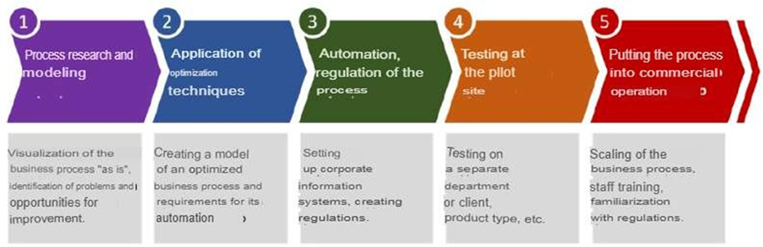
Fig. 1 - The sequence of optimization of business processes [4]
In our opinion, while there are significant advantages to optimizing the cost structure of technological companies using modern technologies, there are also several significant challenges. One of the main obstacles is the high cost of implementing new technologies. Acquiring and configuring complex equipment, developing software, and training staff require significant capital investment, which can be challenging, especially for smaller companies. It is often difficult to accurately estimate the return on investment (ROI) beforehand, increasing the risk.
Another challenge is the need for a significant change in corporate culture and processes. Introducing automation, AI, or digital twins is not just a simple technological update; it often necessitates a review of existing work processes, roles, and even the organizational structure. The resistance to change from staff who are accustomed to old working methods can hinder or even prevent the successful implementation of new systems.
The lack of qualified personnel is a serious problem that needs to be addressed. To work with artificial intelligence (AI), the Internet of Things (IoT), big data analytics, and to develop and maintain complex automated systems, engineers and specialists with unique skills are needed, which are often not available in the labor market. This creates a need for expensive training or difficulty in finding the right employees.
System integration also presents significant challenges. Enterprises often have many disparate information systems that were developed at different times on different platforms, which makes combining them into a single, cohesive ecosystem for efficient data collection and analysis a complex and time-consuming task that requires significant resources and expertise in system architecture. Poor integration can lead to errors, data loss, and additional costs, as well as reduced efficiency.
Cybersecurity issues are becoming more and more significant. The increasing number of connected IoT (Internet of Things) devices, the use of cloud-based solutions, and widespread adoption of digital technologies all contribute to a larger surface area for potential cyberattacks. A breach in the security of data or production systems can result in significant financial losses, confidential information leakage, and reputational harm. Ensuring adequate protection requires continuous investment and expert knowledge.
Finally, there is a risk of making incorrect choices about technologies or their inefficient use. The technology market is constantly changing, and selecting the most suitable solutions for specific business tasks requires a thorough understanding of both your own requirements and the capabilities of available tools. Without a well-thought-out strategy and expert assistance, investments in new technologies could prove ineffective or even make problems worse instead of solving them.
Therefore, optimizing the cost structure is crucial for improving the efficiency of technology businesses, as it enables rational allocation of financial resources and reduction of costs without compromising product quality or innovative development.
The implementation of cost management systems, cost analysis, and control, as well as the automation of production processes and the modernization of equipment, contribute to reducing both fixed, variable costs, and increasing the competitiveness of an enterprise. Additionally, optimizing the cost structure requires an integrated approach that includes reviewing procurement policies, implementing energy-saving technologies, and developing staff.
Through these measures, a company not only achieves resource savings but also improves production performance, directly affecting profit growth and sustainable growth in a dynamic market. Therefore, optimizing the cost structure serves as a strategic tool for ensuring long-term efficiency and sustainability for technological enterprises.
References:
Gomonko E.A. Cost management at the enterprise: textbook / Gomonko E.A., Tarasova T.F. Moscow: KNORUS, 2010. 320 p.
Kalyuzhny N.V. Methods of cost optimization at the enterprise. Issues of science and education, (22 (34)), 2018. pp. 29-32.
Syso T.N. Optimization of enterprise cost management // OmSU Bulletin. Series: Economics. - 2016. – No. 4. – pp. 18-23.
Optimization of business processes and systems of the company [Electronic resource] URL: https://zvonobot.ru/blog/optimizatsiya-biznes-protsessov-tseli-metody-instruktsiya/
Other articles of the issue