

Economic and social consequences of adaptive pricing in digital markets
Authors
Viktar F. Karpovich

Share
Annotation
The increasing use of data-driven pricing changes the relationship between firms, consumers and competing market participants. Although adaptive pricing can improve firm-level economic performance, its effects on market efficiency and consumer welfare are not necessarily positive. This study develops a three-level conceptual model for assessing these consequences at the firm, market and societal levels. It identifies market structure, competitive intensity, information transparency and institutional safeguards as conditions influencing the compatibility of private economic benefits with market efficiency and consumer interests. The model provides a framework for differentiated assessment of adaptive pricing outcomes.
Keywords
Authors
Viktar F. Karpovich
Share
Introduction
Digital transformation is changing price formation. Data analytics, machine learning and automated monitoring enable firms to respond more rapidly to changes in demand, costs and competitors’ prices. Pricing is thus becoming a continuous process of market adaptation.
More frequent adjustments can improve revenue management and align prices with current market conditions. However, benefits to individual firms do not necessarily imply improved market efficiency or consumer welfare.
Empirical research confirms that effects are context-dependent. Assad et al. (2024) show that outcomes in the German gasoline market depend on market structure. Brown and MacKay (2023) find that algorithms can influence price levels and dispersion, while Hanspach et al. (2024) show that algorithmic pricing does not necessarily increase e-commerce prices.
Consumer effects are similarly ambiguous. Personalized pricing may increase firm profitability while producing different welfare effects across consumer groups (Dubé & Misra, 2023). Algorithmic pricing can also affect trust and price-search behaviour (Vomberg et al., 2025).
This study continues the author’s previous research on adaptive pricing in the digital economy. Whereas the earlier publication examined the economic nature and adaptation mechanism of pricing, the present article focuses on the consequences of applying adaptive pricing and the conditions under which firm-level benefits can be reconciled with market efficiency and consumer interests.
In a related study, Karpovich (2026) examined predictive pricing as a tool for harmonizing agricultural markets under regional economic integration, using evidence from Belarus and the EAEU. The present article develops this research direction further by shifting the analytical focus from price forecasting and market coordination to the broader economic and social consequences of adaptive pricing in digital markets.
The study develops a framework for assessing the economic and social consequences of adaptive pricing. It hypothesizes that compatibility between private benefits, market efficiency and consumer welfare depends on market structure, competition, transparency and institutional safeguards.
Economic and social effects of adaptive pricing
Adaptive pricing has consequences at three interconnected levels. At the firm level, it may improve pricing accuracy, revenue and inventory management. Profitability gains, however, depend on data quality, implementation costs, demand and competitors’ strategies.
At the market level, rapid price adjustments may intensify competition but can also increase strategic interdependence. Calvano et al. (2020) show that learning algorithms can generate supracompetitive outcomes in a repeated oligopoly model. This identifies a risk, not proof that algorithmic pricing inevitably causes collusion.
Assad et al. (2024) likewise show that outcomes vary with market structure. Assessment should therefore consider concentration, the number of competitors and strategic interaction.
At the societal level, adaptive pricing may improve accessibility by reducing inefficient price distortions. Yet personalized pricing can redistribute benefits between firms and consumers: higher firm profitability does not necessarily improve welfare for all consumers (Dubé & Misra, 2023).
Consumer trust and information also matter. Vomberg et al. (2025) associate algorithmic dynamic pricing with lower initial trust and greater price search, while indicating that transparency and price-matching guarantees can mitigate adverse responses. Effects therefore cannot be reduced to firm profitability or average prices.
Conditions for reconciling private and social interests
Compatibility depends on four conditions.
First, market structure matters. Effective competition can encourage attractive prices and better service, whereas concentration and rapid mutual reactions may weaken rivalry.
Second, transparency affects benefit distribution. Firms may hold detailed consumer data while buyers know little about price differentiation criteria. This asymmetry can facilitate extraction of consumer surplus. Transparency need not disclose proprietary algorithms, but should enable consumers to understand relevant practices and compare offers.
Third, differentiation should be economically justified. Differences reflecting costs, demand and product characteristics may improve allocation; differentiation based mainly on estimated willingness to pay can raise distributional concerns, especially when its basis is opaque.
Fourth, safeguards should address anticompetitive practices, personal-data protection, accountability for automated decisions and consumer complaints. The OECD (2023) notes that algorithms can enhance efficiency or restrict competition; oversight should focus on outcomes and identifiable risks, not algorithm use itself.
A three-level conceptual model for assessing adaptive pricing consequences
Adaptive pricing should be evaluated across three dimensions. Firm-level indicators include revenue, profitability, price-cost margins and decision efficiency. Market indicators include price dispersion, concentration, competitive responses and price stability. Societal indicators include consumer surplus, accessibility, price fairness and the distribution of benefits.
The consequences of adaptive pricing can be represented as a vector:
EAP = (Ef, Em, Es),
where Ef denotes the firm-level economic effect, Em the market-level effect and Es the societal effect.
The direction and magnitude of these effects depend on the characteristics of the pricing mechanism and the conditions of the digital market:
EAP = F(A, M, C, T, I),
where A represents the characteristics of adaptive pricing, M the market structure, C competitive intensity, T pricing transparency and I institutional safeguards.
These expressions are conceptual, not empirically estimated. The dimensions may move in different directions: profitability may rise while consumer surplus falls, or improved adjustments may reduce distortions and benefit both firms and consumers.
Three situations are distinguished: compatibility, when firm performance improves alongside effective competition and consumer welfare; partial compatibility, when firm benefits coexist with mixed market or consumer outcomes; and conflict, when higher profitability accompanies weaker competition, exploitation of information asymmetry or declining consumer welfare.
Figure 1. Author’s conceptual framework for assessing the economic and social consequences of adaptive pricing in digital markets
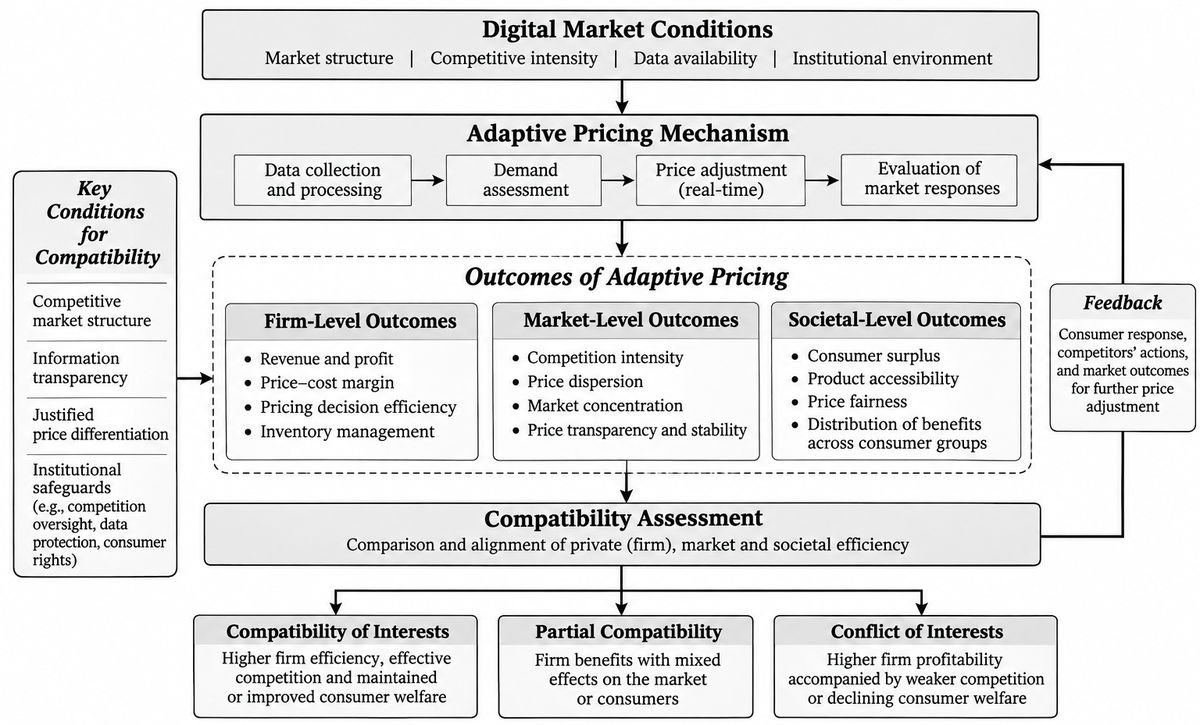
Source: developed by the author.
Discussion
For firms, pricing efficiency should not be assessed only through short-term profit. A strategy that raises margins but undermines trust may reduce long-term competitiveness. Consumer responses, price dispersion and customer relationships should complement financial indicators.
For platforms, transparent pricing and comparable offers support consumer choice and competition. Public oversight should be proportionate: algorithms may improve allocation and competition, but create risks when combined with concentration, opaque data practices and limited choice.
Empirical testing requires firm financial data, product prices, concentration measures and consumer information. Causal identification is essential: observed price changes cannot automatically be attributed to algorithm adoption.
Conclusion
The consequences of adaptive pricing are heterogeneous and depend on market conditions. The principal contribution is a three-level model distinguishing firm efficiency, market efficiency and societal welfare. Higher profitability alone does not demonstrate stronger competition or improved consumer welfare.
Compatibility depends on market structure and competition, information transparency, justified price differentiation and institutional safeguards. The model distinguishes compatibility, partial compatibility and conflict, showing not only whether benefits arise but also how they are distributed.
The study does not assume that adaptive pricing necessarily raises or lowers social welfare. Effects depend on technological, competitive, informational and institutional factors. Further research should test the proposed indicators in specific digital markets.
References:
Assad, S., Clark, R., Ershov, D., & Xu, L. (2024). Algorithmic pricing and competition: Empirical evidence from the German retail gasoline market. Journal of Political Economy, 132(3), 723–771. https://doi.org/10.1086/726906
Brown, Z. Y., & MacKay, A. (2023). Competition in pricing algorithms. American Economic Journal: Microeconomics, 15(2), 109–156. https://doi.org/10.1257/mic.20210158
Calvano, E., Calzolari, G., Denicolò, V., & Pastorello, S. (2020). Artificial intelligence, algorithmic pricing, and collusion. American Economic Review, 110(10), 3267–3297. https://doi.org/10.1257/aer.20190623
Dubé, J.-P., & Misra, S. (2023). Personalized pricing and consumer welfare. Journal of Political Economy, 131(1), 131–189. https://doi.org/10.1086/720793
Hanspach, P., Sapi, G., & Wieting, M. (2024). Algorithms in the marketplace: An empirical analysis of automated pricing in e-commerce. Information Economics and Policy, 69, 101111. https://doi.org/10.1016/j.infoecopol.2024.101111
Karpovich, V. (2026). Predictive pricing as a tool for harmonizing agricultural markets under regional economic integration (the case of the EAEU). European Journal of Economics and Management Sciences, 2026(2), 73–76. https://doi.org/10.29013/EJEMS-26-2-73-76
OECD. (2023). Algorithmic competition. OECD Publishing. https://doi.org/10.1787/cb3b2075-en
Vomberg, A., Homburg, C., & Sarantopoulos, P. (2025). Algorithmic pricing: Effects on consumer trust and price search. International Journal of Research in Marketing, 42(4), Part B, 1166–1186. https://doi.org/10.1016/j.ijresmar.2024.10.006
Other articles of the issue