
An Integrative Linguacultural Approach to Preserving and Developing the Ukrainian Language in the Us Diaspora: Synergy of Family and Educational Practices
Authors
Tetiana Klapatiuk
Share
Annotation
Ukrainian in the United States is kept alive mainly by families and weekend schools. This article combines a synthesis of studies on family language policy and community heritage schools with American Community Survey estimates for 2010–2024. The population born in Ukraine rose from 355,000 in 2019 to 510,000 in 2024. Residents reporting “Ukrainian or other Slavic languages” at home, the narrowest category in the annual tables, increased by 65.5% to 533,000 after a decade without detectable change, partly perhaps because bilinguals now name Ukrainian rather than Russian; the share speaking English less than “very well” rose from 36.1% to 43.7%. Ukrainian ancestry grew by a quarter, mostly in 2022, when Russian ancestry fell, which points to re-identification as well as migration. In 2017–2021 Ukrainian made up about half of the language group. Studies agree that home use sustains speech and belonging but seldom literacy, while standard-only schooling may push children away. I propose an integrative linguacultural model in which family, school, mainstream education and community ties carry particular dimensions of language (semantic–pragmatic, poetic, identity), and family and school coordinate goals, home reading and writing, and their response to mixed speech. The model is offered as a set of testable propositions.
Keywords
Authors
Tetiana Klapatiuk
Share
Introduction
Between 2019 and 2024 the number of US residents born in Ukraine rose from 355,000 to 510,000 (U.S. Census Bureau, 2025a). A teacher at a New York school of Ukrainian studies already counted children who had just emigrated among heritage learners, next to children born outside Ukraine into Ukrainian families (Pikhmanets, 2022). The census figures suggest that the first group has grown since 2022.
Heritage languages in the United States rarely outlast the third generation, and home use without explicit instruction seldom produces highly proficient users (Lee & Wright, 2014). Family language policies alone cannot save minority languages unless schools treat them as legitimate (Curdt-Christiansen et al., 2023), and a school that takes over literacy can reduce home practice to supplementing school content (Her, 2024). For Ukrainian in the United States the evidence is thin. One study finds that community schools in Southern California reinforce family language policies after 2022 (Kudyma & Krivchikova-Karkafi, 2026), another follows two displaced adolescents (Senyshyn, 2026); the rest consists of accounts by a diaspora teacher and Ukrainian methodologists (Pikhmanets, 2022; Turkevych, 2022) and school studies in England and Italy (Bocale, 2026; Harrison, 2021).
This article joins census data on the US diaspora after 2022 with a synthesis of family and school practices, mapped onto the cultural dimensions of language described by Risager (2020). It asks what the census shows and cannot show, and how family and school can be coordinated within one linguacultural approach.
Material and Methods
The article is conceptual: its discussion of family and school practices draws exclusively on published studies. No observational data from the weekend school where I teach were used.
Sources were identified through OpenAlex and Crossref searches, citation chasing and suggestions made during internal review. I included peer-reviewed studies, chapters and practitioner accounts on how families or community schools maintain a heritage language, with priority to Ukrainian. A documented run of 16 OpenAlex queries on 23 October 2026 (first 15 results each, 225 unique records) retrieves 11 of the 15 works used; the other four came from outside these searches. Table 2 condenses the notes kept on each study. This is a structured narrative synthesis, not a systematic review.
Census data are American Community Survey 1-year estimates for 2010–2024 from the Bureau’s Summary File, accessed 22 October 2026 (U.S. Census Bureau, 2025a): Ukrainian and Russian ancestry (table B04006; people with two ancestries count under each), birth in Ukraine (B05006), and language spoken at home by ability to speak English, age 5+ (B16001). The narrowest B16001 line containing Ukrainian is “Ukrainian or other Slavic languages” (“Other Slavic languages” before 2016); Russian, Polish and Serbo-Croatian have their own lines. There are no standard 1-year estimates for 2020. Each person reports one non-English language; the group values for 2010 and 2019 equal those in the Bureau’s report (Dietrich & Hernandez, 2022). A 5-year detailed table for 2017–2021 reports Ukrainian alone (U.S. Census Bureau, 2025b) and is used as a benchmark.
Margins of error are 90% intervals, so a standard error SE is the margin divided by 1.645. A change between estimates E1 and E2 is tested with (1), and margins of shares use the Bureau’s formula for proportions.
z=E2-E1SE12+SE22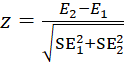 (1)
What the Census Shows and What It Cannot
Between 2010 and 2019 the three counts changed little (Figure 1): ancestry rose by 7.5%, the Ukraine-born population stayed between 326,000 and 355,000, and the language group went from 323,000 to 322,000 (95% interval of the change, −8.9% to +8.0%). Growth began before the full-scale invasion: by 2021 the group was 19.6% and the Ukraine-born population 12.2% above their 2019 levels.
Figure 1. Residents reporting Ukrainian ancestry, born in Ukraine, and speaking “Ukrainian or other Slavic languages” at home, United States, 2010–2024
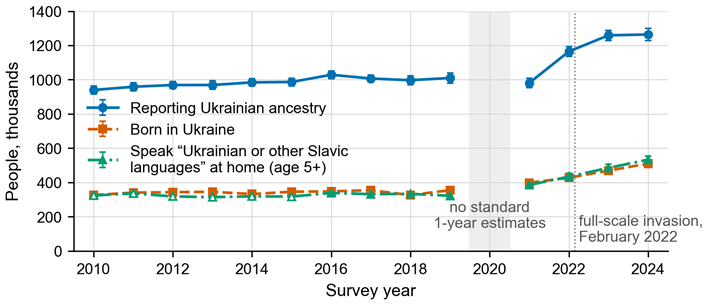
Note. Error bars are 90% margins of error. Hollow markers (2010–2015): the same language line under its earlier name, “Other Slavic languages”; the line excludes Russian, Polish and Serbo-Croatian, which have their own lines. Standard 1-year estimates for 2020 were not released. Source: U.S. Census Bureau (2025a), tables B04006, B05006 and B16001; author’s calculations.
From 2019 to 2024 the Ukraine-born population rose by 155,000 (43.7%) and the language group by 211,000 (65.5%), both with p < .001 (Table 1). Ancestry rose by 254,000, but 72.4% of that came in 2022, when it grew by 184,000 while the Ukraine-born population grew by 29,000 (p = .053) and Russian ancestry fell by 308,000. Some residents apparently moved their self-description from Russian to Ukrainian, as Holian and Wolowyna (2025) also find among the US-born; the higher level held through 2024. The language series is open to the same shift: Holian and Wolowyna (2025) report more Ukrainian use among Ukrainian immigrants. In 2022 the group grew by 49,000 while Russian at home fell by 70,000 (by 2024 it was again 8.5% above its 2019 level). A Ukrainian–Russian bilingual who now names Ukrainian enters the group without being a new speaker, so the 65.5% growth is an upper bound for growth in speakers.
Table 1. Ukrainian ancestry, birth in Ukraine and home language, United States, 2019 and 2024 (thousands)
|
Indicator |
2019 |
2024 |
Change |
|
Ukrainian ancestry |
1,009.9 (29.1) |
1,263.8 (36.4) |
+254.0 (+25.1%) |
|
Born in Ukraine |
354.8 (14.8) |
510.0 (22.7) |
+155.2 (+43.7%) |
|
Language group, 5+a |
321.9 (16.5) |
532.7 (21.2) |
+210.8 (+65.5%) |
|
– limited Englishb |
116.1 (9.8) |
232.6 (13.3) |
+116.5 (+100.3%) |
|
– share limited, % |
36.1 (2.4) |
43.7 (1.8) |
+7.6 p.p. |
Note. 90% margins of error in parentheses. a “Ukrainian or other Slavic languages” (table B16001). b Speak English less than “very well”. All changes are significant at p < .001 (ACS z-test); the 95% interval for the change in the share is 4.0 to 11.2 percentage points. Source: U.S. Census Bureau (2025a); author’s calculations.
Speakers with limited English doubled, from 116,000 to 233,000, and their share rose from 36.1% to 43.7% after staying between 33.5% and 37.1% in 2016–2021 (Figure 2). Speakers with very good English also grew, by 94,000, so the shift does not come from a shrinking base. Switching bilinguals also enter this share, in a direction set by their English.
Figure 2. Speakers of “Ukrainian or other Slavic languages” at home by ability to speak English, 2016–2024
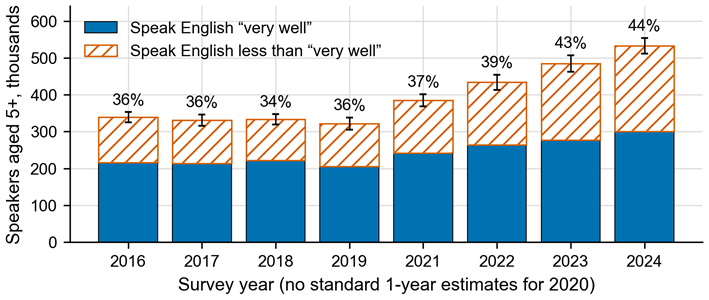
Note. Percentages above the bars are the share who speak English less than “very well”; error bars are 90% margins of error of the total. Source: U.S. Census Bureau (2025a), table B16001; author’s calculations.
The detailed table for 2017–2021 counts 184,000 Ukrainian speakers, 51.9% of the group, of whom 45.3% spoke English less than “very well”, against 35.9% for the whole group (U.S. Census Bureau, 2025b). Group shares thus understate the Ukrainian ones, but this table ends before the wave. New York, California, Pennsylvania, Florida and Illinois held 47.0% of people of Ukrainian ancestry in 2024, and California had the largest language group, 69,000, level with Illinois within sampling error.
The annual tables cannot separate Ukrainian from other Slavic languages that lack their own line, record only one home language per person, and say nothing about literacy or transmission between generations, so I compute no “retention rate”.
Family and School as Two Halves of One Program
Families decide whether a child meets Ukrainian at all. Family language policy joins beliefs, daily practice and deliberate management, and it is connected with children’s success at school (King et al., 2008). Some newly arrived parents limit Ukrainian for fear of slowing their children’s English, and these children soon lose even the Ukrainian they had (Pikhmanets, 2022). The family is strongest on everyday meanings and belonging; it rarely supplies literacy or a formal register.
That gap falls to the school (Lee & Wright, 2014). Heritage learners understand more than they produce (Turkevych, 2022); they sound native but read and write poorly, often lack polite address with vy, and know mainly the vocabulary of family, community and church (Pikhmanets, 2022). Pikhmanets (2022) finds that teaching them “as in Ukraine” overwhelms them and foreign-language methods are too easy, and argues for a heritage-specific approach with authentic texts rather than more practice time.
How a school treats mixed speech may affect whether children stay with Ukrainian. In a complementary school in England, mixing Ukrainian with English helped learning, yet teachers also asked for “Ukrainian, please” and corrected Russian (Harrison, 2021). In community schools in Italy, teachers treated home varieties as deficient; Bocale (2026) warns that this may alienate children, while noting that the effect is still unmeasured. Developments in Ukraine since 2022 make this more pressing: the shift from Russian is larger in public than in family life (Kulyk, 2024), and adult “new speakers” value fluency over correctness in informal clubs that tolerate mixing (Kudriavtseva, 2025). If diaspora parents follow that path, a school that corrects every Russian or mixed form may correct the very families moving toward Ukrainian.
Two displaced Ukrainian adolescents in the United States kept up schooling in both countries and used Ukrainian, English and at times Russian to stay on track (Senyshyn, 2026). Table 2 summarizes what each setting supplies and where it fails alone.
Table 2. What each setting contributes to Ukrainian as a heritage language, and its risks when acting alone
|
Setting |
Supplies best |
Risk when acting alone |
Studies |
|
Family |
Daily use, affect, belonging |
Speech without literacy; Ukrainian dropped for fear of hurting English |
King et al. (2008); Pikhmanets (2022) |
|
School of Ukrainian studies |
Literacy, formal register, literature |
Ill-fitting methods; standard-only norms |
Bocale (2026); Harrison (2021); Pikhmanets (2022) |
|
Mainstream education |
Legitimacy; dual-language programs |
English-only norms; school taking over literacy |
Curdt-Christiansen et al. (2023); Her (2024) |
|
Community ties |
Youth groups, festivals, trips; informal clubs |
Contact without instruction |
Kudriavtseva (2025)a; Pikhmanets (2022) |
Note. a Adults in Ukraine. Source: author’s synthesis of the studies cited.
An Integrative Linguacultural Model
Risager (2020) describes linguaculture as the cultural side of language, with three dimensions: semantic–pragmatic (meanings and forms of address), poetic (sound and verbal art) and identity. Figure 3 assigns them to the settings. The family carries identity and everyday meanings. The school carries written language and the formal register, as well as the poetic dimension of literature and song. Community life offers youth organizations, festivals and trips to Ukraine, which Pikhmanets (2022) lists as strengthening Ukrainian roots and which I assign to identity and the poetic dimension; mainstream education supports identity by treating Ukrainian as legitimate (Curdt-Christiansen et al., 2023).
By synergy I mean that coordinated family and school practices achieve what neither achieves alone. Kudyma and Krivchikova-Karkafi (2026) show community schools reinforcing family policy; the model adds the linguacultural mapping and three mechanisms, which are propositions, not findings. Agreed home language goals serve identity, turning tacit beliefs into the “management” part of family policy (King et al., 2008). Home reading and writing linked to school texts serve literacy and the poetic dimension but should leave the family its own role, since a school that takes over literacy can shrink home practice (Her, 2024). Accepting mixed repertoires as a starting point serves the semantic–pragmatic and identity dimensions (Bocale, 2026; Harrison, 2021). Each is testable, for instance by comparing the literacy of children whose families do or do not receive school texts for home use.
Figure 3. The integrative linguacultural model of Ukrainian heritage language maintenance
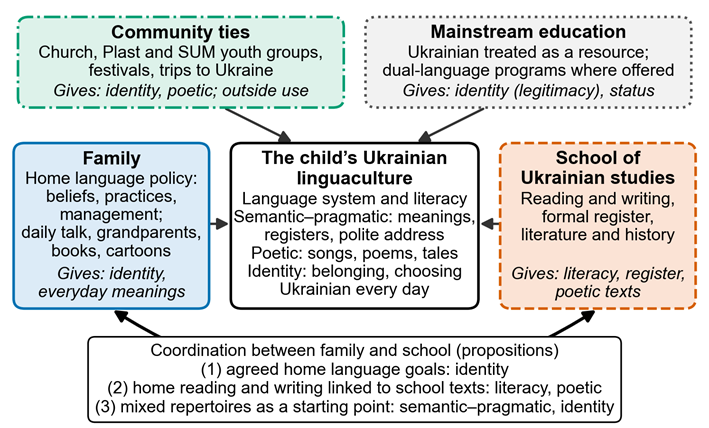
Note. The three dimensions of linguaculture follow Risager (2020); the roles of the settings and the coordination mechanisms summarize the studies in Table 2. Source: author’s conceptual synthesis.
Discussion
The post-2022 wave has added many speakers with limited English, whose children join schools where, as one New York teacher reported before 2022, most pupils are heritage learners rather than native speakers (Pikhmanets, 2022). That is a chance for the language and a strain on schools that need systematic support (Hazizova, 2025). If the third-generation pattern holds (Lee & Wright, 2014), the newcomers’ grandchildren are likely to lose Ukrainian; whether coordinated action by family and school while the children are still fluent can change this is what the model’s propositions would test.
Three limitations matter most. The annual tables mix Ukrainian with other Slavic languages and record one language per person, and the latest published Ukrainian-only table covers 2017–2021. The studies on practices are few and mostly small (one school in England, two schools in Italy, two adolescents in the US), only three concern Ukrainian in the United States, and several are practitioners’ accounts. The model is a set of propositions, not a tested intervention.
Conclusion
Between 2019 and 2024 the Ukraine-born population of the United States grew by 155,000 and the home language group that includes Ukrainian by almost two-thirds, with 43.7% of its members speaking English less than “very well”. Part of the rise in Ukrainian ancestry, and probably in the language group, appears to reflect re-identification rather than arrival (Holian & Wolowyna, 2025). The studies reviewed agree that families sustain speech and belonging while schools are needed for literacy and the formal register; the model adds testable propositions on coordinating the two. The next steps are Ukrainian-only estimates for all speakers after 2022 and tests of whether shared home reading and acceptance of mixed speech improve children’s literacy.
Data Availability
All census data are public (U.S. Census Bureau, 2025a, 2025b). The table of studies reviewed, the search log and the code for all calculations and figures are available from the author on request.
References:
Bocale, P. (2026). Ukrainian matters: Exploring language ideologies in Ukrainian community schools in Italy. Studia Universitatis Hereditati, 14(1), 65–80. https://doi.org/10.26493/2350-5443.14(1)65-80
Curdt-Christiansen, X. L., Li, W., & Zhu, H. (2023). Pride, prejudice and pragmatism: Family language policies in the UK. Language Policy, 22(4), 391–411. https://doi.org/10.1007/s10993-023-09669-0
Dietrich, S., & Hernandez, E. (2022). Language use in the United States: 2019 (American Community Survey Reports ACS-50). U.S. Census Bureau. https://www.census.gov/content/dam/Census/library/publications/2022/acs/acs-50.pdf
Harrison, K. (2021). ‘In Ukrainian, please!’: Language ideologies in a Ukrainian complementary school. Languages, 6(4), Article 179. https://doi.org/10.3390/languages6040179
Hazizova, O. (2025). Formuvannia ta zberezhennia ukrainskoi natsionalnoi identychnosti molodoho pokolinnia za kordonom: ukrainoznavchi praktyky [Formation and preservation of Ukrainian national identity of the young generation abroad: Ukrainian studies practices]. Almanac of Ukrainian Studies, (36), 19–25. https://doi.org/10.17721/2520-2626/2025.36.3 (In Ukr.)
Her, L. (2024). An asymmetrical partnership: The shifting onus of Hmong heritage language teaching from families to dual-language programs. The Modern Language Journal, 108(4), 866–887. https://doi.org/10.1111/modl.12961
Holian, M., & Wolowyna, O. (2025). Identity and the Russian-Ukrainian war: Evidence from the American Community Survey. Journal of Economics, Race, and Policy, 8(4), 295–322. https://doi.org/10.1007/s41996-025-00171-9
King, K. A., Fogle, L., & Logan-Terry, A. (2008). Family language policy. Language and Linguistics Compass, 2(5), 907–922. https://doi.org/10.1111/j.1749-818X.2008.00076.x
Kudriavtseva, N. (2025). New speakers of Ukrainian: Ideologies of linguistic conversion. Language in Society. Advance online publication. https://doi.org/10.1017/S0047404525101711
Kudyma, A., & Krivchikova-Karkafi, L. (2026). Ukrainian language maintenance as cultural resistance. Heritage Language Journal, 23(3), 1–30. https://doi.org/10.1163/15507076-bja10064
Kulyk, V. (2024). Language shift in time of war: The abandonment of Russian in Ukraine. Post-Soviet Affairs, 40(3), 159–174. https://doi.org/10.1080/1060586X.2024.2318141
Lee, J. S., & Wright, W. E. (2014). The rediscovery of heritage and community language education in the United States. Review of Research in Education, 38(1), 137–165. https://doi.org/10.3102/0091732X13507546
Pikhmanets, C. (2022). Ukrainska mova yak uspadkovana u shkolakh ukrainoznavstva v diaspori [Ukrainian as a heritage language in schools of Ukrainian studies abroad]. Theory and Practice of Teaching Ukrainian as a Foreign Language, (16), 38–48. https://doi.org/10.30970/ufl.2022.16.3719 (In Ukr.)
Risager, K. (2020). Linguaculture and transnationality: The cultural dimensions of language. In J. Jackson (Ed.), The Routledge handbook of language and intercultural communication (2nd ed., pp. 109–123). Routledge. https://doi.org/10.4324/9781003036210-9
Senyshyn, R. M. (2026). Narrating dual schooling: Language, identity, and educational precarity among displaced Ukrainian adolescents in the United States. Journal of Language, Identity & Education. Advance online publication. https://doi.org/10.1080/15348458.2026.2732194
Turkevych, O. (2022). Ukrainska mova yak uspadkovana: yii movtsi ta uchni [Ukrainian as a heritage language: Its speakers and learners]. Theory and Practice of Teaching Ukrainian as a Foreign Language, (16), 31–37. https://doi.org/10.30970/ufl.2022.16.3718 (In Ukr.)
U.S. Census Bureau. (2025a). American Community Survey 1-year estimates, 2010–2024: Tables B04006, B05006 and B16001 [Data set]. Retrieved October 22, 2026, from https://www2.census.gov/programs-surveys/acs/summary_file/
U.S. Census Bureau. (2025b). Detailed languages spoken at home and ability to speak English for the population 5 years and over in the United States: 2017–2021 [Data set]. Retrieved October 22, 2026, from https://www2.census.gov/programs-surveys/demo/tables/language-use/2017/2017-2021-acs-lang-tables-nation.xlsx
Other articles of the issue