

Ethics of Documentaries in the Era of AI generation: the Boundaries of post-processing in street and reportage photography
Authors
Kopotilova Vera Georgievna, Kurmanbayeva Diana, Grigoryan Jani

Share
Annotation
The article discusses the issue of preserving documentary accuracy in street and reportage photography in light of the widespread use of digital post-production and AI-generated content. Special attention is given to the distinction between technical corrections and visual manipulations. It is argued that acceptable processing aims to improve image clarity, correct lighting, color, sharpness, and composition, without altering the actual content of the scene. The impact of generative AI, which can create new elements in an image, alter backgrounds, and add details, disrupting the connection between the photograph and the real event, is also examined. The article emphasizes the difference between street photography, which allows for more artistic expression, and reportage, which requires strict adherence to authenticity. The conclusion is drawn about the need for professional responsibility on the part of the photographer to preserve the meaning of the original scene and to mark AI processing in cases where it has affected the content of the image
Keywords
Authors
Kopotilova Vera Georgievna, Kurmanbayeva Diana, Grigoryan Jani
Share
Relevance of the study
The relevance of the research lies in the fact that in modern documentary, street, and reportage photography, it is increasingly difficult to draw a line between acceptable image processing and its distortion. If traditional color correction is designed to improve the readability of the frame, the transmission of light, color, and atmosphere, then modern artificial intelligence tools allow not only to correct the image, but also to remove, add, or change its elements. As a result, a photograph may lose its connection with a real event and turn into a visual construct.
This problem is especially acute in reportage photography, where the image is perceived as a source of socially significant information. Any interference that changes the content of the frame can mislead the viewer and undermine confidence in the photographer, the editorial staff, and the media. In street photography, despite the great freedom of the author's expression, the requirement of an honest attitude to reality also remains.
Due to the spread of artificial intelligence, there is a need for a clear definition of professional and ethical standards. You need to understand which photo processing methods are acceptable and which are manipulative. The study of this topic is important for preserving the documentary value of photography, increasing the responsibility of authors, and strengthening public confidence in visual information.
The purpose of the study
The aim of this research is to explore the professional and ethical limits of acceptable post-processing techniques in street and documentary photography in the era of AI-generated images, and to identify the criteria that can distinguish between technical image enhancement and manipulation of reality.
Materials and research methods
The research materials covered the principles of professional ethics in photojournalism, current digital post-production techniques, the characteristics of street and reportage photography, and examples of AI tools used in creating and editing visual content.
In the course of the work, methods of analysis, comparison, generalization, and classification were employed.
The results of the study
Documentality in photography refers to the ability of an image to maintain a connection with a real-life event, place, time, and people involved in the scene being captured. This is particularly important for street photography and reportage, as the viewer perceives these images not only as artistic creations, but also as a representation of reality. The documentary value of a photo is therefore determined not only by its composition, lighting, and expressiveness, but also by its honesty in capturing the essence of the event being depicted.
The professional ethics of photojournalism are based on the principle of not misleading the audience. The Code of Ethics of the National Association of Press Photographers states that visual journalists should not alter images in a way that distorts the meaning of events or misrepresents people. Therefore, the main criterion for documenting events is not the complete absence of editing, but preserving the true content of each frame [5].
In reportage photography, strict requirements for authenticity apply, as these images are used by the media and shape public perceptions of events. Images must be accurate and cannot be digitally altered except for specified technical adjustments.
Street photography offers greater freedom in capturing a photographer's vision, allowing them to choose the moment, angle, distance, composition, contrast, and lighting. However, this freedom does not extend to changing the reality of the scene. Removing people, adding objects, altering backgrounds, or manipulating circumstances in a way that distorts the truth violates the documentary nature of the image.
Table 1 presents the criteria for documentary photography.
Table 1
Criteria for documentary photography
|
Criteria |
Content of the criterion |
Value for photography |
|
Connection to a real event |
The frame should reflect a real-life situation. |
The witness function of photography is preserved |
|
Saving the participants of the scene |
People and objects should not be arbitrarily deleted or added. |
The actual basis of the image is not distorted |
|
Context accuracy |
The location, setting, and circumstances of the shooting are not changed. |
The viewer gets a reliable idea of the event. |
|
Lack of manipulation |
Processing should not change the meaning of what is happening |
Trust in the author and the publication remains. |
|
Transparency of intervention |
Significant changes should be indicated |
The audience understands the nature of the image |
A source: author's development
Therefore, documentary photography is both a professional and ethical category. It requires not only technical skill from the photographer, but also a sense of responsibility towards the viewer. The documentary frame can be expressive, contrasting, and compositionally structured, but it should not show anything that was not present in the original scene.
Post-processing in documentary, street, and reportage photography can be acceptable if it is aimed at improving the technical quality of the image without altering its content. This includes tasks such as correcting exposure, white balance, contrast, sharpness, cropping, removing digital noise, and preparing the file for publication. These actions do not create new reality, but rather help to accurately and clearly present the recorded scene.
The limit of acceptable processing is when a technical improvement starts to become a change in the actual content. For instance, darkening or lightening a frame may be justifiable if it doesn't obscure important elements of the scene. However, removing a person, adding an object, changing the sky, replacing the background, or redrawing space can all change the content of an image. In these cases, a photograph ceases to be a mere document and becomes a result of creative manipulation.
Photos and videos should not be altered beyond the standard methods used for editorial purposes. Professional editing is acceptable as long as it doesn't distort the original content.
The distinction between conventional digital editing and the use of generative AI becomes particularly significant (Figure).
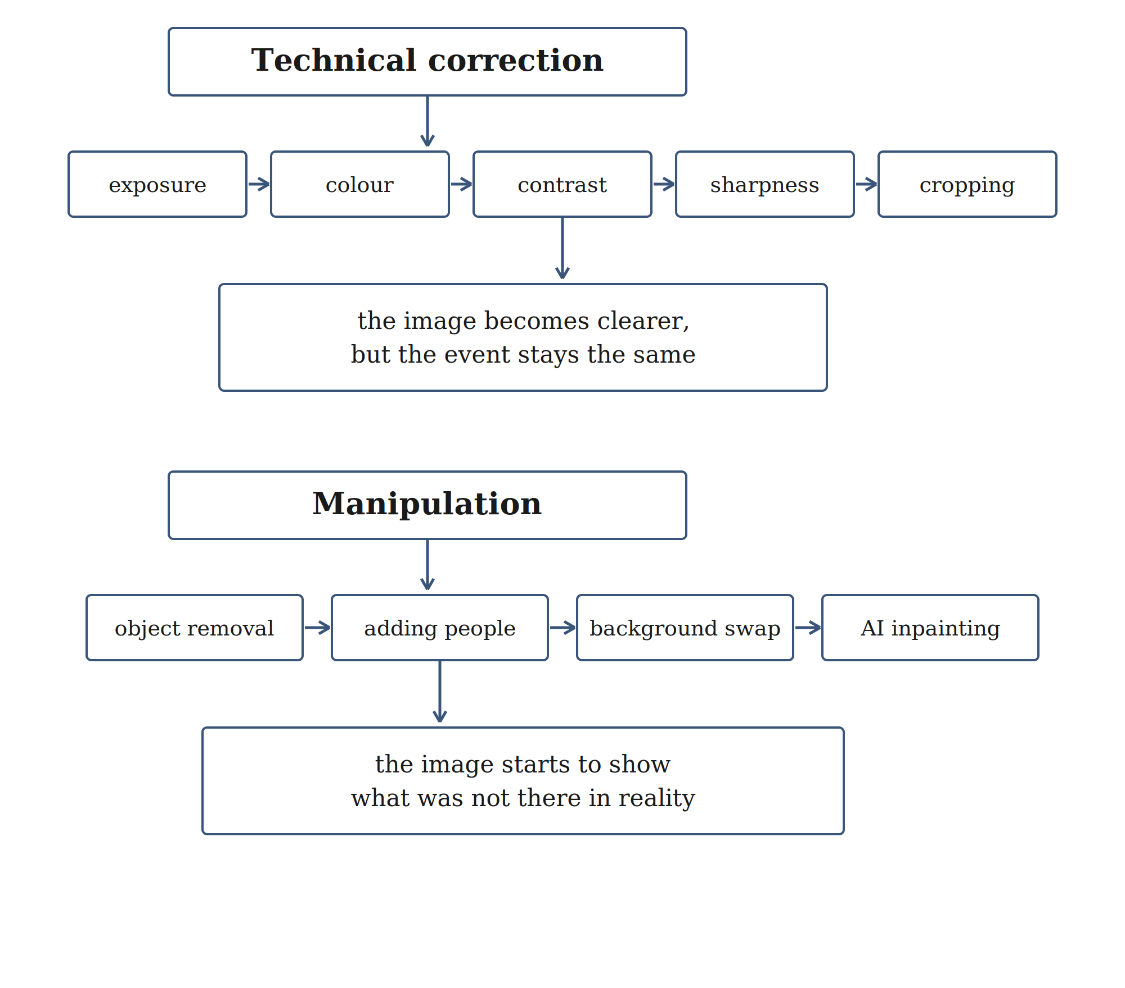
Fig. The distinction between technical correction and manipulation (developed by the author)
Acceptable post-processing does not conflict with documentarity if it preserves the factual basis of the image. The color, lighting, sharpness, and composition can be adjusted, but the people, objects, location, and meaning of the event must remain unchanged. It is the preservation of meaning that differentiates professional technical correction from visual manipulation.
The professional boundary in documentary photography is defined by whether the image maintains a reliable representation of the event after processing. For photojournalism, it is not only the image itself that is important, but also its informative function: photography should convey the situation in such a way that the viewer does not draw a false conclusion about the location, participants, scale, or nature of what is taking place. The content of photos and videos should not be altered digitally if it changes the actual basis of the material [1, p. 34].
Manipulation is the process by which an image is altered to create a specific image. These changes include removing important details, adding new objects, combining elements from different frames, changing the background, artificially enhancing drama, or cropping, which loses important context. The danger of manipulation lies in the fact that the viewer may perceive such an image as a document, although in fact it is already a modified visual version of the event.
Artificial intelligence has exacerbated the problem of visual authenticity, as modern generative tools can not only enhance the image, but also create new fragments of the frame. This is especially important for documentary photography, where the viewer expects to see an image associated with a specific physical moment [3, p. 97].
The main difference between AI generation and traditional processing is the source of visual information. In the process of classical correction, the photographer works with what has already been captured by the camera. When using AI generation, the program can create new details: expand the space beyond the frame, replace part of the scene, change texture, add objects, or visually "correct" the image. As a result, the result will no longer be an exact copy of the moment captured in the photo.
Table 2 shows the differences between conventional processing and AI generation.
Table 2
The difference between conventional processing and AI generation
|
Criteria |
Normal processing |
AI generation |
|
The basis of the image |
The frame captured by the camera |
The frame can be supplemented with artificially created elements. |
|
Working with content |
The content is saved |
The content can be changed. |
|
The level of risk |
Depends on the degree of correction |
High when creating new parts |
|
Verifiability |
Easier to match with the source file |
It is more difficult to determine the origin of individual fragments |
|
Importance for documentaries |
It may be acceptable |
Requires disclosure or prohibition in strict photojournalism |
A source: author's development
In this regard, technologies for verifying the authenticity of digital content are of great importance. The C2PA standard was designed to capture information about the source of a file and its history of changes. Such tools do not replace professional ethics, but rather help to make the image journey more transparent for editors, platforms, and viewers [4].
Street photography and reportage both work with reality, but they serve different professional goals. Street photography often captures everyday urban life, random moments, characteristic gestures, and the atmosphere of a street. The ability to observe and capture an expressive moment, as well as convey the mood of a space, is important in this genre. Therefore, more emphasis on contrast, lighting, color, and composition is permitted, so long as the real essence of the scene remains intact.
Reportage photography has a more strict ethical code because it is linked to the transmission of specific events. Such pictures are seen as part of public information and not just the author's personal statement. Therefore, it is essential to maintain accuracy in the report, including who is being depicted, where the event takes place, what is happening, and the context in which the viewer should interpret it. Even a dramatic shot should not give a false impression of the situation.
The difference between the two genres is not that one allows for more authenticity than the other. The level of copyright freedom allowed varies. In street photography, the author may express a stronger personal style, but they should not create scenes that are entirely made up. In reportage, the priority is accuracy rather than style.
Ethically acceptable post-processing of photographs should preserve the essence of the scene that was filmed. A photographer can enhance the technical quality of an image by making it lighter, clearer, more contrasty, or more aesthetically pleasing, but they should not alter the actual content of the frame.
The main question is whether the processed image accurately reflects the original moment captured. Such processing can be acceptable if it helps the viewer better understand the elements of the image, such as correcting color balance, removing technical noise, sharpening slightly, adjusting brightness, or trimming excess space around the edges. However, if important details are lost, the scene is altered, new elements are added, or an emotional meaning is changed as a result of the processing, then it goes beyond professional boundaries.
The context of the publication plays a significant role in how a technique is perceived. The same technique may be interpreted differently in an art exhibition, an author's portfolio, a news report, or a photography competition. The stronger an image's claim to authenticity and social significance, the more stringent the processing requirements should be [2, p. 21].
Table 3 outlines the criteria for acceptable post-processing.
Table 3
Criteria for acceptable post-processing
|
Criteria |
Acceptable solution |
An unacceptable decision |
|
Frame Content |
Real objects and participants are saved |
Significant elements are added or removed. |
|
Context |
The location and circumstances remain clear |
The situation is being replaced or hidden |
|
Light and color |
Adjusted for better readability |
They create a false atmosphere of the event |
|
Cropping |
Refines the composition |
Removes important information |
|
Sharpness and noise |
Fix technical flaws |
They mask essential details |
|
The final meaning |
The scene feels the same as it was shot |
The scene gets a new meaning |
A source: author's development
Ethically acceptable post-processing should not be used to rewrite reality. While it can enhance the image's appearance, it should not alter its actual content. The key criterion for ethical post-processing remains the preservation of meaning, ensuring that the photo after processing shows the same scene that was captured by the camera.
The labeling of AI-processed images becomes necessary when artificial intelligence has been used to alter the content of a photo. If the technology has been used for minor technical enhancements such as noise reduction or automatic brightness adjustment, a separate explanation may not always be necessary. However, if AI has created new elements, replaced the background, added details, or altered the appearance of a scene, viewers should understand that the image is not a traditional documentary photograph.
In this scenario, professional responsibility is shared among the photographer, editor, and publication site. The photographer has the responsibility to honestly indicate the nature of any processing they have done to the image. The editor should ensure that the image matches the intended genre and purpose. The platform or publication should avoid presenting an artificially altered image as a documentary without providing any explanation.
Labeling is not just a technological issue, but also a matter of trust. Viewers may not always be able to distinguish between photographic capture and algorithmic manipulation. Honest labeling of AI-assisted processing helps maintain the distinction between documentation, illustration, and artistic experimentation.
Conclusions
Thus, the documentary nature of the photograph is preserved only if the processing does not alter the actual content of the frame, replace the circumstances of the shoot, or mislead the viewer. Technical corrections may be acceptable if they improve the perception of an already captured scene, but they should not create new visual elements. AI-generated content may help increase confidence and allow for supplementing, modifying, or refining changes, but it is important to ensure the integrity of the original image. In street and reportage photography, professional honesty, the preservation of the original meaning, and a clear explanation of when AI has been used are especially crucial.
References:
- Gurtovaya E.A. Photojournalism in the Age of Artificial Intelligence: New Challenges and Opportunities // Journal of the Belarusian State University. Journalism. – 2024. – No. 2. – pp. 31-36.
- Denikin A.A. Digital Photography and Contemporary Art // Nestor-History Limited Liability Company. – 2016. – p. 224.
- Provotorova M.S., Shevchenko D.A. The Impact of Artificial Intelligence on the Formation of Journalistic Media Content // Man. Society. Obshchestvo. – 2025. – No. 5. – pp. 94-102.
- C2PA. Verifying Media Content Sources [Electronic resource]. – URL: https://c2pa.org/.
- National Press Photographers Association. Code of Ethics [Electronic resource]. – URL: https://nppa.org/resources/code-ethics.
Other articles of the issue