

Linguistic mechanisms of vocabulary acquisition in late ontogenesis: contextual, associative and discursive strategies of adult native speakers
Authors
Dodoyan Arpine

Share
Annotation
The article explores the linguistic mechanisms behind vocabulary acquisition in late adulthood. The focus is on the contextual, associative, and discourse strategies that native speakers use to understand, integrate, and apply new words. It shows that the lexical growth of adults is not merely a matter of memorizing words, but rather involves incorporating new vocabulary into an established system of linguistic knowledge. Context helps to define the meaning of a word within a given context; associative links connect it to familiar concepts, and discourse techniques ensure its appropriate use in specific communication situations. The conclusion is that the assimilation of new words in adulthood is a multifaceted process influenced by language experience, communicative context, and usage patterns.
Keywords
Authors
Dodoyan Arpine
Share
Relevance of the study
The relevance of this study is due to the fact that vocabulary acquisition does not stop in childhood but continues throughout life. Adult native speakers are constantly confronted with new words and meanings in the professional, educational, household sphere, mass media, and digital communication. Therefore, the study of the mechanisms of vocabulary acquisition in late ontogenesis is important for modern linguistics, psycholinguistics, and the theory of linguistic activity [4, p. 69].
At later stages of development, new vocabulary is acquired on the basis of existing linguistic knowledge. Context, associative connections, frequency of use of words, and the possibility of their inclusion in real speech play an important role. Adults most often learn new words not in isolation but through reading, conversations, work environment, mass media, and online communication [2, p. 97].
Contextual, associative, and discursive strategies play a crucial role in acquiring new vocabulary. Context provides important clues to understanding the meaning of a word, helping to understand its meaning through its surroundings and usage. Associations help to consolidate new words in memory, linking them with previously learned concepts and personal experiences. Discursive strategies allow us to include new words in our active speech and use them appropriately in specific communicative situations [10, p. 195].
Therefore, the significance of this study lies in the need to better understand how adult native speakers comprehend, memorize, and utilize new vocabulary. By considering contextual, associative, and discursive processes, we can explore lexical development in later stages of ontogenesis as a complex and ongoing process.
The purpose of the study
The aim of this study is to identify and describe the main linguistic mechanisms of acquiring new vocabulary in late ontogenesis through the analysis of contextual, associative, and discursive strategies used by adult native speakers.
Materials and research methods
The research material is based on a scientific approach to the study of lexical assimilation, mental vocabulary, speech activity, and discursive practice among adult native speakers. The paper uses methods such as theoretical analysis, generalization of scientific literature, contextual analysis, semantic interpretation, and elements of discourse analysis.
The results of the study
The study of linguistic mechanisms of vocabulary acquisition in late ontogenesis requires the use of several scientific approaches. This is because the replenishment of an adult native speaker's vocabulary is associated with speech practice, cognitive information processing, and social conditions of communication. In psycholinguistics, lexical assimilation is understood as the process of incorporating a new unit into the mental lexicon. This is the system of words and their meanings that a person possesses and can use in speech. For adults, this process is different from that of children. A new word does not simply occupy an empty space in the language system; it correlates with existing speech experiences, knowledge, and stable semantic connections [3, p. 504].
The cognitive approach is crucial for research. It enables us to view the acquisition of vocabulary as a process of comprehending, comparing, and consolidating information. When an adult encounters a new word, they typically attempt to determine its meaning by referencing already known concepts, the context of the conversation, the communicative situation, and their personal experience. Consequently, lexical acquisition in late development is not only about memorizing the word's form but also about clarifying its significance, scope of usage, and semantic connections with other linguistic elements.
No less significant is the discursive approach, as a word becomes part of a person's active vocabulary only if they are able to use it appropriately in a specific speech situation. Understanding the meaning of a word alone is not sufficient: an adult native speaker needs to take into account the genre of the text, the audience, the purpose of the communication, and the context in which the word is used. That is why, when analyzing vocabulary acquisition, it is important to consider not only individual words but also the conditions in which they are used in professional, educational, media, daily, and digital contexts.
Contextual strategies play a central role in the acquisition of new vocabulary for adult native speakers. In real-life communication, new words are rarely encountered in isolation. Instead, they are usually found in texts, oral speech, professional documents, news reports, educational materials, or online conversations. Therefore, the meaning of a new lexical item is determined by its context, the overall theme of the conversation, its syntactic position, and its connection to other words.
The basis of contextual assimilation is semantic inference. An adult native speaker compares an unfamiliar word with the elements of the utterance they already understand and, on this basis, forms a preliminary idea of its meaning. This idea can be refined through repeated encounters with the word in different situations. When a word is used in various, yet understandable contexts, people get more reasons to differentiate between its main meaning, shades of meaning, and scope of usage.
Contextual diversity plays an important role in understanding new vocabulary. If a word is used in only one context, its meaning can be perceived too narrowly and associated with that specific situation. However, if it appears in various thematic and linguistic contexts, it becomes easier for a native speaker to understand the stable meaning of the word and apply it to new communication situations. This is particularly important when learning specialized, technical, political, and digital terminology, as these words often have specific meanings depending on the field they are used in.
The limitations of the contextual strategy should also be considered. The context does not always provide an accurate understanding of a word. Errors can occur due to ambiguity, figurative usage, terminological ambiguity, or a lack of background knowledge. In these cases, an adult native speaker may be able to roughly understand the general meaning of an utterance, but it would be incorrect to determine the exact meaning of a specific lexical unit. Therefore, contextual learning is more effective when a new word is encountered repeatedly, in various speech situations, and with sufficient semantic support.
Associative mechanisms play a significant role in the acquisition of new vocabulary for adults, as they perceive new words not in isolation but through connections with previously learned words, meanings, and experiences (Table 1). In our mental lexicon, each word is linked to other units based on meaning, sound, thematic similarity, and usage context. Therefore, acquiring new vocabulary requires not only understanding a specific meaning but also integrating the new word into the existing network of lexical associations [8, p. 86].
Table 1
Associative factors of learning new vocabulary
|
The associative factor |
How does it affect the assimilation of a word |
What is important to consider |
|
Semantic proximity |
It helps to connect a new word with already known concepts |
There may be confusion of meanings and inaccurate usage |
|
Sound or graphic similarity |
Facilitates the recognition of the word form |
It may cause erroneous semantic approximations |
|
Thematic connection |
Accelerates memorization in a familiar area |
It is especially significant in professional and educational vocabulary |
|
Personal experience |
Makes the word more understandable and memorable |
It affects the depth and stability of associations |
A source: author's development
Associative mechanisms suggest that vocabulary acquisition in adulthood is linked to the reorganization of existing lexical connections. A new word does not immediately become part of a person's vocabulary; it must first be recognized and understood, then related to other words, before it can be actively used [5, p. 119].
Discursive strategies relate to the fact that new vocabulary is learned through real-life communication. Professional, academic, educational, media, and digital discourse are especially important for adult native speakers (Table 2). Within each of these contexts, a word gains not only a meaning but also rules for use: where it is appropriate, which words it can be combined with, what style of language it implies, and what communicative purpose it serves.
Table 2
Discursive conditions for mastering new vocabulary
|
Type of discourse |
The source of the new vocabulary |
The peculiarity of assimilation |
|
Professional |
Terms, instructions, business correspondence |
The word is fixed through practical necessity |
|
Scientific and educational |
Concepts, definitions, theoretical texts |
The accuracy of the meaning and the connection with the system of concepts are important |
|
Media |
News, articles, interviews, public discussions |
Vocabulary is learned through repetition and social significance |
|
Digital |
Social networks, comments, messengers |
Words spread quickly and depend on the communication situation |
A source: author's development
Learning new vocabulary in a discourse is different from simply memorizing a dictionary definition. A person may understand a word but cannot use it in their own speech unless they know the conditions for its use. Therefore, a crucial indicator of assimilation is the transition of a word from passive to active vocabulary. This transition happens through reading, discussing, professional communication, practicing writing, and participating in typical speech situations.
In professional discourse, new vocabulary is learned through documents, instructions, scientific texts, business correspondence, and verbal interaction between specialists. New terms spread rapidly in the media and digital discourse, as they are often repeated, receive feedback in society, and are used in various forms of communication. At the same time, digital communication focuses on brevity, expressiveness, quoting, repetition, and group affiliation [6, p. 19].
Discursive strategies allow us to view the assimilation of new vocabulary as a socially determined process. A word becomes part of an adult native speaker's speech practice when it is not only understood but also used in accordance with the norms of a particular discourse. Therefore, when studying lexical assimilation, it is important to take into account not only the meaning of a word but also its scope of use, type of text, communicative purpose, and social context of use.
Contextual, associative, and discursive strategies are interrelated and interdependent. In the process of mastering new vocabulary, a native speaker first hears a word in a speech environment. They then associate it with previously learned words and meanings. After that, they decide whether it is suitable for use in a specific communication situation. Thus, lexical assimilation is a complex and repetitive process: people can return to the meaning of a word after encountering it in speech again [1, p. 459].
The context provides the main understanding of a word. It helps to define the approximate meaning, grammatical function, and possible connections with other words. However, the context alone is not sufficient for complete assimilation. To truly understand a word, it needs to be integrated into a system of associations, connecting it with similar concepts, thematic areas, personal experiences, and previously learned lexical units. This process not only helps to fully understand the meaning of a word but also allows us to differentiate it from similar or related words.
The discursive strategy completes this process, as the word is mastered only when a native speaker can use it appropriately. It is important not only to know the meaning of a word but also to understand in which context it is acceptable, with which other words it can be combined, and what function it serves in an utterance. Thus, the active assimilation of vocabulary involves a transition from understanding to using: from reading and recognizing a word to actually using it in oral or written communication.
The interaction between the three strategies is particularly noticeable when it comes to mastering professional, scientific, and digital vocabulary. For example, when a new term is encountered, it is first understood in the context of a document or educational text. Then the term is associated with well-known concepts from the relevant field. Finally, it is consolidated through professional communication. If any of these stages are not followed, assimilation of the term may be incomplete. The word may be understood in the text but not used in speech or used inaccurately.
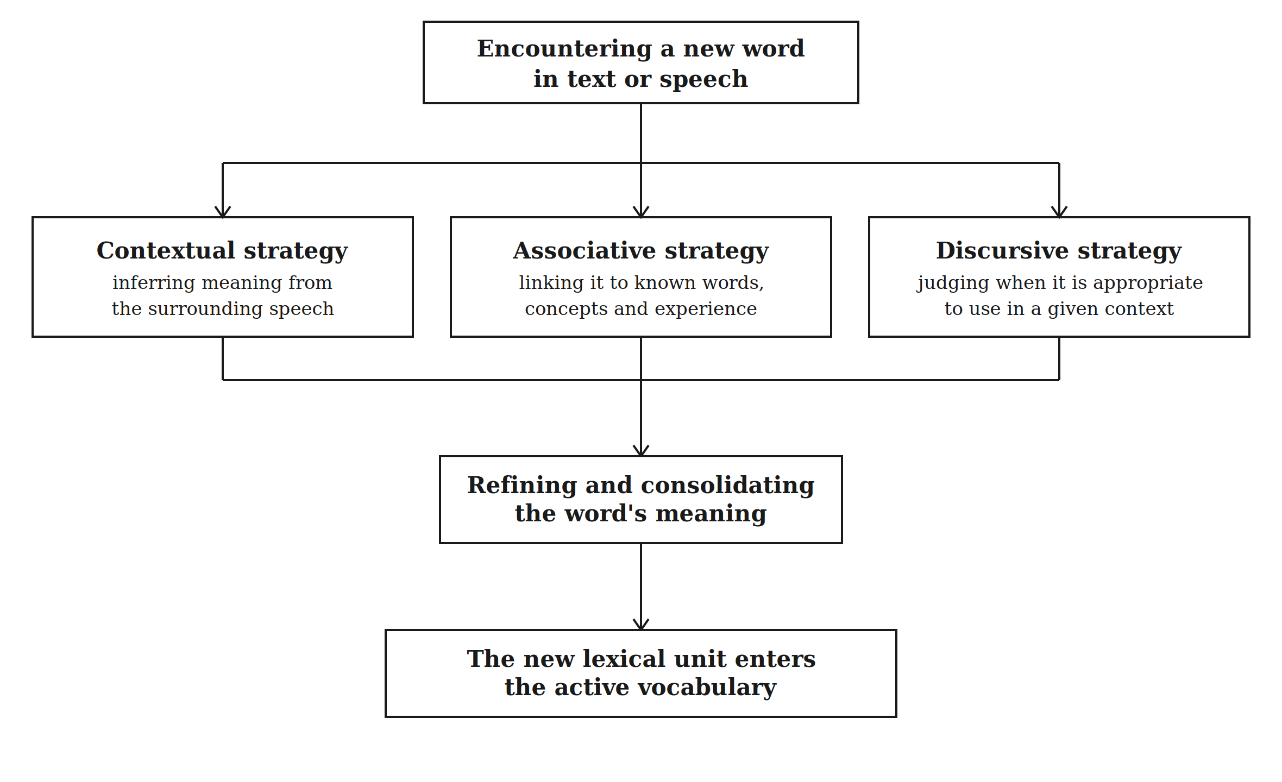
Fig. Interaction of strategies for learning new vocabulary (developed by the author)
The interaction of contextual, associative, and discursive strategies demonstrates that vocabulary acquisition in adulthood is not just about memorizing vocabulary definitions. Instead, an adult native speaker learns new words by understanding their context, integrating them into their existing knowledge, and then applying them to their speech. It is thanks to the combined effect of these three processes that a new lexical unit moves from passive recognition to active use [9, p. 87].
Conclusions
The conducted research allows us to conclude that vocabulary acquisition in late adolescence and adulthood is complex. An adult native speaker learns a new word in several stages: an initial understanding of its meaning in context, association with already known words and concepts, clarification of the meaning upon repeated meetings and further use in specific speech situations. Contextual strategies provide semantic guidance, associative mechanisms help consolidate words in the lexicon, and discursive strategies translate new units into active speech use. Consequently, the development of vocabulary in adults continues throughout life and depends on language experience, social environment, and communication patterns.
The potential for further research lies in a deeper study of how adult native speakers learn new vocabulary in various fields of communication, such as professional, educational, media, and digital. It is especially interesting to analyze which words pass from passive to active use and which factors contribute to this process [7, p. 315].
Future research could involve conducting associative experiments, interviewing adults of different age groups, and analyzing actual speech materials. These efforts would allow for a more precise understanding of the role of context, associations, and discourse practices in the assimilation of new words in later stages of development.
References:
- Akinina M.V. Basic principles of classification of exercises in a foreign language for a language university // Actual problems of the humanities: Proceedings of the All-Russian scientific and practical conference. – 2022. – pp. 457-462. – DOI 10.36906/NVSU-2022/76.
- Galichkina E.N. Internet discourse: main areas of study and development trends // Bulletin of the Volgograd State Pedagogical University. – 2021. – No. 7 (160). – pp. 94-101.
- Galperina E.I., Kruchinina O.V., Stankova E.P., Kornev A.N. Late components of event-related potentials in children, adolescents and adults when reading words // Journal of Higher Nervous Activity named after I.P. Pavlov. – 2021. – Vol. 71, No. 4. – pp. 500-514. – DOI 10.31857/S0044467721040031.
- Gordikova E.E., Makeeva M.N. Solving the problem of assimilation of the semantics of foreign words by older people // Scientific space of modern youth: priority tasks and innovative solutions: III ReFORUM "Manage your dream!": collection of articles by participants of the II All-Russian youth scientific and practical conference. – 2021. – pp. 68-70.
- Gridina T.A. Dictionary of V.I. Dahl and modern associative lexicography // Philological class. – 2021. – Vol. 26, No. 4. – pp. 117-126. – DOI 10.51762/1FK-2021-26-04-10.
- Kopus T.L. On the Study of Digital Language // Service plus. – 2021. – Vol. 15, No. 2. – pp. 13-23. – DOI 10.24412/2413-693X-2021-2-13-23.
- Kushneruk S.L. Telegram Discourse as a Digital Communication Format // Medialinguistics. – 2024. – Vol. 11, No. 3. – pp. 300-324. – DOI 10.21638/spbu22.2024.302.
- Lopareva T.A. Mental lexicon of a foreign language learner // Improving the teaching of foreign languages at school and university: Collection of scientific and methodological works. – 2017. – pp. 84-89.
- Ovchinnikova I.G. The structure of the mental lexicon: age dynamics of associative links // Psycholinguistic aspects of the study of speech activity. – 2006. – No. 4. – pp. 85-92.
- Ufimtseva N.V., Cherkasova G.A. Associative lexicography and studies of linguistic consciousness // Philology and Culture. – 2014. – No. 4(38). – pp. 193-199.
Other articles of the issue