

Analysis of the transformation of precious metal processing technologies in modern jewelry art
Authors
Melnychuk Serhii

Share
Annotation
The article provides a comprehensive overview of the development and transformation of precious metal processing technologies in the context of modern jewelry art. It reveals the evolution from traditional craft techniques to high-tech, digital, and environmentally friendly production solutions. Key innovative areas such as additive manufacturing, laser and microplasma processing, precision milling on numerically controlled machines, electrochemical and plasma texturing, as well as the use of high-strength alloy alloys and metal composites are considered. In addition, the article analyzes the deep integration of algorithmic design and artificial intelligence into the process of designing jewelry forms, which opens up new horizons in the art of jewelry creation. A comparative analysis of the physico-mechanical properties of the treated surfaces, as well as indicators of wear resistance, corrosion resistance, microrelief, and energy efficiency of production cycles, allows us to draw conclusions about the direct impact of technological innovations on aesthetic perception, functional durability, and serial reproducibility of jewelry. Special attention is paid to the role of digital twins, parametric modeling, automated optical control, and closed-loop charge recycling systems in radically reducing material costs, minimizing production waste, and ensuring compliance with international standards for sustainable development and responsible supplier selection. The paper analyzes socio-cultural and professional changes in the field of jewelry. Special attention is paid to how the role of a master jeweler has transformed from a simple performer to an engineer operator. The article analyzes changes in educational approaches and the formation of new criteria of artistic value in the era of the fusion of traditional craft and digital technologies. Based on the conducted research, practical recommendations are offered on the adaptation of technological chains for both small workshops and large industrial enterprises. In addition, the prospects for regulatory standardization of innovative processing methods are being considered. Priority areas for further research in the field of jewelry materials science, digital surface aesthetics, machine vision for quality control, and circular economy in the jewelry industry are also being identified.
Keywords
Authors
Melnychuk Serhii
Share
Relevance of the study. The relevance of this study stems from the significant technological transformation of the jewelry industry. Traditional artisanal methods of precious metal processing are being rapidly supplemented and replaced by digital, additive, and robotic production systems. This transformation is driven by several factors, including stricter environmental standards, growing consumer demand for personalized and technologically advanced products, a shortage of skilled craftsmen, and the need to improve the reproducibility of quality while reducing material consumption in production cycles.
In the context of the advanced development of engineering solutions, there is a significant gap between the innovative potential of modern alloy processing methods and their regulatory, methodological, and educational support. This gap reduces the effectiveness of implementing new technologies in serial and original production. It also makes outdated industry standards obsolete and requires a systematic scientific understanding of the evolution of approaches to shaping, texturing, and finishing precious metals. Such an understanding should take into account the influence of these processes on the physical and mechanical properties, aesthetic perception, economic efficiency, and environmental impact of finished products.
The absence of a unified approach for comparing the strength properties of fastening components with their optical and compositional effects on the perception of products reduces the efficiency of introducing promising technologies in mass production, making this study both timely and practically significant for both the technological support of jewelry businesses and the development of materials science and standardization in the jewelry industry.
The purpose of the study. The aim of the study is to thoroughly analyze the transformation of precious metal processing techniques in contemporary jewelry, identify significant technological changes, quantify and evaluate their impact on the performance, artistic expression, and production process of jewelry. Additionally, the study aims to develop scientifically grounded criteria, proven recommendations, and a methodological framework for incorporating innovative methods into different production scales, from small independent workshops to industrial facilities. Furthermore, the research will propose adjustments to regulatory and technical documents and educational programs to facilitate the adaptation of these innovations.
Materials and research methods. To achieve this goal, a range of theoretical, experimental, analytical, and expert statistical methods have been applied.
During the preparation phase, a systematic review of scientific literature, patent databases, technological standards, and industry reports was conducted, which allowed us to classify modern approaches to precious metal processing, identify dominant trends, and identify gaps in metrological and standardization support for the industry. In the experimental phase, control samples of standard jewelry alloys were produced using both traditional and innovative processing methods.
The experimental, expert, and calculated data were processed using various statistical methods, including variance, correlation, regression, and factor analysis. This allowed us to identify statistically significant relationships between different processing modes, alloy structures, and final indicators such as reliability, aesthetics, and resource efficiency. Based on these findings, we were able to formulate practical recommendations for technology adaptation and implementation of automated quality control, standardization of digital production processes, and development of interdisciplinary training programs for specialists in the field of jewelry art.
The results of the study. The history of the evolution of precious metal processing techniques in modern jewelry is a complex process that has seen craft traditions, scientific discoveries, and engineering innovations continually redefine the boundaries of what is possible in the creation of jewelry. This transformation has not only impacted production methods but also the aesthetic, functional, and philosophical aspects of the finished product.
This evolution can be traced back to ancient civilizations such as Egypt, Mesopotamia, India, and China, where skilled craftsmen possessed basic techniques for smelting, forging, and casting precious metals into stone and clay forms. They also employed simple methods such as wire drawing, coinage, and inlay to create intricate designs. These early craftsmen laid the foundation for a culture based on practical knowledge of metal properties and intuitive skill [4].
In the ancient period and the Middle Ages, the development of goldsmith guilds, the improvement of tools, and the discovery of new alloys, particularly the introduction of copper and silver into gold alloys to regulate hardness and color, made it possible to master complex techniques such as filigree, granulation, scanning, blackening, and enameling. These techniques relied on microscopic handwork to achieve a decorative effect, and each object was a unique artifact that bore the imprint of the master's individual style.
The Renaissance and subsequent centuries became a time of systematization of knowledge. In the treatises of Cennino Cennini, Benvenuto Cellini, and other masters, technological regulations were fixed. At that time, new technologies appeared: water and mechanical drives for rolling mills and drawing boards increased productivity. And the development of electroplating processes in the 19th century opened up the possibilities of controlled deposition of precious coatings, which significantly expanded the palette of textures and color solutions [6, 7].
The Industrial Revolution was the first significant frontier of transformation. Standardization of samples, the introduction of stamping, mechanical engraving, and broaching tools allowed the transition from single production to serial production. However, a dichotomy has emerged between a mass-produced product and an author's statement. This stimulated the search for new forms of artistic expression within the framework of technological limitations.
In the early and mid-20th century, new materials and technologies were used in jewelry making. The use of platinum and palladium made it possible to create thin and durable frames. The development of electrochemical polishing, sandblasting, and vibration surface treatment has opened up new possibilities for controlling microrelief and reflectivity. And the appearance of the first semi-automatic machine tools with software control laid the foundations for precision shaping.
In the last decades of the 20th century, a real breakthrough occurred with the advent of computer technology. Computer-aided design (CAD) systems have made it possible to visualize and optimize complex shapes even before the start of physical production. And numerical control machines (CNC) provided micron precision milling [5], engraving, and polishing, which made the reproducibility of artistic designs independent of the subjective factor of the performer (Fig. 1).
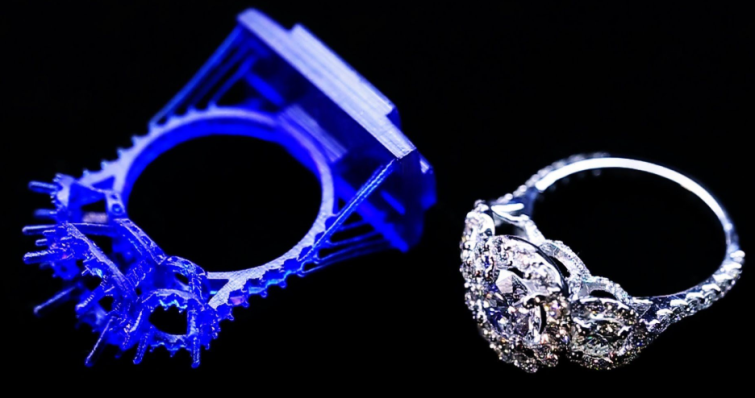
Fig. 1 – 3D printing of jewelry
Modern technologies for processing precious metals in jewelry represent a complex system of innovations. It includes additive manufacturing, precision subtractive processing, laser-plasma technologies, digital modeling, and sustainable manufacturing practices. This creates new opportunities for creating shapes and aesthetics of finished products [10].
One of the most significant innovative areas is selective laser melting (SLM/DMLS) of metal powders. With this technology, it is possible to create openwork, topologically optimized, and gradient structures with internal shock absorption channels, integrated hinges, and organic shapes that were not available with traditional casting (Table 1).
Table 1 – Selective laser melting of metal powders [1, 9]
|
Parameter |
Characteristic |
|
Technology definition |
The additive method of layer-by-layer synthesis of 3D objects from metal powder involves the selective melting of particles using high-energy laser radiation in an inert gas environment, followed by post-processing. |
|
The physical principle |
Local melting of a powder layer (20-60 microns thick) using a laser beam with a wavelength of 1060-1080 nanometers, forming a metal bath that crystallizes into a monolithic structure. This process is repeated layer by layer according to a digital 3D model. |
|
Basic materials |
• Gold alloys: Au 585/750 (with Ag, Cu, Pd, Ni ligatures); • Platinum: Pt 950, Pt 900; • Palladium: Pd 950; • Silver: Ag 925, Ag 999; • Titanium and its alloys (for structural elements); • Cobalt-chrome ligatures (for frames); • Composite powders with nano additives (YOO₃, TiC). |
|
Equipment |
• 3D printers for precious metals (EOS M 200/400, SLM Solutions, Realizer, Aconity3D); • Fiber/pulsed lasers with a power of 200-400 watts; • Powder supply and recovery systems; • Chambers with controlled atmosphere (argon, nitrogen, oxygen <100 ppm); • Post-processing: annealing furnaces, sandblasting plants, electroplating lines, polishing machines. |
|
Key process parameters |
• Layer thickness: 20-60 microns; • Scanning speed: 200-1500 mm/s; • Laser power: 150-400W; • Laser spot diameter: 40-100 microns; • Scanning strategy: checkerboard, spiral, vector; • Platform temperature: 80-200 °C; • Energy density: 50-150 J/mm3. |
|
Accuracy and resolution |
• Geometric accuracy: ±0.05–0.1mm; • Minimum wall thickness: 0.15–0.3mm; • Surface roughness (Ra): 6-15 microns (before post-treatment); • Density of the finished product: 99.5%–99.9% of the theoretical. |
|
Advantages of the technology |
|
|
Limitations and challenges |
• The high cost of equipment, ranging from $150,000 to $500,000, and the need for qualified personnel; • The complexity of post-processing, including the removal of supports, heat treatment, polishing, and electroplating; • Monolithic additive structures have limited maintainability; • Requirements for powder purity, as oxidation, humidity, and agglomeration can reduce quality; • The need to develop new quality control standards for additive jewelry; Limitations on the minimum size of details and accuracy of micro-decoration reproduction. |
|
Quality control methods |
• Optical and X-ray computed tomography (micro-CT) to detect internal defects; • Scanning electron microscopy (SEM) for microstructure analysis. • Measurement of microhardness (according to the Vickers method) and residual stress; • 3D scanning and comparison with a CAD model (with deviations <0.05 mm); • Spectral analysis of the alloy composition; • Testing for wear, corrosion, and adhesion of coatings. |
|
Aesthetic possibilities |
• Gradient structures with a smooth transition of density and texture; • Surface nanotexturing for controlling lighting effects; • Integration of optical fibers and microchannels for optical innovations; • Organic and biomimetic forms inspired by natural structures; • Combining matte and glossy areas in a monolithic product without the need for additional operations. |
|
Practical application examples |
• Chopard (L.U.C.XP collection "Esprit de Fleurier Peony") – additively manufactured platinum base with microlattice structure, which reduces weight by 35% while maintaining strength. • Cartier – using SLM (selective laser melting) to create customized frames for complex designs. • NUST MISIS and Almaz-Holding – development of gold alloys with nano-additives for additive manufacturing, resulting in increased wear resistance. • Customized wedding rings from designer workshops – topologically optimized designs calculated by the finite element method, creating unique and personalized rings. |
For example, the Swiss jewelry manufacturer Chopard used a platinum base in its collection "L.U.C XP Esprit de Fleurier Peony", which was created using additive technologies. This base has a microlattice structure, which reduces its weight by 35% while maintaining mechanical strength. This creates the effect of visual weightlessness of the petals.
Another innovative technology is precision micro-milling. It is carried out on five-axis CNC machines equipped with diamond tools and real-time optical control systems. Due to this, the positioning accuracy is up to ±0.005 mm. This technology allows you to create complex geometric patterns, micro-notches to improve the adhesion of enamel, and precision seating for stones. The Russian company Estet Jewelry House uses this technology to produce original rings with algorithmically generated relief. Each surface element is calculated using the finite element method for optimal stress distribution during daily operation.
Laser and microplasma processing open up new horizons in the field of local surface hardening, precise texturing, and welding of various alloys, without causing thermal deformation of the product [3].
The "Magnifica" collection by the Bvlgari brand makes use of laser pulse-modulated engraving to create a nano-relief on a gold surface, which controls reflectivity and produces a "live flicker" effect as the viewing angle changes. Microplasma spraying of a palladium layer on a silver base provides corrosion resistance comparable to that of platinum, while maintaining an affordable cost.
Electrochemical and plasma surface structuring allow for the formation of a controlled micro-relief without the use of mechanical abrasives. This controls the wettability and adhesion of finishing coatings, as well as optical effects.
Researchers at NUST MISIS, in collaboration with the Almaz-Holding jewelry manufacturer, have developed a method using pulsed current electrochemical etching to create a hierarchical nanostructure on 750-carat gold. This provides superhydrophobic properties and increased wear resistance, which is particularly important for everyday wear items.
In parallel, the field of high-strength alloyed metals and metal composites is evolving. The use of gold alloys with dispersed yttrium oxide nanoparticles and cobalt-chromium ligatures with improved elasticity, as well as titanium composites reinforced with ceramics, allows us to create thin-walled structures that are resistant to deformation and scratching. This expands design possibilities while maintaining reliability [2].
Digitalization of production processes is manifested in the use of parametric and generative design. Due to this, the shape of the product is optimized based on specified mechanical, aesthetic, and production criteria using algorithms. For example, the Graff brand uses AI algorithms to create unique cutting patterns and frames that take into account the optical paths of light rays in a diamond and the stress-strain state of the metal. This allows you to maximize the "game" of the stone with minimal material consumption.
Sustainable production is an important area of transformation. The introduction of closed charge recycling cycles with electrolytic recovery of precious metals from waste, the use of certified responsible raw materials, low-energy treatment modes, and biodegradable auxiliary materials is becoming not only an environmental trend but also a competitive factor [8].
Automated quality control based on computer vision and machine learning technologies is able to detect the smallest surface defects, geometry deviations, and alloy inhomogeneities with an accuracy inaccessible to the human eye.
Gradient structures created with the help of additive technologies ensure smooth transitions of mass and texture, creating the impression of "organicity." Nanotextured surfaces control light flows, creating dynamic optical effects without the need for additional coatings. Topologically optimized openwork designs create the illusion of "weightlessness" of the product, which corresponds to modern trends in minimalism and eco-friendly design.
It is important to note that the transformation process also affects the professional identity of the master. The role of a jeweler is changing from a simple performer to an engineering operator capable of interpreting artistic ideas using digital tools, material analysis, and production logistics. This requires a review of educational programs, which should become more interdisciplinary.
In our opinion, the introduction of innovations is fraught with some difficulties. Among them are the high cost of equipment and the need for qualified personnel. New quality control standards also need to be developed. In addition, some monolithic structures created using additive technologies have limited maintainability. There are also risks associated with the long-term stability of new alloys and interfaces.
Nevertheless, a thorough analysis shows that modern methods of processing precious metals, based on an interdisciplinary approach, make it possible to bring jewelry art to a new level. Engineering precision not only does not interfere but also becomes the basis for creating unique and expressive products. These products are characterized by exceptional reliability, visual innovation, and meet the requirements of sustainable development. They are created using fewer materials, minimize waste, and have a long service life. This approach determines the future development of the industry in the era of digital transformation and global environmental challenges.
Conclusions. The history of the development of precious metal processing technologies in modern jewelry is not just a matter of replacing traditions with innovations, but a complex and multifaceted process. In it, traditional craftsmanship and digital engineering enrich each other, creating new forms of jewelry art. Technological precision becomes a tool for expressing artistic freedom, and the sustainability and efficiency of production cycles are an integral part of the aesthetic and ethical ideal of modern decoration.
The current stage of technology development is characterized by the close integration of artificial intelligence and machine learning into parametric design processes. This makes it possible to optimize the shapes of the products, taking into account both mechanical and aesthetic requirements. Automated optical quality control using computer vision is also actively developing. In addition, digital twins of production cycles are being created, which help simulate the behavior of the alloy at all stages – from melting to final polishing.
References:
- Barancheeva L.A. Historical essay on the study of metal in decorative and applied arts // Science and School. – 2012. – No. 5. – pp. 160-162.
- Egorova U.F. Use of traditional technology for processing precious metals in modern conditions // Scientific Bulletin of Moscow State Mining University. – 2010. – No. 8. – pp. 22-24.
- Izmestiev S.A. Properties of precious metals influencing the jewelry manufacturing process // Innovations. Science. Education. – 2021. – No. 34. – pp. 606-613.
- Lugovoy V.P., Lugovaya I.S. Classification of methods of artistic processing of jewelry. – 2022.
- Sidelnikov S.B. et al. Creation of new jewelry alloys from multicomponent systems of precious metals and technologies for their processing // Bulletin of Magnitogorsk State Technical University named after G.I. Nosov. – 2015. – No. 4 (52). – pp. 38-44.
- Canda L., Heput T., Ardelean E. Methods for recovering precious metals from industrial waste // IOP conference series: materials science and engineering. – IOP Publishing, 2016. – Vol. 106. – No. 1. – p. 012020.
- Chen Y. et al. Precious metal recovery // Joule. – 2021. – Vol. 5. – No. 12. – pp. 3097-3115.
- Goriaeva O.Y. et al. A new technology for the processing of precious metal containing secondary raw materials // Recycling of metals and engineered materials. – 2000. – pp. 731-737.
- Izatt R.M., Hagelüken C. Recycling and sustainable utilization of precious and specialty metals // Metal sustainability: Global challenges, consequences, and prospects. – 2016. – pp. 1-22.
- Mooiman M.B., Sole K.C., Dinham N. The precious metals industry: Global challenges, responses, and prospects //Metal sustainability: Global challenges, consequences, and prospects. – 2016. – pp. 361-396.
Other articles of the issue