

Architectural psychology in urban planning: the influence of the spatial environment on human perception
Authors
Yelyubayev Azat

Share
Annotation
This article examines in detail the importance of architectural psychology in modern urban planning. The focus is on the profound impact of the spatial urban environment on a person's emotional, cognitive, and behavioral perception. In conditions of rapid urbanization, special attention is paid to the problems of urban stress and alienation that arise due to monotonous, visually aggressive, and uncomfortable buildings for humans. The article provides scientific substantiation of the influence of various factors, such as the scale of architectural objects, the density of residential areas, color patterns, insolation, and geometry of streets, on the psycho-physiological state of citizens. Special attention is paid to the principles of video ecology and the concept of human-oriented design. Empirical research proves that the integration of natural elements, intuitive navigation, and the proportionality of architectural forms promote social interaction, provide a sense of security, and reduce anxiety. It is concluded that an interdisciplinary approach is extremely important in the development of master plans. It allows you to take into account the psychological needs of society, which is a prerequisite for creating a stable and comfortable living environment
Keywords
Authors
Yelyubayev Azat
Share
Relevance of the study. The relevance of the study is due to the rapid growth of cities worldwide and how this affects the psychological state of their inhabitants. Modern urban planning practice often focuses on economic efficiency, transport logistics convenience, and maximum building consolidation, without taking into account the laws of video ecology and basic human needs.
An increase in building height, the monotony of typical residential areas, a lack of green spaces for recreation, and an aggressive visual environment are directly related to an increase in chronic urban stress, heightened anxiety, decreased cognitive functions, and increased social isolation.
In this regard, there is an urgent need for the deep implementation of architectural psychology principles in the spatial planning process. Understanding how space geometry affects neurobiological and emotional responses is crucial for creating a therapeutic and safe urban environment that meets sustainable development criteria and contributes to improving the population's mental health.
The purpose of the study. The aim of the research is to thoroughly investigate, categorize, and scientifically justify the mechanisms of how the architectural and spatial environment influences a person's psychological perception, emotional state, and behavior in a modern city. This goal is achieved by assessing the impact of various urban planning elements, such as the scale of development, color schemes, public space geometry, and insolation, on citizens' psychophysiological comfort. Additionally, this research aims to develop practical, interdisciplinary recommendations for creating a human-centered and visually appealing urban landscape.
Materials and research methods. Our research is based on a synergetic approach that combines analytical methods of urban planning, environmental psychology, and urban sociology.
As a theoretical basis, we used fundamental works on video ecology, proxemics, and behavioral geography, as well as urban planning documentation and master plans of the studied territories.
In the course of our work, we applied both empirical and theoretical methods. Spatial and structural analysis of urban areas has become the main theoretical method. To obtain the primary data, we conducted field observations of how people move around the city and interact with its elements (behavioral mapping).
The results of the study. The understanding of the relationship between the organization of space and a person's mental state originated in antiquity. Vitruvius' treatise "Ten Books on Architecture" outlined the need for harmony of utility, durability, and beauty, and aesthetics were directly related to the comfort of perception. However, a truly scientific understanding of this problem began only at the end of the 19th century.
The Austrian architect and urban planner Camillo Sitte, in his work "The Artistic Foundations of Urban Planning" (1889), for the first time criticized the regular city plan, which was based on dry geometry. He empirically proved that curved streets, asymmetrical squares, and the proportionality of buildings in old European cities are more comfortable from a psychological point of view, as they correspond to the natural physiology of visual perception.
At the beginning of the 20th century, Ebenezer Howard developed the concept of "garden cities," laying the foundations of environmental psychology in urban studies. He pointed out the need for a citizen's daily contact with nature to preserve mental health and prevent social exclusion.
In the middle of the 20th century, architectural psychology was finally formed as an independent scientific discipline that arose at the intersection of environmental psychology and urban studies. Its appearance was due to the desire to find a solution to the problem associated with the monotony and facelessness of modernist buildings.
In 1960, the book "The Image of the City" by American urbanist Kevin Lynch was published, which became a real revolution in the field of urban planning. Lynch introduced the concept of mental maps into scientific use and demonstrated that the clarity of landmarks, nodes, and boundaries in an urban environment are key factors for spatial orientation and reducing the level of basic anxiety.
Almost simultaneously with Lynch, in 1961, Jane Jacobs's work "The Death and Life of Great American Cities" was published, which destroyed the idea of rigid functional zoning. In this book, Jacobs proved that safety and psychological comfort depend on the density of social contacts, the versatility of neighborhoods, and the informal control provided by "eyes on the street." During the same period, anthropologist Edward Hall developed proxemics, the science of human spatial needs. He scientifically substantiated the concept of personal distances and their direct impact on the design of squares, parks, and transit zones.
In the 1970s and 1980s, researchers focused on studying behavioral patterns. During this period, architect Christopher Alexander published his seminal work, The Timeless Way of Building, in which he proposed a humanistic approach to design. This approach is based on intuitive spatial archetypes that respond to people's deep emotional needs.
Sociologist William Whyte, who used the methods of hidden time-lapse photography to study social behavior in New York squares, made a significant contribution to the formation of the empirical database. His research revealed the genuine needs of townspeople, which are not limited to generally accepted norms, such as a convenient location for seating, sun protection, and the possibility of open space. At the end of the 20th century, the Danish architect Jan Gehl developed these ideas, popularizing the concept of "cities for people." He proved that buildings with a height of no more than 5-6 floors, active ground floors, and traffic restrictions are key factors contributing to the creation of a sense of belonging, security, and social integration.
Currently, research in this field is moving to a new level, covering neuroarchitecture and psychogeography. Researchers such as Colin Ellard are using innovative tools such as virtual reality (VR), wearable biometric sensors, mobile electroencephalography (EEG), and eye-tracking technologies [4] to study a person's inner world and their interaction with the surrounding space.
This allows you to measure cortisol levels, heart rate, and brain activity of people in real time and with a high degree of objectivity when they interact with various elements of the urban environment. This step marks the final transition from an intuitive or philosophical understanding of architectural psychology to evidence-based design. The psycho-emotional well-being of the inhabitants of a megalopolis becomes a mathematically measurable quantity and the main criterion for the quality of the created spatial environment (Fig. 1).
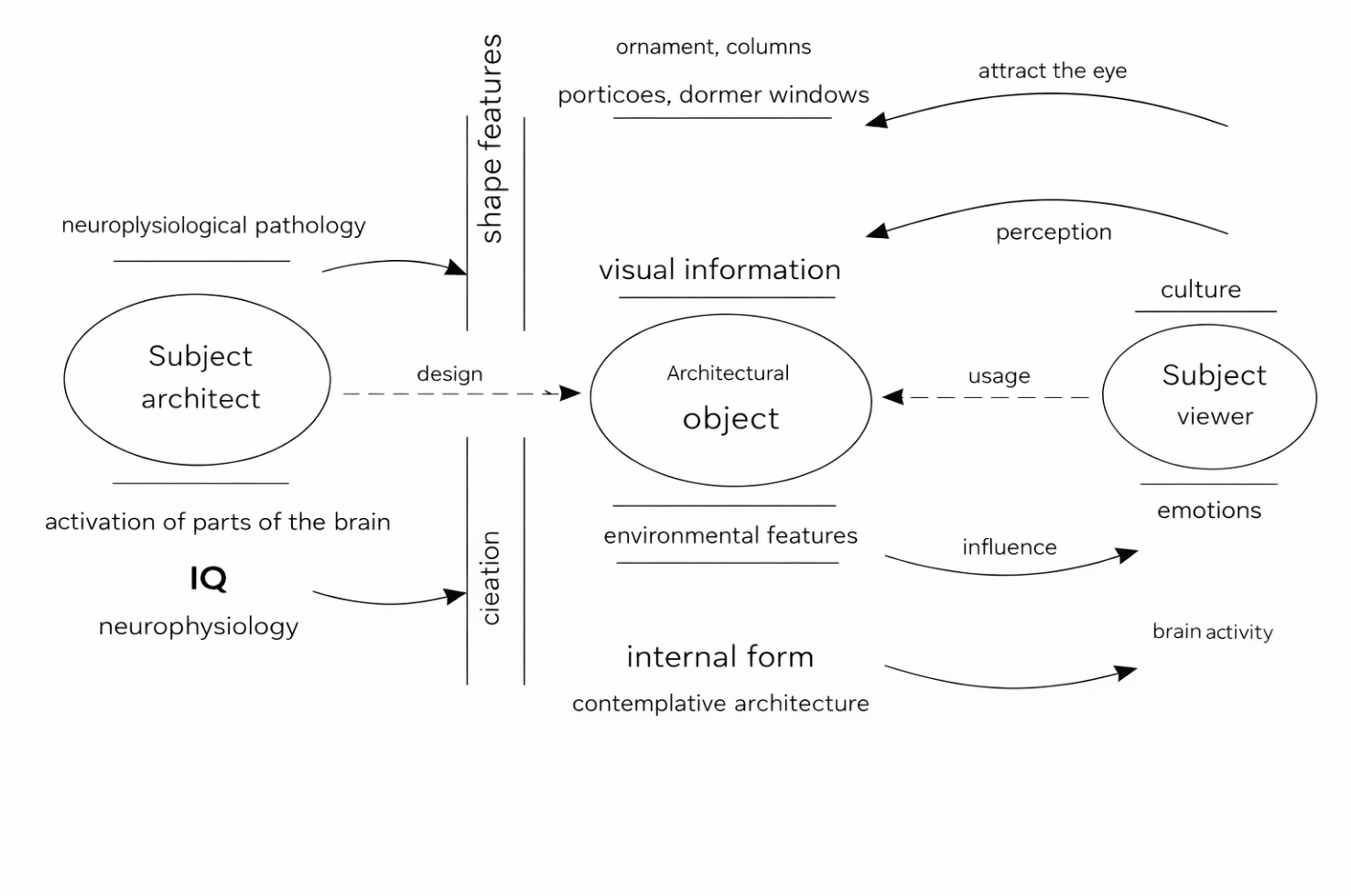
Fig. 1 – the scheme of studying architecture in relation to the human psyche [1]
In recent decades, the influence of the urban environment on the human psyche has been actively taken into account in real projects. Many cities demonstrate how thoughtful architecture can change people's behavior and emotional state.
One of the most striking examples is the Superblock district in Barcelona. Here, traffic has been moved outside residential areas, and the inner streets have turned into pedestrian spaces. As a result, noise and pollution levels have significantly decreased, and residents feel safe and in control of the environment. People began to go out more often, communicate more, and the space began to be perceived as "their own" rather than transit.
Another great example is the High Line Park in New York City, which was created on the site of a former railroad line. Its linear structure sets a calm rhythm of movement and creates a feeling of a "psychological corridor" where a person feels far from the urban chaos. Vegetation, city views, and alternating open and closed spaces help restore attention and reduce stress [2].
The concept of a "city for people" is being actively implemented in Copenhagen. Narrow streets, a variety of facades, cafes on the ground floors and many places to relax create an atmosphere of comfort and safety. The human scale of the building helps to reduce anxiety and facilitate orientation, which is especially important for everyday comfort.
Singapore's experience is interesting, where skyscrapers blend harmoniously with vertical gardens and green terraces. This integration of nature into dense urban development reduces the feeling of space congestion. Studies show that even eye contact with greenery reduces stress levels and improves concentration [3].
In Tokyo, special attention is paid to the lighting and details of the streets. Soft, uniform light and active ground floors of buildings create a sense of security, even at night. A person perceives such an environment as predictable and "alive," which helps to reduce anxiety levels.
Modern medical centers in Scandinavian countries are a prime example of how color and materials can affect the perception of space. These centers use natural textures, soft shades, and plenty of daylight. This approach helps patients feel more relaxed, promotes speedy recovery, and reduces fear of the medical situation.
It is also worth noting how pedestrian zones have developed in Paris and Milan. Reducing car traffic and installing outdoor furniture have changed people's behavior. They began to stay on the streets longer, communicate with each other more often, and the streets themselves began to be perceived not as roads, but as public spaces.
Modern examples show that the spatial environment directly affects the perception of a city through scale, light, sound, greenery, and traffic management. When all these elements are taken into account, the city is perceived as comfortable, safe, and "humane." And people's behavior becomes more calm, open, and socially oriented (Table 1).
Table 1 – The impact of the spatial environment on an individual's perception
|
No. |
The factor |
Characteristic |
|
1 |
Physical characteristics of the space |
The size, shape, lighting, and color of a room can significantly affect people's mood and behavior. For example, bright lighting can increase energy levels, while dark or too bright colors can cause discomfort. |
|
2 |
Acoustic environment |
Environmental sounds, such as the noise of the city or calm music, can have a significant impact on our concentration and emotional state. Silence, on the contrary, promotes relaxation and concentration. |
|
3 |
Social aspects |
The environment has a significant impact on the way people interact. Open spaces encourage communication and cooperation, while enclosed areas can create a sense of privacy or separation. |
|
4 |
Cultural values |
Different cultures perceive and understand space in their own way. For example, in some societies, open spaces are valued for the opportunity to communicate, while in others they prefer privacy more. |
|
5 |
Psychological effects |
Space can evoke various associations and emotions, which affects our perception. Familiar places can evoke nostalgia, while new and unusual spaces can arouse anxiety or curiosity. |
|
6 |
Architectural features |
The design of buildings and interiors also plays a significant role. Spaces designed with convenience and aesthetics in mind can improve overall well-being and increase productivity. |
It should be noted that the study of the impact of the spatial environment on human perception involves a number of significant methodological and practical difficulties, which makes it difficult to obtain unambiguous and comprehensive results.
One of the main problems is the subjectivity of perception. People react differently to the same spaces depending on their age, cultural context, personal experience, and even their current emotional state. This makes it almost impossible to create a universal model that could accurately describe the reactions of all users of the environment.
The difficulty of studying the perception of the environment is because it consists of many components. Space affects a person simultaneously through many factors: lighting, sound, scale, density, color, materials, smells, and social activity. In real conditions, it is difficult to isolate the influence of each of these elements, as they interact with each other. Laboratory studies allow you to control variables, but at the same time, the realism of perception is lost. Field research, on the other hand, suffers from the impossibility of strict control.
Another difficulty is the limited methods that are used to measure perception. Most of the data obtained with their help is based on surveys, interviews, and self-reports, which can lead to distortions. People may not always be able to accurately understand and describe exactly how space affects them. Modern techniques such as eye movement tracking, neurophysiological measurements, and behavior analysis can help, but they require sophisticated equipment and ambiguous interpretation of results.
The time factor is equally important. The perception of space changes over time as a person gets used to a new environment. What seems uncomfortable or attractive at first may be perceived differently after weeks or months. This makes it difficult to assess long-term effects and requires lengthy studies, which are rarely carried out in full.
Another problem is the difficulty of applying the research results in practice. Even if certain patterns are identified, their implementation in real projects is often limited by economic, political, and technical constraints. Architects and urban planners have to make compromises, which reduces the accuracy of scientific recommendations.
In addition, there is a cultural and geographical dependence of perception. Solutions that are effective in one country may not be suitable for others due to differences in lifestyle, population density, and social norms. This makes it difficult to create universal design principles.
Finally, the rapid development of technology and lifestyle changes are also creating new challenges. The digital environment, remote work, and virtual spaces are changing the way humans interact with their physical environment, and science is not always keeping pace with these changes.
All these difficulties show that studying the influence of the spatial environment on human perception remains a difficult interdisciplinary task. It is difficult to draw accurate and universal conclusions in this area, and research requires a combination of different methods and approaches.
We believe that an integrated and interdisciplinary approach is needed to solve problems in studying the influence of the spatial environment on humans. It should include both qualitative and quantitative methods.
First, in order to overcome the subjectivity of perception, it is necessary to increase the sample of studies and take into account the diversity of users by age, culture and social experience. Comparative studies should also be conducted in different contexts. This will make it possible to identify not universal, but typical patterns that may be applicable to specific groups.
Digital modeling and virtual reality can be effectively used to study complex environments. These technologies allow you to change individual space parameters and track a person's reaction without losing the realism of perception. In addition, factor analysis is used, which helps to identify the contribution of various environmental characteristics.
The limitations of measurement methods can be compensated by combining different data sources. Instead of relying solely on surveys, biometric metrics, motion tracking, behavior analysis, and neurophysiological methods are used. This allows you to get a more objective picture, especially if the data is compared with each other. The development of methods for interpreting these data also plays an important role.
The problem of the time factor is solved by conducting long-term studies in which perception is studied over a long period. Repeated measurements and monitoring of human adaptation to the environment are also used, which allows us to take into account the effect of habituation and identify stable perceptual features.
To improve the practical application of research results, it is necessary to strengthen the interaction between scientists, architects, and urban planners. This is achieved through the development of practical recommendations, standards, and design tools based on scientific evidence. In addition, scientists can participate in real projects at an early stage.
Cultural conditioning of perception is taken into account through local research and adaptation of solutions to a specific social and geographical context. Instead of universal models, flexible principles are being formed that allow for variability.
Finally, in the context of technological change, it is essential to integrate the study of the physical and digital environments, considering them as an interconnected system. This approach allows us to better understand the impact of hybrid spaces and new modes of human interaction with our surroundings.
Conclusions. The spatial environment surrounding a person significantly impacts perception, behavior, and emotional state. Urban space serves not only as a functional shell but also as an important psychological factor, forming a sense of comfort, security, identity, and social engagement. The quality of architectural solutions, construction scale, presence of natural elements, and the level of visual and sensory stress directly affect cognitive processes and a person's general well-being.
Modern urban planning requires considering these aspects at all design stages. Interdisciplinary research and user behavior data are used for this purpose. Implementing architectural psychology principles allows for creating more sustainable, humane, and adaptive urban spaces aimed not only at economic efficiency but also at improving the population's quality of life.
References:
- Vinogradova E.I., Kilimnik E.V. Analysis of architectural and psychological studies of the late 20th - early 21st centuries // Artikult. – No. 3 (39). – 2020. – pp. 137-148.
- Rakov A.P., Tankeev P.V. Urban planning and architecture // Urban planning and architecture Founders: Samara State Technical University. – 2023. – Vol. 13. – No. 4. – pp. 171-176.
- Nasar J.L. Environmental psychology and urban design // Companion to urban design. – Routledge, 2011. – pp. 162-174.
- Shojazadeh H.R., Kazemi M., Shafizadeh A.A. Environmental psychology in architecture and urban design // Research Journal of Recent Sciences, ISSN. – 2014. – Vol. 2277. – p. 2502.
Other articles of the issue