

The use of modular systems and the possibility of customization in modern furniture design
Authors
Tojiboev Jakhongir
Share
Annotation
This article discusses the use of modular systems and customization in modern furniture design. This topic is especially relevant in light of the growing demands on functionality, flexibility, individuality and environmental sustainability of the subject environment. The article reveals the key concepts of modularity and customization, as well as their interrelationships and differences in the structure of modern furniture design. Special attention is paid to the specifics of the use of modular systems in residential, public and work interiors, as well as the role of customization as a tool for individualizing furniture design. The article demonstrates that modular systems open up wide possibilities for the variability of composition, ease of transformation and prolongation of the service life of furniture. At the same time, customization allows you to take into account the individual needs of users within a standardized design system. The paper also substantiates that the modern development of furniture design is inextricably linked with the deepening of a systematic approach, digitalization of the design process, increased versatility and focus on the principles of sustainable consumption. Based on this, it is concluded that modular systems and customization are key areas for the development of modern furniture design, contributing to the creation of a flexible, adaptive and individualized subject environment.
Keywords
Authors
Tojiboev Jakhongir
Share
Relevance of the study
The relevance of the research is because modern furniture design is developing in the context of growing demands for functionality, flexibility, customization and environmental sustainability. According to the UN, the proportion of the world's urban population continues to increase and could reach 68% by 2050. This leads to an increase in demand for more efficient use of living space and, as a result, for furniture that can adapt to changing operating conditions. In this regard, modular systems are becoming especially important, as they allow you to vary the configuration of products, transform the space and increase the functionality of the interior.
This topic is becoming particularly relevant due to changes in consumer preferences in the furniture market. The global furniture market is showing steady growth driven by the demand for modular, environmentally friendly and technologically integrated solutions. This indicates that modularity is becoming one of the key areas of industry development. At the same time, there is a growing interest in personalized products and consumption scenarios. Consumers tend not only to get a standard piece of furniture, but also a solution that will take into account the specifics of their space, lifestyle and aesthetic preferences. Thus, customization in modern furniture design goes beyond a simple marketing option and becomes an important design principle contributing to the individualization of the environment and increasing the consumer value of the product.
The environmental aspect is equally important. Modern European materials on the development of the furniture industry emphasize that the transition to a circular economy is closely related to design at the design stage. This includes extending the life of the product, the possibility of its repair and reuse, as well as modular construction. Thus, the study of modular systems in combination with customization becomes relevant not only from an aesthetic and functional point of view, but also from an industrial, economic and environmental point of view.
Thus, the topic of using modular systems and the possibility of customization in modern furniture design is very relevant. It reflects the main trends in the development of the furniture industry and responds to the needs of society in an adaptive, personalized and environmentally friendly subject environment.
The purpose of the study
The purpose of this study is to analyze the specifics of using modular systems and the possibility of customization in modern furniture design. In addition, we intend to evaluate their contribution to the formation of a dynamic, functional, individualized and long-term subject environment.
Materials and research methods
The research is based on scientific publications and analytical materials on modern furniture design. Special attention is paid to the topics of modular design, customization, and digitalization of design and sustainable development of the subject environment.
The research methodology includes an analysis of scientific literature, a comparison of different approaches to understanding modularity and customization, as well as a generalization of theoretical provisions and a systematization of features and trends characteristic of modern furniture design.
The results of the study
In modern furniture design, a modular system is a method of creating products from individual unified elements that can be combined in various ways. This approach allows you to look at furniture not as a static object, but as a flexible structure that can adapt to different conditions of use. The modular system opens up wide possibilities for creating a variety of compositions, simplifies the process of rebuilding and allows you to change the configuration of furniture without having to completely replace the entire product.
In furniture design, customization means that the individual needs of users are taken into account. It includes the ability to select sizes, materials, colors, finishes and composition of the product within a pre-prepared system. Thus, the user becomes an active participant in the process of creating furniture, and it becomes more personal. In modern practice, customization is closely related to the principles of mass production, when individual characteristics are combined with technological standardization.
Modularity and customization are inextricably linked, but they are not the same thing. Modularity refers to the constructive organization of a product, while customization shows how well it is adapted to a specific user. Most often, the modular structure serves as the basis for customization, since the elements are compatible with each other, the dimensions are repeated, and the connection system is carefully thought out. This allows you to create a variety of options based on a single design [1, p. 3].
From a theoretical point of view, the key principles of modular design are standardization, compatibility of elements, the possibility of transformation, ease of assembly and disassembly, as well as the possibility of replacing individual parts. These qualities ensure the durability of the product and significantly expand its functionality. In modern approaches, modularity is considered not only as an artistic device, but also as a way to extend the life cycle of furniture.
With the development of digital technologies, customization takes on new facets. Configurators and planners provide users with the ability to select product parameters and visualize future results. Due to this, customization becomes an integral part of system design, and not just an individual order [5, p. 29].
Modular systems play an important role in modern furniture design, allowing flexible space organization. Their practicality lies in the fact that furniture is created not as a single, unchanging object, but as a set of compatible elements that can be combined in various ways. This allows you to use the same set of components to create different spatial and functional scenarios. Table 1 shows the main characteristics of the use of modular systems in modern furniture design.
Table 1
Features of the use of modular systems in modern furniture design
|
Application Feature |
Brief description |
Significance for furniture design |
|
Flexible space organization |
Modular systems open up wide possibilities for creativity and allow you to create a variety of compositions from individual elements, adapting them to the specifics of the room and the conditions of use. |
Provides furniture adaptation to different spatial and functional tasks. |
|
Application in residential and public interiors |
Modular furniture is used in residential, office and public spaces where reconfiguration and rational organization of the environment are required. |
Increases the versatility of furniture and expands the scope of its application. |
|
Combining multiple functions |
The same object can serve different purposes: to place, store, and zone space. |
Increases the practical value of furniture and makes the interior more comfortable. |
|
Adapting to user needs |
Modular furniture makes it easy to adapt its composition and structure to your individual needs. |
Enhances the design's focus on convenience and customization of the environment. |
|
Convenience of updating |
Individual parts can be replaced, added, or rebuilt without replacing the entire product. |
Promotes longer-term use of furniture and its practical flexibility. |
|
Compliance with modern design requirements |
Modular systems meet the requirements of functionality, flexibility and convenience. |
It makes such solutions in demand in modern design practice. |
A source: author's development
In modern furniture design, customization is seen as a way to make standard production more flexible and tailored to the individual needs of users. In the scientific literature, mass customization is defined as the process of adapting a product to diverse and unique customer requirements using flexible manufacturing technologies and configurators. This is especially important in furniture design, as furniture is closely related to the parameters of the room, lifestyle, storage scenarios, ergonomics and visual preferences of each person. Therefore, customization becomes not just an additional option, but one of the key mechanisms for individualizing the subject environment (see figure).
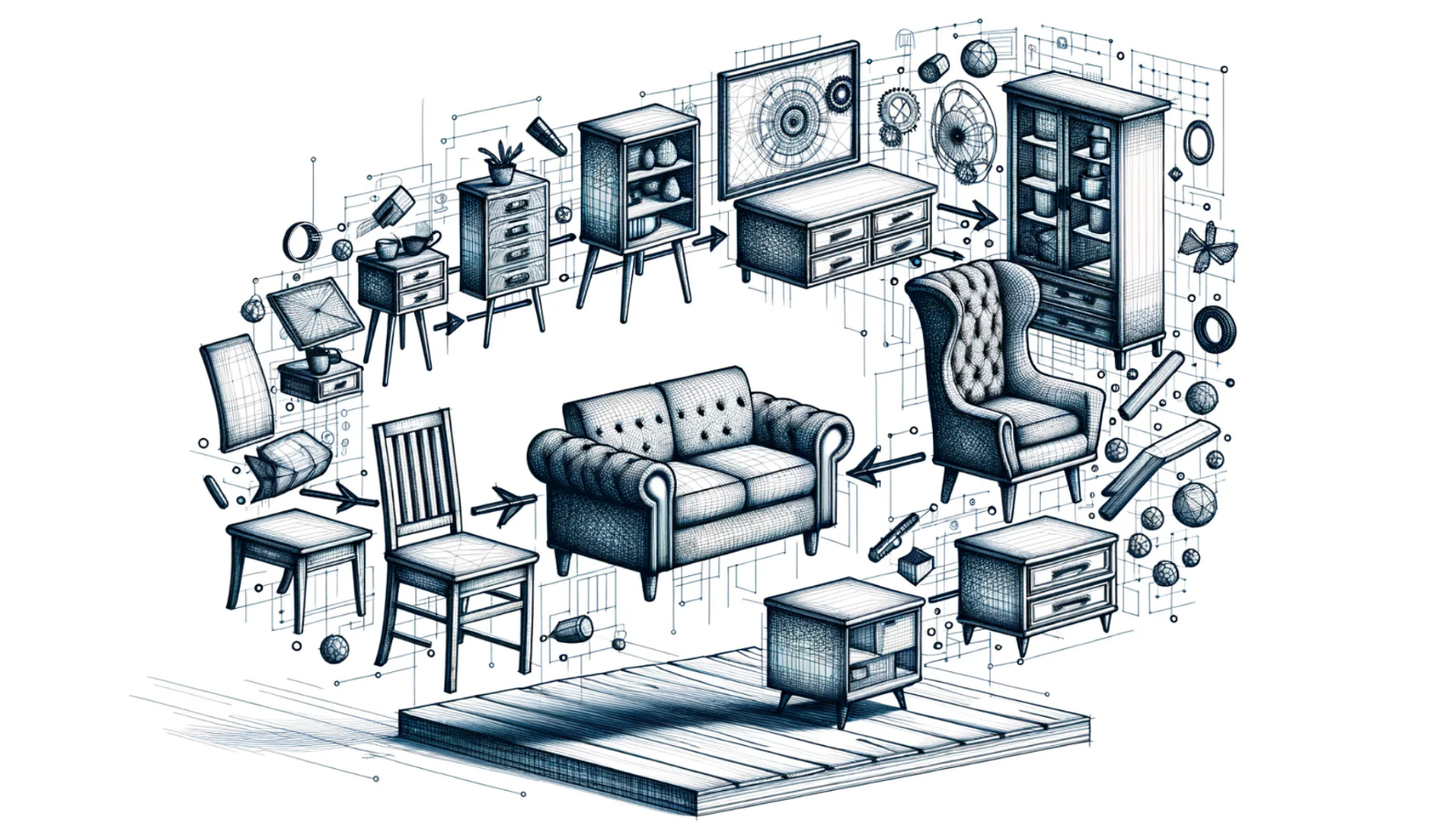
Fig. Visualization of the variety of shapes and customization options in modern furniture design
Customization in furniture design implies the possibility of choosing individual product characteristics. It can be size, shape, material, color, finish, and interior layout, type of fittings and composition of functional elements. Customization differs from a fully authored single design in that an individual version is created within a predefined parameter system. This allows you to combine industrial repeatability with personal customization of the product to meet the user's needs. Research on design for mass customization emphasizes that such a model is based on an open product platform and a variety of acceptable design options.
Furniture customization as a factor of individualization is changing the approach to design. In the traditional model, the designer created furniture, focusing on the average consumer. However, in customization, the focus is shifting to taking into account user data and specific operating conditions. This means that instead of designing a standard item, we are moving on to creating a selection system in which changeable product parameters and restrictions on their combinations are preset. As a result, the consumer becomes an active participant in the final decision-making process. Customization is carried out not after the design is completed, but already at the stage of product architecture development.
Digital technologies play an important role in the development of customization. In modern research of the furniture industry, it is noted that individualized production is inextricably linked to the integration of digital control systems, production planning and data transfer between the design and manufacturing stages. For the furniture industry, this means that it is now possible to more accurately take into account the parameters of each order, coordinate changes faster and produce products with unique characteristics within the industrial process. Thus, digitalization makes customization not only a design phenomenon, but also a technological one.
Customization is of particular importance for modern furniture design, as it significantly increases the user value of the product. Research in the field of personalized manufacturing demonstrates that customers are happy to choose the opportunity to customize the product parameters themselves. This is due to a feeling of greater control over the result and a more accurate compliance of the product with personal expectations. In the field of furniture, this effect is particularly pronounced, since furniture has been used for a long time and is closely related to a person's daily experience. Thus, customization not only improves the functionality of furniture, but also significantly increases its subjective significance for the user.
Customization is of particular importance in the context of sustainable consumption. When a product meets the user's real needs as much as possible, it is less likely to be quickly replaced due to inconvenience, inconsistency in the size of the room or insufficient functionality. Modern research in the furniture industry devoted to the circular economy highlights the importance of design solutions that extend the life of a product, simplify its renewal and make it more suitable for long-term use. In this context, customization can be considered as a factor of more responsible design, since individually selected furniture potentially retains its value for the owner longer [2, p. 104].
The main manifestations of customization as a tool for individualizing furniture design are summarized in Table 2.
Table 2
Manifestations of customization as a factor of furniture design individualization
|
Aspect |
Content |
Importance for furniture design |
|
Selecting product parameters |
The user can make changes to the dimensions, materials, color, finish and composition of the elements within a given system. |
The furniture becomes more suitable for a particular interior and takes into account individual preferences. |
|
User participation |
The consumer is involved in the formation of the final product version through the selection of acceptable characteristics. |
Individualization is achieved already at the design decision stage. |
|
Digital support |
Customization is carried out using configurators, digital planning, and combining design and production data. |
Order approval is accelerated and the production of customized furniture is simplified. |
|
Connection with industrial production |
Customized solutions are created based on a standardized product architecture. |
Serial production and personal customization of the product are combined. |
|
Functional accuracy |
The product more accurately meets the operating conditions, the size of the space and household scenarios. |
The practical suitability of furniture increases. |
|
Sustainability of use |
A more complete product compliance with user expectations contributes to its longer service life. |
The connection of design with the principles of responsible consumption is being strengthened. |
A source: author's development
Modern trends in furniture design demonstrate that modular systems and customization are increasingly becoming interrelated areas of design. The focus is not just on creating a separate piece of furniture, but on developing an integrated system that can adapt to different conditions of use, space features, and user requests. This indicates the transition from static solutions to more flexible and dynamic forms of organization of the subject environment [4, p. 88].
One of the main trends in furniture design is the strengthening of a systematic approach to design. Increasingly, modularity is the basis for furniture creation – the ability to change, complement, rebuild and use furniture in various functional scenarios. At the same time, customization is actively used in furniture design – the ability to take into account the individual preferences of users within the framework of a pre-planned design. As a result, modern furniture design combines both standardization and variability, allowing you to create unique and functional solutions.
Digitalization plays an important role in the project process. The use of digital models, configurators, and parametric tools significantly expands the possibilities of customizing furniture, as well as making the design process more precise and controlled. Due to this, customization becomes not just a separate service, but an integral part of the overall system for the development and production of furniture solutions.
Another important trend is the combination of modularity and customization with the principles of sustainable design. In the modern world, furniture is increasingly being designed with the possibility of updating, replacing individual elements, disassembly and long-term use. This makes modular and customizable solutions not only more practical, but also extend the life cycle of the product [3, p. 568].
In addition, the importance of multifunctional furniture is increasing. In the context of an ever-changing lifestyle, furniture must solve several tasks simultaneously, quickly adapt to different situations and ensure a rational organization of space. That is why modular systems and customization are becoming key tools for creating a flexible, user-friendly and modern subject environment.
Conclusions
Thus, modular systems and customization play a key role in modern furniture design, being complementary areas of design. Modular systems provide flexibility of composition, versatility, ease of updating and adaptation of furniture to various spatial conditions. In turn, customization makes furniture design more individual, allowing you to take into account the specific needs of the user, the parameters of the space and the features of the product operation. The study revealed that modern furniture design is developing towards a combination of standardization and variability. The active use of digital tools allows you to create furniture that is not only beautiful, but also useful in everyday life, and prolongs its service life.
Thus, the use of modular systems and the possibility of customization should be considered one of the key factors contributing to the creation of a modern, adaptive, convenient and durable subject environment.
References:
References
- Vapnyarskaya O.I. Genesis and modern approaches to defining customization // Service in Russia and abroad. – 2014. – pp. 1-13.
- Dyachkova M.S. The essence of the concept of "customization" // Theory and practice of modern science. – No. 3 (57). – 2020. – pp. 103-107.
- Komarov S.A. Modern trends and innovations in furniture production: market analysis and development prospects // Innovations and investments. – 2023. – No. 11. – pp. 567-570.
- Obednina S.V., Bystrova T.Yu. Modular principle of form formation in design // Academic Bulletin of the UralNIIproekt RAASN. – 2013. – pp. 85-90.
- Ovchinnikova D.N., Nekrasova E.A. Personalization and customization of the interface as ways to engage and retain users // Young scientist. – 2025. – No. 19 (570). – pp. 29-30.
Other articles of the issue