

The effect of nail extensions on the health of the nail plate: damage mechanisms and prevention methods
Authors
Saduova Tolkyn

Share
Annotation
This article examines in detail the effect of various nail extension techniques on the condition of the natural nail plate. Attention is paid to both chemical and mechanical factors that can harm the nail. The processes occurring with the nail under the influence of primers, monomers, gels and acrylates, as well as the effects of prolonged wearing of artificial coatings, are analyzed. Special attention is paid to changes in the structure of keratin, dehydration of the nail, thinning and delamination of the plate, impaired microcirculation and possible fungal complications that may occur if proper working techniques are not followed. The article provides up-to-date data on the causes of nail damage during sawdust, aggressive preparation of the nail plate, and the use of non-sterile tools. In addition, the authors propose scientifically based prevention methods gentle nail preparation techniques; selection of hypoallergenic materials; proper nail care between treatments; determination of optimal correction intervals; and ways to restore nails after removing artificial coating.
Keywords
Authors
Saduova Tolkyn
Share
Relevance of the study. With the increasing popularity of nail extension and strengthening procedures, more and more people are faced with damage to the nail plate of varying degrees. Although modeling techniques such as gel, acrylic, and polygel extensions have become very common, the potential health risks of natural nails remain unnoticed by both beauty industry professionals and clients.
Chemicals contained in nail extension materials, as well as mechanical effects during coating removal, ultraviolet radiation, non-compliance with safety regulations and insufficient qualifications of artisans can cause thinning of the nail plate, matrix injuries, allergic reactions and the development of microbial complications. The relevance of the study is due to an increase in the number of complaints about the deterioration of nails after regular use of artificial coatings, as well as the lack of systematic data on the mechanisms of their damage and effective preventive measures.
The purpose of the study. To investigate the main causes of damage to natural nails with various extension methods and develop the most effective prevention methods to minimize the risk of structural, chemical and biomechanical changes in the nail plate.
Materials and research methods. The study used modern scientific publications on dermatology, cosmetology and materials science, as well as the results of practical observations of nail service masters. The methodology of the work included a comparative analysis of the chemical composition of gel, acrylic and polygel systems. Their effect on the keratin structure and the level of dehydration of the nail plate was evaluated. In addition, mechanical aspects were considered: the degree of abrasive action during sawdust, the effect of hardware manicure, the features of surface preparation and coating removal.
The study used methods of visual analysis of the condition of nails both before and after prolonged wearing of artificial materials. In addition, the frequency of allergic and microbial complications was analyzed. Preventive technologies such as gentle treatment methods, hypoallergenic materials, optimization of the correction regime and recommendations for nail restoration were also studied.
The results of the study. The history of studying the effect of artificial coatings on natural nails is closely related to the development of the modeling industry, which originated in the middle of the XX century.
The first steps towards artificial nail lengthening were taken in the 1950s and 1960s, when beauty artists began using dental acrylates. At that time, the main attention of scientists was focused on the chemical composition of materials, since acrylic monomers often caused severe allergic reactions and skin irritation. This prompted dermatologists to study for the first time the systemic effects of monomers such as methyl methacrylate on the nail plate and surrounding tissues.
In the 1970s and 1980s, with the expansion of the use of acrylic nails, research began to focus on mechanical damage: thinning of the nail, violation of the surface layer of keratin, increased fragility and the risk of infection. Dermatologists began to notice that some people's nails peel off after using such products, chemical burns and fungal infections occur. In this regard, the first restrictions were imposed on the use of the most aggressive components.
In the 1990s, new gel technologies emerged, which led to a surge in scientific research. The attention of scientists has shifted to the study of photoinitiators, the interaction of gels with ultraviolet radiation and the effects of dehydration of the nail during the preparation of its surface. Potential allergens were identified among the components of gels and photo-cured systems, and the effect of overheating during polymerization on the structure of the nail matrix was investigated. During this period, the first systematic reviews appeared on microbiological complications that can occur due to improper application and removal of coatings [2].
Since the 2000s, research has become more multifaceted. Scientists have begun to study the biomechanical properties of the nail plate, its reaction to prolonged wearing of coatings and the changes that occur during regular extension and removal procedures. Special attention was paid to the issues of sanitary and hygienic safety, sterilization of instruments and prevention of microbiological risks. A comparison was made of various modeling methods — acrylic, gel and biogel — in terms of their effect on the keratin structure.
In recent decades, the focus has been on damage prevention, the development of hypoallergenic materials and the creation of gentle technologies for the preparation of the nail plate. Research has begun to take into account not only chemical and mechanical factors, but also the individual characteristics of the nail plate, as well as the professional skills of the artisans and the impact of improper self-care (Fig. 1).
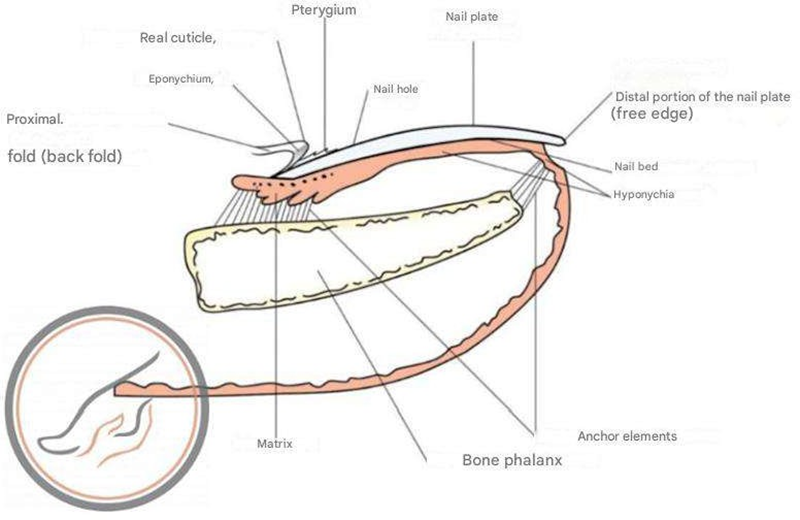
Fig. 1 – Diagram of the nail structure
Modern research reveals a complex mechanism of negative effects on nails, starting with microcracks, thinning, and ending with immune reactions and deterioration of regeneration. Due to this, scientifically based prevention methods have been developed, which include minimizing sawdust, using safe formulations, and following optimal correction regimens.
This gave rise to a modern scientific basis that allows us to understand how various nail extension technologies affect the condition of nails and what measures can minimize the risk of damage while maintaining an aesthetic appearance [1].
It is important to note that modern scientific research and clinical observations indicate that prolonged wearing of acrylic, gel and polygel systems can lead to damage to the nail plate. This occurs under the influence of a combination of chemical, mechanical and microbiological factors. One of the most common examples is thinning of the nail after repeated extension and removal, especially if the sawdust process was aggressive. Regular grinding of the nail surface leads to damage to the keratin layers, which reduces the strength and makes it more vulnerable to delamination [3]. In practice, dermatologists often encounter cases when, after 6-12 months of continuous wearing of artificial nails, clients encounter increased fragility, soreness and slow plate growth. This may be due to microtrauma of the matrix (Table 1).
Table 1 – The effect of nail extensions on the health of the nail plate
|
№ |
Positive impact |
Negative impact |
|
1 |
The aesthetic side The extended nails look very neat and can be decorated with a variety of designs. |
Damage to natural nails The process of removing nail extensions can damage the top layer of the natural nail plate. |
|
2 |
Protection Extensions can become a reliable barrier that protects your natural nails from mechanical damage and breakage. |
Infections Improper application or removal of nail polish can lead to the penetration of bacteria or fungi under the nail plate. |
|
3 |
Alignment and strengthening of the nail plate Nail extensions allow you to give them the desired shape, strengthen the structure and prevent possible deformations that may occur due to mechanical stress. |
Allergic reactions Some of the materials used for extensions can cause allergic reactions or skin irritation. |
|
4 |
Support during the recovery period after illnesses After hypovitaminosis, hormonal changes or long-term diseases, nails can become very brittle. Artificial material not only facilitates the rehabilitation process, but also prevents new injuries. |
Chemicals The gels, acrylics and other substances used in the build-up process can be toxic with prolonged exposure. |
Another modern example is allergic contact dermatitis, which occurs due to unpolymerized monomers found in gels and acrylics. In recent years, the number of complaints related to allergies to acrylates such as HEMA and di-HEMA has increased significantly. Clients complain of itching and redness of the skin around the nails, and in more severe cases, peeling of the nail plate. It has been proven that such reactions most often occur when using low-quality materials or when the polymerization mode in the lamp is incorrect. As a result, some of the monomers remain active and penetrate the skin, causing irritation and inflammation.
Currently, a common type of nail damage is "green nail", a bacterial infection caused by Pseudomonas aeruginosa. It occurs when a moist, airtight cavity forms between an artificial material and a natural nail, creating ideal conditions for bacterial growth. Such problems often arise due to violations in modeling techniques, too rare corrections, or when clients try to fix a broken nail on their own. In such cases, the nails acquire a characteristic greenish tint, and without timely treatment, the infection can penetrate deeper into the nail bed.
Mechanical damage includes detachments, cracks, and deformations of the nail plate, which can occur due to nails that are too long or incorrectly modeled. Recently, traumatologists and dermatologists have increasingly encountered situations where excessive length or unsuccessful modeling of an artificial nail leads to the separation of the natural nail upon impact. This can cause severe pain, bleeding, and prolonged disruption of nail plate growth.
Modern prevention methods are aimed at minimizing these risks. One of the key approaches is the gentle preparation of the nail plate, without aggressive cutting. For clients with sensitive skin, it is recommended to use hypoallergenic formulations without HEMA. It is also important to strictly observe polymerization modes and use lamps of sufficient power to avoid the presence of unpolymerized monomers. From the point of view of hygiene, prevention includes thorough antiseptic treatment of nails before applying the material and mandatory corrections every 3-4 weeks. This prevents the formation of pockets where bacteria can multiply.
In addition, experts advise clients to take breaks between extensions, use nourishing cuticle oils, as well as strengthening agents based on keratin or biotin. It is important to avoid removing the coating yourself, as this can lead to injury to the nail plate. These measures will help significantly reduce the risk of damage and maintain the health of natural nails, even with frequent use of artificial coatings.
However, it is worth noting that in modern practice, nail extensions are often accompanied by some problems. They can be related to both materials and technology violations.
One of the most common problems is the thinning and weakening of the nail plate. This is due to regular aggressive sawdust, which disrupts the upper keratin layers of the nail and makes it more brittle and painful.
Another common problem is allergic contact dermatitis, which can be caused by acrylates in gels and acrylic formulations. This is especially common when using products with HEMA and when there is insufficient polymerization in the lamp. Clients may experience itching, redness, burning, and even detachment of the nail plate. In recent years, this problem has become more common.
A bacterial lesion known as a "green nail" represents a separate category of problems. It occurs due to the formation of air pockets between the natural nail and the artificial coating, which creates favorable conditions for the reproduction of Pseudomonas aeruginosa. The main causes of problems are poor preparation of the plate, non-compliance with the technology of applying the material, peeling, increased humidity and contact with water without the use of protective equipment, as well as insufficient sterility of instruments. Gradually, the bacterial colony spreads under the coating, weakening the structure of the nail. This can lead to its delamination, brittleness and prolonged recovery after removal of the affected area.
For prevention, it is important to thoroughly degrease and dry nails, use materials with good adhesion, completely remove detachments, keep clean and avoid contact with water after the procedure. If a green spot appears on the nail, the coating must be removed to ensure that the nail is dry. Then you should consult a specialist who will assess the extent of the lesion and give recommendations on proper nail care.
An equally serious problem is mechanical damage: detachment, cracks, deformations and partial separation of the natural nail. These phenomena are especially common with long artificial nails, irregular architecture, or shock loads. The situation is aggravated by non-compliance with sanitary standards, the use of substandard materials, irregular corrections and self-removal of the coating. All this significantly increases the risk of injury and infection.
We are convinced that effective elimination of the negative consequences that may occur after nail extensions is possible only with an integrated approach. This approach should include proper technique, choice of safe materials, and proper care.
To prevent thinning and weakening of the nail plate, it is important to minimize aggressive sawdust. To do this, work at low milling speeds and remove the old coating in layers without affecting the artificial material. The use of soft buffs and the refusal to completely wear off the upper keratin layers will help maintain the strength of natural nails and avoid painful sensations.
It is important to choose high-quality materials with a minimum content of HEMA and other aggressive monomers, as they often cause allergic contact dermatitis. Careful polymerization in a lamp of sufficient power reduces the risk of gel not leaking, which can cause burning and allergic reactions.
To avoid bacterial complications, it is necessary to ensure complete adhesion of the material to the nail plate, eliminating the formation of air bubbles. The master must strictly observe all sanitary standards, disinfect tools and carefully prepare the nail plate for coating, avoiding waterlogging and dust formation. If a green spot does appear, the artificial material should be completely removed, treated with an antiseptic and given time to recover until the natural color returns completely.
Mechanical damage can be prevented if the artificial nail architecture is done correctly, the optimal length is chosen, and recommendations for hand loads are followed. In case of cracks or peeling, it is important to contact the master in a timely manner, rather than trying to remove the coating yourself, so as not to damage the natural nail.
An important aspect of prevention is the proper removal of the coating. It is recommended to carry out the procedure under the supervision of a master using a milling cutter or special liquids, as self-removal can lead to injury to the nail plate. If signs of damage appear, it is recommended to take breaks between procedures. Firming oils and creams containing vitamin E and nutritional components will help speed up the restoration of the nail plate. If all these measures are followed, the risks can be significantly reduced and the nails can remain healthy even with frequent extensions.
Conclusions. The health of natural nails with regular extensions directly depends on following the correct technique of the procedure, using safe materials and ensuring proper care. Most problems, such as plate thinning, allergic reactions, detachment, or bacterial complications, are not the inevitable consequences of build-up, but arise from violations of technology or improper handling of the coating.
With the work of an experienced artisan, the use of high-quality materials and careful attitude towards the client, nail extensions remain a safe and comfortable procedure. It is important to remember that prevention is always better than treatment, so regular corrections; careful removal of coating and supportive home care will help keep your nails strong and healthy even with prolonged wearing of artificial material.
References:
- Birzhankyzy B. I. Modern practice of using innovative technologies in nail strengthening // Current research. - 2022. - No. 36 (115).
- Kondalova I. A., Kushnaryova M. A. On the problem of nail extensions // Advances in modern natural science. - 2013. - No. 9. - p. 49-49.
- Dinani N., George S. Nail cosmetics: a dermatological perspective // Clinical and experimental dermatology. - 2019. - Vol. 44. - No. 6. - pp. 599-605.
Other articles of the issue