

Risk analysis in the field of international furniture trade: how to minimize losses when interacting with China
Authors
Bykov Pavel
Share
Annotation
The article presents a systematic analysis of the risks faced by companies engaged in the international furniture trade when working with suppliers from China. In addition, the authors evaluate the economic effectiveness of measures aimed at reducing losses. The study revealed that the main causes of damage are related to different shipping times and container downtime, as well as non-compliance of materials and packaging with the requirements of importing countries. In addition, the losses are affected by fluctuations in transportation rates and exchange rates. A quantitative model of expected losses was created based on open data such as reliability of schedules, rate indices, downtime tariffs, and foreign trade statistics for the furniture product group. This made it possible to compare the options before and after the implementation of the proposed measures. Practical recommendations include clarification of the terms of delivery and the responsibilities of the parties in the contract, multi-stage quality control and packaging testing, early booking and downtime management, insurance coverage and settlement coordination. The results showed that the risk-based organization of processes makes it possible to reduce unscheduled costs, stabilize deadlines and increase the predictability of the importer's margin
Keywords
Authors
Bykov Pavel
Share
Relevance of the study
International furniture trade is characterized by a high degree of uncertainty, and China remains a key manufacturing center and source of supply for many countries. Long chains, which include steps from the production of raw materials and components to assembly, international transportation and domestic distribution, are vulnerable to failures at each stage. Problems can arise at any of them: from disruptions of the production schedule and fluctuations in quality to congestion of the port infrastructure, container downtime, delays at customs and discrepancies between the planned and actual delivery time. In addition, trade is affected by fluctuations in exchange rates, changes in customs, tariff and non-tariff requirements, as well as stricter standards on material safety and emissions of harmful substances, as well as labeling and packaging requirements.
The risks associated with furniture production increase significantly due to the large size of the products, increased requirements for packaging strength, as well as a large number of visible defects and significant return costs. In addition, vulnerabilities arise when choosing the terms of delivery according to the rules of Incoterms, the distribution of responsibility between the parties, the structure of prepayment and guarantees, as well as when working with contract production under someone else's trademark and individual developments. Experience shows that without systematic risk management, which includes checking the integrity of counterparties, fixing quality indicators and deadlines in the contract, multi-stage inspections, as well as insurance protection of cargo and civil liability, companies face loss of margins, increased inventory and disrupted sales.
Under these conditions, a scientifically based risk analysis and an economically verified set of measures to reduce them (from the choice of delivery terms and payment scheme to standardization of quality, packaging engineering and digital control of cargo movement) becomes an essential element of importers' competitiveness.
The purpose of the study
The purpose of this study is to identify and assess the main risks associated with importing furniture from China, as well as to propose cost-effective ways to minimize them based on open data.
Materials and research methods
Information base: we have at our disposal the official statistics of foreign trade in the furniture product group. We also have public indexes of container shipping rates, indicators of reliability of shipping line schedules, and open tariffs for downtime and storage. In addition, we carefully study the regulations of importing countries regarding the safety of materials, labeling and packaging, as well as contractual documentation and quality inspection protocols.
Risk analysis methods: risk register and "probability – impact" matrix, scenario analysis ("basic" and "intense"), modeling of expected losses from events such as "delay", "downtime", "damage", "rise in price", sensitivity analysis, comparison of "before" and "after" options, taking into account the costs of implementing measures, performance monitoring based on key indicators.
The results of the study
Risk management in the furniture trade is based on standard methods aimed at identifying, assessing and accounting for possible uncertainties at all stages — from the conclusion of contracts to after-sales service. The methodology is based on the international standard ISO 31000. He defines risk as "the impact of uncertainty on the achievement of goals." The standard establishes the principles of integrating risk management into organizational processes, consistency, consideration of the human factor and continuous improvement [3].
China's production and logistics infrastructure is concentrated around large industrial centers and seaports, which determines the regularity and predictability of furniture supplies. According to the statistics of foreign trade operations for the group of 94, China occupies a leading position in the export of furniture and related products. The concentration of cargo flows around several port agglomerations makes the timing and cost of deliveries dependent on the capacity of these hubs. In 2023, the port of Shanghai handled about 49 million standard containers (twenty-foot equivalents, TEU), retaining the first place in the world. The port of Ningbo-Zhoushan reported 35.3 million TEU for the same year, which indicates the reliability of the eastern corridor for the export of finished products [5].
To clearly demonstrate the scale and structure of container traffic along China's main sea routes, let's turn to comparable data for 2023. Comparing ports allows us to link furniture shipment planning to their actual capacity and assess the likelihood of seasonal terminal congestion. The figure below shows the container turnover volumes of China's largest ports.
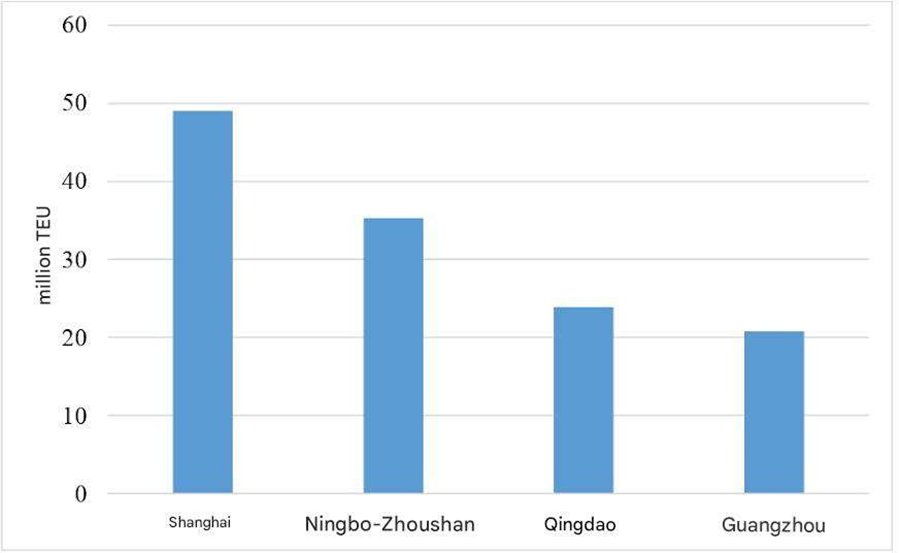
Fig. Container turnover of Chinese ports in 2023 (million TEU) [5]
For the production of wooden furniture in China, it is important to comply with national requirements for the content of formaldehyde and take into account the requirements of importing countries. The basic restrictions are set out in the mandatory GB 18580-2017 standard "Materials for interior decoration — limits for the release of formaldehyde from wood slabs and products made from them." In 2026, it will be replaced by a new version — GB 18580-2025. There is also a classification standard GB/T 39600-2021, which divides products into classes E1, E0 and ENF depending on the level of formaldehyde release. For export shipments of furniture, it is important to specify the required class, test method and laboratory protocols in the specifications. Failure to comply with these conditions can lead to delays, additional inspections, and even denial of market access [1].
To the specifics of working with Chinese suppliers, we can add problems related to the efficiency of ports and land logistics. The Port Efficiency Index shows that differences in the processing speed of ships and containers at large hubs directly affect the variability of the actual delivery time and the amount of downtime. For furniture loads, which are usually sensitive to shock and humidity, even minor delays can increase the risk of damage. This requires additional measures, such as strengthening packaging, testing transport strength standards, installing impact and humidity sensors, expanding insurance coverage, and choosing routes with more predictable handling.
In transactions with Chinese factories and traders, it is important to pay special attention to the terms of delivery and payment methods. In China, documentary letters of credit and other non-cash forms of payments are widely used, which allow you to synchronize payments with the submission of transportation and inspection documents. For furniture importers, this means that they must take into account transportation and insurance controls, the availability of consolidation sites, shipping schedules, and the capacity of the selected port to ensure timely delivery of their goods.
In order to quantify the risks associated with international furniture trade, it is necessary to take into account both verifiable market data and the factors described in regulatory documents. These factors affect the timing, cost, and safety of cargo. The key inputs for the simulation are the reliability of shipping line schedules, freight rate dynamics, and downtime at transport network nodes, currency volatility, and regulatory requirements of countries where furniture is imported.
In order to assess time risks in monetary terms, in practice, the expected value of losses is used. It is calculated as the product of the probability of occurrence of an event and the amount of damage, which can be measured in days of delay or in the currency of the contract. Officially published freight rate indexes are used as the initial data for the assessment. For example, as of June 20, 2024, the composite global container transportation index was $5,117 per forty-foot container, which is significantly higher than the average pre-crisis values. On November 6, 2025, the spot rate for the Shanghai-Rotterdam route was estimated at $1,962 per forty-foot container. At the same time, the aggregated index of container freight on the same day was 1550.7 points. For furniture shipments, where transportation costs take up a significant part of the cost due to large dimensions and complex packaging, such changes directly affect the increase in cost and the risk of lower margins [2].
The next stage of identifying problems is related to limitations in the operation of the logistics infrastructure. The World Bank's report on the Logistics Efficiency Index 2023 presents indicators of "downtime" in ports and "delivery time" between ports calculated based on extensive data. An analysis of more than 2.5 million observations shows that it is the duration and spread of downtime in network nodes that lead to "long tails" of actual deadlines, which increases the likelihood of shipments falling out of the planned supply window. This is especially important for furniture, as an increase in travel time increases the risk of damage due to additional overload and exposure to external factors, as well as increases the likelihood of additional costs due to container downtime at terminals. These indicators serve as the basis for scenario calculations: "base", "busy season" and "unfavorable" scenarios. As part of these calculations, the upper quantiles and the corresponding time and budget reserves are allocated [6].
The risks associated with compliance with the requirements of the countries of import for the safety of materials, labeling and packaging can lead to delays and refusals in the release of goods. International phytosanitary standard No. 15 applies to wooden containers and cushioning materials. In some countries, it has become mandatory for imports from third countries. Violations of labeling or processing may result in delays and additional inspections. To assess this risk in monetary terms, it is necessary to take into account the expected cumulative losses. This amount includes fees for downtime, additional control services, possible recycling or repackaging, as well as penalties that may be imposed on counterparties due to delivery time violations.
Transportation strength testing and packaging engineering are used to reduce the risk of damage during transportation. Research in the field of dynamic impacts during falls and impacts has shown that optimizing packaging in conditions that simulate real logistics statistically reduces the amount of damage and, consequently, the expected damage per unit of production. This is especially true for cabinet furniture and wood-based products that are sensitive to impact and moisture. In practical calculations, importers establish the permissible proportion of defects and damages during acceptance, link it to the inspection plan, and test methods. This allows us to predict the residual risk of marriage for each batch [4].
Currency risk should be considered separately, as payments for furniture and transportation are often made in US dollars, while costs are calculated in Yuan. According to official statistics, time series of the exchange rate between the Yuan and the US dollar are available on an annual and monthly basis. This allows you to model scenarios of strengthening and weakening of the buyer's national currency and assess how sensitive the margin is to exchange rate changes. In our applied model, currency risk is taken into account as the distribution of monthly exchange rate changes. This allows you to estimate the expected reassessment of the purchase over a selected time horizon, for example, within 3-6 months between the signing of the contract and the payment of the main batch.
Table 1 shows the tools that help to purposefully reduce these risks when working with suppliers from China.
Table 1
Tools for minimizing losses when working with China
|
The tool |
Point |
What kind of risk reduces |
Effect metric |
|
Choosing the basis according to the rules of Incoterms |
Fixes the moment of transfer of risks and the area of responsibility |
Deadlines, downtime, cost overruns |
The proportion of deliveries completed on time; the proportion of orders for which there were no overruns. |
|
Shipment calendar and early booking |
Synchronization with the power of ports and lines |
Delays, downtime |
Average waiting time; percentage of advance bookings. |
|
Quality inspection before and before shipment |
Early detection of inconsistencies |
Quality inconsistencies, refunds |
The percentage of defective goods upon acceptance; the number of complaints. |
|
Laboratory testing of materials |
Confirmation of compliance with regulations |
Delays in release, non-conformity of materials |
The percentage of parties that received complete protocol packages. |
|
Reinforced packaging and strength testing |
Overload and vibration protection |
Damage in transit |
The share of damages; the average amount of payments for insured events. |
|
Cargo insurance with extended coverage |
Financial compensation for unforeseen losses |
Damages, losses, force majeure |
The proportion of reimbursed cases; the settlement period. |
|
Demurrage and cub management |
Preventing container downtime charges |
Downtime, increased cost of transportation |
Downtime payments per container; percentage of shipments without downtime. |
|
Currency hedging |
Limiting the impact of the exchange rate |
Re-evaluation of the purchase |
Price deviation due to the exchange rate; share of hedged volumes. |
A source: author's development
Currently, based on the current market situation, the main financial losses in furniture shipments from China are due to delays in scheduled delivery, container downtime (fines and lost profits), as well as due to the variability of freight rates. On average, the most "recoupable" are early booking and time reserve in the contract (risk reduction of 46.2% of delays), demurrage/cub management measures (direct impact on public tariff payments), as well as negotiation/contractual instruments for rates (index/corridor binding). The use of reinforced packaging and extended insurance coverage can further reduce the expected damage costs, which is especially important for oversized furniture. The magnitude of this effect depends on your complaint history and routes, and it can be estimated using the "before/after" method, taking into account the cost of implementing these measures. The final set of activities and their cost-effectiveness should be regularly reviewed, taking into account changes in the rate indices and statistics on schedules and downtime.
Table 2 provides a matrix that links each type of risk to a specific instrument and provides an easy way to verify the results.
Table 2
The short matrix "risk tool – how to check the effect"
|
Risk |
The tool |
How to capture the effect |
|
Deadlines are disrupted |
Early booking, reservation according to the terms in the contract |
Proportion of deliveries on time, average delay (in days). |
|
Container downtime |
Agreed "free days", documents ready, quick pick-up |
Downtime payments per container, the proportion of batches without downtime. |
|
Quality mismatch |
Inspections at three stages, linking payments to certificates |
The percentage of defects on acceptance, the number of complaints per thousand products. |
|
Damage in transit |
Reinforced packaging, strength testing, sensors |
The share of damages, the amount of insurance payments per batch. |
|
Increase in the cost of transportation |
Contractual bid corridors, route selection |
Deviation of the actual bid from the budget. |
|
Currency revaluation |
Coordination of the settlement currency, fixing the exchange rate |
Deviation of the purchase price at the exchange rate. |
A source: author's development
In practice, it all comes down to a few simple steps: supplier verification, a thorough contract, and early logistics planning. First, you need to make sure that the supplier has all the necessary documents: registration, confirmation of capacity, samples and test reports. Then important details are included in the contract: the basis of delivery, the time of transfer of risks, requirements for goods and packaging, the inspection plan and the calculation procedure that will be linked to the documents.
Quality control is carried out in stages: from checking reference samples and sampling during the production process to the final inspection before shipment with mandatory recording of the results. The packaging is designed taking into account the route and is tested for resistance to drops, vibrations and humidity. Special sensors are used to protect sensitive products.
Shipments are planned, taking into account seasonal peaks. Time is reserved for this, the necessary documents are prepared before the arrival of the cargo, and containers are quickly picked up to avoid charges for their downtime. If necessary, routes and lines are diversified, and as the volume of shipments increases, mixed shipments are transformed into full-container shipments.
Insurance coverage is selected depending on the route and packaging, payments are made in stages, and an agreed settlement currency or exchange rate fixing offsets currency fluctuations. Regular analysis of delays, downtime, defects, damages, and budget deviations allows for timely adjustments to requirements and schedules, which helps to stabilize deadlines and minimize losses.
Conclusions
Thus, the main losses in the international furniture trade are related to the unpredictability of shipping times and container downtime, as well as inconsistencies in quality and legislation. In addition, prices and exchange rates are affected by changes in rates and exchange rates. Risks are increasing in the Chinese market due to the high concentration of production and dependence on large ports, as well as strict requirements for materials, packaging and documents. The sustainability of supplies is ensured by a comprehensive risk management system at all stages — from contract conclusion and quality control to shipment planning and insurance protection.
Quantitative assessment based on open indicators allows you to calculate expected delays, downtime payments, sensitivity to changes in rates and exchange rates, the proportion of defects and damages. Early booking and time reserve, downtime management, linking payments to inspection reports and documents, enhanced packaging and correct insurance coverage, provide the greatest economic effect.
The limitations are related to the variability of the external environment and differences in approaches that are used in ports and among carriers. The data needs to be clarified for specific routes and assortment. In the future, it is planned to examine the impact of packaging engineering in more detail, typify contractual solutions, and expand scenario analysis based on seasonal factors and alternative routes. In general, a systematic risk-based approach to working with China makes it possible to stabilize delivery times, minimize unscheduled costs, and increase margin predictability.
References:
- GB 18580-2017 Indoor decorating and refurbishing materials – Limit of formaldehyde emission of wood-based panels and finishing products (English Version) – Code of China [Electronic resource]. – Access mode: https://www.codeofchina.com/standard/GB18580-2017.html.
- Global Market Update [Electronic resource]. – Access mode: https://www.pentagonfreight.com/wp-content/uploads/2024/08/2024-Q2-Market-Report.pdf.
- ISO 31000 – Wikipedia [Electronic resource]. – Access mode: https://en.wikipedia.org/wiki/ISO_31000.
- Measurement and Analysis of the Shock and Drop Levels Experienced by Small and Medium Packages in the Korean Parcel Delivery System
- [Electronic resource]. – Access mode: https://pdfs.semanticscholar.org/2339/c8917baf2caa08a90c5efe53bb973cdfa57f.pdf.
- Shanghai remains world's top container port by TEUs [Electronic resource]. – Access mode: https://english.shanghai.gov.cn/en-Latest-WhatsNew/20240103/fb3f56e6285a4f92bb5259c397cb5b1e.html.
- Trade Logistics in the Global Economy [Electronic resource]. – Access mode: https://lpi.worldbank.org/sites/default/files/2023-04/LPI_2023_report_with_layout.pdf.
Other articles of the issue