

Algorithms for constructing tattoo compositions in large and small format
Authors
Proskura Serhii Anatoliiovych
Share
Annotation
The article is devoted to the study and systematization of algorithms for creating tattoos in large and small formats. It examines the differences in design approaches, artistic challenges, and technical limitations common to these two formats. The article describes the features of the formation of the compositional structure, the choice of scale, the distribution of visual accents and achieving a balance between detail and readability of the image. Special attention is paid to how the anatomy of the body affects the structure of the tattoo composition. Aspects such as the role of negative space, contrast, and rhythmic connections between elements are explored. Algorithms are presented that demonstrate how changing the size of the format affects the process of creating a drawing. These algorithms include the stages of sketching, structuring, refining, and adapting the drawing to the skin surface. The study highlights the importance of an integrated approach that combines artistic rules, technical techniques, and the practice of the master's interaction with the client. This approach ensures stable quality of results in both large-scale and miniature tattoo projects.
Keywords
Authors
Proskura Serhii Anatoliiovych
Share
Relevance of the study. Modern tattoo art continues to evolve, enriched with new visual solutions, styles and technical aspects. The growing popularity of large-scale tattoo compositions that require careful design taking into account the anatomy and plasticity of the body, as well as miniature works where precision and optimization of details are important, underscores the need for scientifically based algorithms that allow you to create harmonious compositions.
The relevance of this study is due to the lack of systematic approaches that could guarantee stable artistic and technical results when creating tattoos of various formats. In addition, tattoo artists need universal planning tools that allow them to adapt their compositional solutions to the size, style, skin characteristics and individual requirements of each client.
The purpose of the study. The purpose of the research is to create and substantiate algorithms for the development of tattoo compositions in large and small formats. These algorithms should ensure optimal distribution of visual accents, preservation of image readability, harmonious interaction of elements and stability of the artistic structure in conditions of various scales and anatomical zones.
Materials and research methods. This work uses a variety of visual and analytical materials, such as graphic sketches, examples of professional tattoo compositions, theoretical work on composition, anatomical diagrams, as well as the practical experience of tattoo industry masters.
Various methods were used in the course of the research: comparative analysis of large and small tattoo formats, structural and compositional analysis of visual schemes, observation of the sketching process at different stages, modeling of compositional solutions on the plane and in the volume of the human body, as well as an analytical and synthetic approach. This allowed us to identify stable patterns and turn them into consistent algorithms that can be used to create new tattoos.
The results of the study. Currently, the process of forming algorithms for creating tattoo compositions is taking place simultaneously with the evolution of tattoo art itself. It has gone from ritual tattoos to a professional visual system with clear rules, principles and design methods. In traditional cultures, tattooing was a kind of symbolic code, and its composition was determined by sacred meanings that were strictly fixed by tradition. Algorithmicity was manifested in repeating patterns, fixed application locations, and stable geometric patterns. However, these early algorithms were culturally driven and were not considered universal artistic techniques [2].
At the end of the XIX — beginning of the XX century, visual motifs were standardized in European and American tattoo styles. This became the basis for the first practical algorithms for creating images in small formats. The tattoos for the flash sheets had to be clear, concise and instantly readable. Therefore, the masters have developed the principles of simplifying the silhouette, enlarging the main elements and limiting the number of details. During this period, approaches based on the hierarchy of visual information and conscious scale management emerged.
The real breakthrough in the world of tattoos occurred in the second half of the XX century, when it began to be perceived as a full-fledged artistic composition. The emergence of biomechanics, realism, Japanese school styles, and large-scale backpiece compositions has created a need for a systematic approach to designing large tattoos. The masters began using their knowledge of academic drawing, composition theory, anatomy, and visual dynamics to create algorithms that helped them distribute large and small elements on the surface of the body, as well as work with depth, contrast, and visual centers. During this period, the algorithms included the analysis of body shape, its curves and the areas that are perceived most naturally. This made it possible to combine artistic and anatomical principles in one tattoo composition.
Modern fashion often refers to the body as a natural carrier of meanings and values that have great cultural significance and special meaning. In society, tattoos are usually not a sign of belonging to any structure, group, or subculture. For modern people, tattoos are a way of self-expression, self-determination, and self-discovery. Young people often strive to stand out from a social group, including on a visual level. In this case, the tattoo allows you to attract attention and may correspond to the demonstrative forms of behavior typical of people.
To create a realistic 3D tattoo, it is important to accurately convey all the features of the drawing, especially the small details. The more details there are in the image, the more vivid and natural it will turn out to be. That is why 3D tattoos require a large amount of space on the skin so that many small elements can be added. The size and subject of tattoos depend on the part of the body they will be applied to.
To make a tattoo look perfect, it is important that it fit perfectly to the skin. In this type of tattoo, special attention is paid to shadows and color saturation. This is the only way to achieve the effect of "revitalizing" the pattern on the skin. Tattooing requires a lot of time and effort from the master. Over the course of several sessions, he studies not only the image itself, but also the contours of the image, applying a lot of highlights, shadows and penumbra. At the same time, the tattoo itself retains its clarity.
Currently, among the popular motifs for 3D tattoos are the following: butterflies and spiders, scorpions and other insects, stars, a deceptive eye or an image of a creature emerging from under the skin, biomechanical drawings, holes or damaged skin, especially after contact with animals, as well as clothing items such as sleeves, cuffs, pockets, locks and other details.
At the beginning of the XXI century, with the advent of digital technologies and 3D modeling, tattoo creation algorithms have moved to a new level. Digital tools made it possible to transfer the sketch to a three-dimensional model of the body, which made it possible to pre-evaluate the scale, interaction of elements and dynamics of the composition (Fig. 1). This has led to the development of detailed techniques for large tattoos, which include the stages of digital planning, multi-layered modeling, and adapting the pattern to complex anatomical geometry. At the same time, the requirements for small tattoo formats have increased: design algorithms have become focused on high accuracy, micro-detail, and image stability control over time.
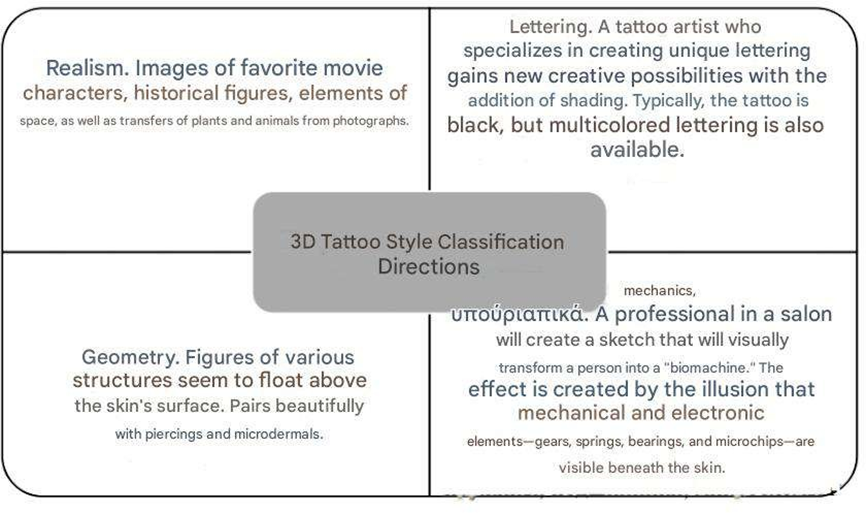
Fig. 1 — Directions of classification of 3D tattoo styles [1]
Modern algorithms for creating tattoo compositions represent a synthesis of artistic creativity, deep anatomical analysis, digital technologies and current stylistic trends. These algorithms have become truly versatile, multi-step, and adaptive, which makes it possible to work effectively with both small compositions and large projects that combine different parts of the body into a single visual structure.
It should be noted that in the modern tattoo industry, composition creation algorithms are a unique combination of artistic techniques, digital technologies and analytical methods. This synthesis allows you to create stable, visually logical and anatomically accurate images, which makes them truly impressive.
In a small format, algorithms are based on a minimalistic structure. The first step is to identify the key symbol and its clear silhouette. Then the shape is simplified, contrast is created, and readability is tested when reduced to micro proportions. The masters apply the rules of dominance, balance of voids and microdosing of details so that the image does not collapse over time [3].
Digital algorithms include automatic line stability checks, contour thickness modeling, and the generation of variations in a scaled-down sketch. This helps to avoid congestion and ensure clarity of perception (Table 1).
Table 1 – Algorithms for constructing tattoo compositions
|
№ |
Algorithm |
Characteristic |
|
1 |
Idea and concept |
First, decide on an idea: choose the theme, style and elements that you want to include in your tattoo. |
|
2 |
Collecting references |
Find the images you like to determine the style and composition of your artwork. These can be photographs, sketches, or drawings. |
|
3 |
Creating a basic composition |
Use graphic editors such as Adobe Illustrator, Photoshop, or specialized tattoo software to form the basis of your composition. Start with simple shapes and contours, gradually adding details to create a complete image. |
|
4 |
Algorithmic design |
Use programming (for example, in Python with libraries such as Turtle or Pygame) to create unique patterns and shapes. |
|
5 |
Fractals |
Explore fractal generators to create complex and interesting patterns. |
|
6 |
The color palette |
Choose a color scheme for your composition. Use the tools to combine colors harmoniously. |
|
7 |
Combining elements |
Experiment with the arrangement of the elements, change their sizes and proportions to create a harmonious composition. |
|
8 |
Preparation for printing |
Preparation of the final file in the required format, which can be sent to the tattoo artist. Make sure that the image resolution is high enough to get a high-quality result. |
|
9 |
Feedback |
Presenting your work to other people is an opportunity to get valuable feedback and make necessary adjustments. |
In the process of creating large-format tattoo compositions, complex multilevel algorithms are used that take into account the relief of the body. The process begins with a 3D scan or digital marking of the body. Then a so-called "motion frame" is created — a system of guiding lines that take into account muscles, bends, and areas of dynamic stretching of the skin.
Based on this framework, large blocks are distributed; a dominant visual center is formed, as well as secondary blocks and line directions that combine the elements into a single whole. Then a depth algorithm is applied based on the gradation of scales and contrasts. This allows you to create a space effect without excessive congestion.
Modern programs automatically analyze areas where distortions may occur, suggest the most suitable angles for placing elements, and adapt the sketch to the body as a complex three-dimensional surface. At the final stages, an integration algorithm is applied that combines the details into a single composition with no visible boundaries. This is especially important for creating sleeves, backs, and large-scale projects.
It is important to note that creating tattoos of any size involves many artistic, technical and anatomical tasks. These tasks manifest themselves in different ways in large and small formats.
In a small format, the main problem is the lack of space. The master has to find a balance between expressiveness and minimalism. If you make it too detailed, then over time the element can merge into a spot, the contours will become thicker, and the micro-parts will lose their shape under the influence of age, skin regeneration and natural pigment expansion.
The main difficulties include ensuring good readability from a distance, maintaining structure when zooming out, and choosing the right line thickness. Incorrect linear weight can break the compositional logic. It is also worth considering the choice of contrast: too little tonal difference makes the work less noticeable, and too much contrast can overload a small space.
In large-format compositions, an important task is the interaction of the image with the anatomy and dynamics of the human body. A large area requires special attention to bends, points of tension, muscle asymmetry, and natural lines of movement. Incorrect display of them can disrupt the integrity of the plot. Difficulties arise when distributing large visual masses. An incorrectly chosen dominant or a suboptimal flow pattern can lead to visual chaos and imbalance.
Another challenge is maintaining a consistent style and rhythm in large areas, especially in large—scale projects such as sleeves and backs. The master needs to combine many elements so that the work looks holistic, and not as a set of individual fragments. Technical difficulties include skin changes in different areas; different healing rates; the difficulty of maintaining the same paint density; the need for a multi-session process, which increases the risk of differences in saturation and texture.
Small formats require maximum precision, the ability to simplify details and carefully work with contrast. Large formats, on the contrary, imply a deep understanding of anatomy, large-scale compositional thinking and the ability to maintain the unity of structure on large surfaces.
We believe that effectively overcoming the difficulties of creating tattoos begins with a clear understanding of the limitations of scale and the peculiarities of human anatomy.
In a small format, the key solution is to optimize the details. The master replaces the microdecor with expressive silhouettes, large shapes and clear contours that can remain readable even years later. Using the correct linear weight allows you to maintain a visual hierarchy. Conscious selection of contrast helps to avoid fading or merging of elements, which ensures that the composition is distinguishable from any distance.
An important tool is the preliminary testing of the sketch in a reduced form. This allows you to identify weaknesses and reproduce them for the actual skin area.
Preliminary testing of the sketch is the most important stage that allows you to evaluate the future tattoo even before it is applied. This process helps the artist to see how the composition will look on the body, taking into account all its anatomical features, curves, dynamics and natural lines.
Testing the sketch allows you to assess how easy the details will be to read, whether the contrast will remain and whether important elements will disappear when zooming in or out. In addition, fitting a sketch on a body or visualizing it in a photo helps to understand how harmoniously it is positioned, whether the weight of the image is correctly distributed, and whether the tattoo will look natural both in static and in motion. This approach to creating a sketch significantly improves the quality of the work, makes the result more predictable and adapts the sketch to a specific person, turning it from an abstract drawing into a thoughtful and time-tolerant composition.
In large-format projects, it is important to carefully analyze the anatomy, the direction of the muscle fibers and the natural lines of movement. This data becomes the basis for compositional logic. The correct distribution of large visual masses is achieved with the help of dominant, secondary accents and rhythmic bundles. This allows you to create a holistic and dynamic structure.
The master always plans the project, even if the work takes place in several sessions. This avoids stylistic differences, uneven tones, and rhythm disturbances. It is very important to adapt the technique to different areas of the body: there should be a soft shadow on thin skin, dense redness on wide surfaces, and delicate transitions on curves. Using transparencies, 3D markup, or digital fitting helps to check the placement strategy and make sure that the composition naturally fits the body relief.
Thus, decisions are based on conscious management of factors such as detail, contrast, anatomical fit, and pre-design. This allows you to create stable, expressive and harmonious tattoo compositions of any size.
Conclusions. The competent construction of a tattoo composition on any scale is based on a deep understanding of the visual structure, skin features and human anatomy. In small formats, images should be as clear as possible, with minimal detail and careful use of contrast. This is necessary so that the image remains readable in a small space and does not lose its expressiveness over time.
On the contrary, large formats open the way to the creation of complex structures. They require careful planning, consideration of body movement, and a harmonious distribution of large visual elements.
Both of these areas are united by a conscious approach to design. The master makes decisions not intuitively, but guided by the logic of composition, durability of the image and visual laws. This allows the tattoo to become not only technically high quality, but also aesthetically completely, time-resistant and harmoniously combined with the shape of the body.
Only a combination of artistic thinking, professional skills and respect for anatomical features can turn a composition into a full-fledged work, where each element serves a common idea.
References:
- Garamova D.V. Application of 3D technologies in the tattoo industry // East European scientific journal. - No. 3 (79). - 2022. - pp. 4-8.
- Khrenova M.V., Oturgasheva N.V. Tattoo as an element of contemporary art // Intellectual potential of Siberia. - 2019. - pp. 329-330.
- Shulyar E.Yu. Tattoo as a sociocultural phenomenon // Universum: philology and art criticism. - No. 8 (98). - 2022. - pp. 8-11.
Other articles of the issue