

The influence of the design parameters of children's furniture and the characteristics of the sleeping place on the child's sleep, health status and psychophysiological development
Authors
Shmatukha Dmytro
Share
Annotation
The article examines the influence of the design features of children's furniture and the characteristics of the sleeping place on the quality of sleep, health and psychophysiological development of the child. It is indicated that uncomfortable support and unstable surface can increase muscle tension, cause micro-arousal and reduce the restorative effect of sleep. And during periods of active growth of the child, the risk of functional disorders of posture increases. The article summarizes approaches to assessing sleep and sleeping conditions using objective registration methods, screening questionnaires and expert assessment for compliance with the principles of safe sleep. Practical recommendations are given on the selection and design of children's furniture, paying attention to the compatibility of the elements, the stability of the structure and compliance with the manufacturer's instructions.
Keywords
Authors
Shmatukha Dmytro
Share
Relevance of the study
Sleep quality is one of the most important factors affecting a child's physical health and psychophysiological development. Proper sleep is necessary to restore the nervous system, support growth processes, improve attention, memory, emotional stability and strengthen the immune system. Sleep disorders in childhood can lead to increased fatigue, decreased concentration, behavioral problems, and an increased risk of developing chronic diseases.
One of the key conditions for ensuring a healthy sleep is the design features of children's furniture and the characteristics of the sleeping place. If the size, stiffness, shape, and ergonomics of the bed, mattress, and pillow do not match the age and anatomical and physiological characteristics of the child, this can lead to muscle tension, impaired posture, and decreased sleep quality. As a result, the likelihood of adverse consequences for both the physical and the psycho-emotional state of the child increases.
The importance of this topic is due to the need for strict compliance with sanitary, hygienic and ergonomic requirements for children's furniture. In addition, in practice, the choice of a sleeping place for a child often occurs without due attention to his individual characteristics and recommendations from specialists. Therefore, the study of the influence of the design parameters of children's furniture and the characteristics of the sleeping place on the sleep and development of the child acquires special scientific and practical importance. It promotes the prevention of health disorders and the creation of a safe object-spatial environment for children.
The purpose of the study
The purpose of this study is to theoretically substantiate and systematize data on the impact of the design features of children's furniture and the characteristics of a sleeping place on the quality of a child's sleep, as well as on related aspects of health and psychophysiological development. Based on the results obtained, practical recommendations will be developed on the selection and design of sleeping places for children of different ages.
Materials and research methods
The research materials used were scientific papers on age-related physiology and sleep medicine, as well as ergonomics of children's furniture. In addition, open regulatory and regulatory documents that contain requirements for the safety of children's beds were studied.
In the course of the work, methods of theoretical analysis and generalization of publications were used, as well as a comparative analysis of standards related to the design and operation of sleeping places for various age groups. A number of measurement approaches aimed at assessing sleep quality have also been systematized.
The results of the study
Sleep is an essential biological process that helps restore the central nervous system, strengthen memory and learning, regulate emotions and behavioral responses, and maintain physical health. Proper sleep is especially important for children, since during this period intensive processes of growth and neuropsychological development occur, requiring regular and sufficient rest. The scientific literature suggests age-related sleep standards based on expert opinions and research results. These norms serve as a guideline in assessing the child's sleep conditions and condition [5].
The design of the bed, including the shape of the bed, the type of base and the presence of restraints, as well as the properties of the mattress and pillow, such as support, pressure distribution and shape retention, can affect muscle tension and comfort. This, in turn, may affect the fragmentation of sleep and the subjective assessment of its quality. For young children, the requirements for a safe sleep organization are especially important. Specialized clinical guidelines emphasize the need to use a separate sleeping space, a "hard and even" surface with a sheet in size, as well as the absence of soft objects in the sleeping area. These provisions serve as a methodological basis for analyzing the characteristics of a cot and mattress in medical research.
Scientific publications note that for a long time the concept of "rigidity" in the context of infant sleep was described only in qualitative terms. There are still ongoing discussions about how to objectively measure the softness or stiffness of sleeping surfaces. This requires a careful approach to the selection of indicators and methods in the empirical part of the study [1].
It should be noted that the "right" furniture for a child should correspond to his physical parameters and provide good body support during prolonged stay in one position. Ergonomic studies of school furniture have shown that the discrepancy between its size and the height of children can lead to incorrect posture and potential problems with the musculoskeletal system. These results may also be relevant for the analysis of the sleeping place, since the duration of staying in a certain position during sleep is even longer than when sitting [6].
Table 1 shows typical measurement methods used in scientific papers to evaluate sleep and related indicators. This table will help us determine the methodological logic of our further research.
Table 1
Methods for assessing the quality of sleep and the compliance of the sleeping place with safety requirements in children
|
What is being evaluated |
Examples of methods |
What does the method provide in the context of the topic |
|
Architecture and sleep quality (objectively) |
Polysomnography; actigraphy |
Registration of sleep and wakefulness indicators, assessment of sleep fragmentation and regime, depending on the chosen method. |
|
Sleep disorders (screening) |
CSHQ (Parent Questionnaire) |
Comparative description of the prevalence of typical sleep problems in children. |
|
Environmental compliance with the principles of safe sleep (for an early age) |
Expert assessment based on clinical recommendations |
Make sure that the surface is smooth and hard, and that there are no soft objects or other factors that may pose a danger. |
A source: author's development based on [7].
Special attention should be paid to age groups, as the requirements for a sleeping place and the risks associated with it vary. For infants, the main task is sleep safety, so the design of the crib and the properties of the mattress should be aimed at preventing dangerous situations and following clinical guidelines for sleep management. For preschoolers and schoolchildren, in addition to safety, the convenience and matching of sleeping furniture to height, as well as factors affecting the regularity of sleep patterns, is becoming more important. Adolescents are influenced by behavioral and environmental factors, but a well-chosen sleeping place remains one of the key elements of sleep hygiene, providing basic conditions for recuperation.
In the manufacture of baby cots, special attention is paid to the construction of side fences and attachment points. This is due to the fact that in the past, collapsible joints, movable elements and unreliable fittings have caused dangerous accidents. As part of the stricter requirements for cots, it was decided to abandon the traditional "lowering" sidewalls. According to the regulator, the disconnection of such guides led to dozens of fatal cases of suffocation and strangulation, which was one of the reasons for the introduction of stricter mandatory standards.
The figure below shows the official infographic of the Consumer Product Safety Commission, reflecting the key areas of strengthening the requirements for the design of cribs. The main elements that must be improved are visually shown: the strength of the slats, the reliability of the fastening fittings, the durability of the mattress base, as well as the prohibition of traditional sliding sidewalls. The need for stricter product testing before being approved for sale is emphasized separately.
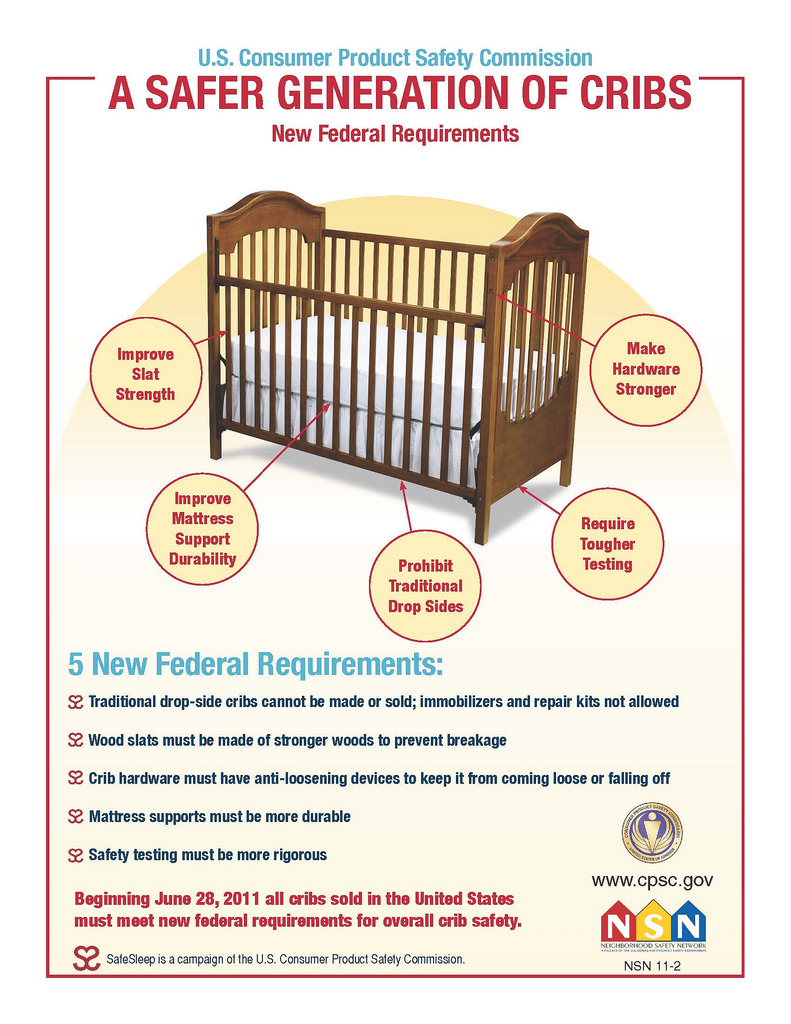
Fig. New federal requirements for the safety of cots [3]
One of the most important structural elements is the quality and type of fasteners. The regulatory documents emphasize that it is necessary to prevent spontaneous loosening of the joints and increase the service life of the mattress support. This is due to the fact that the weakening of the fittings and the wear of the support elements can lead to the formation of unexpected cracks, distortions and instability of the base (Table 2). For a research description of furniture, this means that the "passport" of the product should include not only the geometry, but also the type of joints, the presence of anti-unwinding mechanisms, the method of fastening the base under the mattress, and the manufacturer's requirements for periodic tightening of fasteners.
Table 2
Design requirements for baby cots and sleeping places and their role in reducing injury risks
|
Structurally significant elements of a crib and a sleeping place |
Confirmed requirements |
What risk does the parameter reduce |
|
Side fences (movable elements) |
As part of the updated standards, it is now prohibited to use traditional sliding sidewalls. |
Reducing the risk of dangerous cracks and node failure, as well as associated pinching and suffocation. |
|
Fittings and fasteners |
The need for more reliable fittings and solutions to prevent spontaneous loosening of fasteners. |
Reducing the likelihood of loosening, misalignment and the appearance of gaps not provided for. |
|
Mattress base/support |
Attention is paid to increasing the service life of the mattress support structure and more rigorous testing. |
Reducing the risk of subsidence and deformation of the soil, as well as secondary injuries. |
|
Product testing |
The new crib requirements include tests that are more "rigorous". |
Reducing the likelihood of structural failures in real-world operation. |
A source: author's development based on [2].
For children who move to "adult" type beds, fences and safety are especially important to avoid falls. This is especially true when it comes to bunk beds. There are mandatory requirements for bunk beds, which include at least two safety guards – one on each side – for each tier if the bottom surface of the mattress base is more than 30 inches (760 mm) from the floor. The continuity of the fence is also regulated: the allowable gap between the fence and the end structure is limited to 0.22 inches (5.6 mm), which reduces the risk of injury to fingers. Another important requirement concerns the minimum height of the upper edge of the fence above the surface of the mattress: It must be at least 5 inches (130 mm) when using a mattress of the maximum allowable thickness specified in the manufacturer's instructions [4].
The quality of a child's sleep directly depends on the characteristics of his sleeping place. During sleep, the body spends a lot of time in a static position, and recovery systems work in an enhanced mode. Unsuitable support can cause muscle tension, provoke micro-arousal and disrupt the normal structure of sleep. Even if the duration of sleep is sufficient, it becomes less effective if a person experiences discomfort, the surface is unstable, or the load is unevenly distributed.
It is especially important to ensure a physiologically neutral spine position. During periods of active growth, prolonged exposure to uncomfortable positions can lead to functional disorders of posture. Too soft or too hard, a surface can cause local pressure, asymmetry of muscle tone, and impaired blood circulation. This, in turn, affects the depth of sleep, the frequency of nighttime awakenings and morning fatigue.
The quality of sleep, in turn, directly affects your overall health. Chronically fragmented sleep is often accompanied by increased fatigue, decreased concentration, emotional instability, and increased excitability. This can manifest itself in the form of behavioral difficulties and decreased academic performance.
The microclimate in the bedroom is equally important: the materials of the mattress and bedding affect heat exchange and moisture removal. Overheating or hypothermia can increase anxiety and increase the number of awakenings.
Table 3 provides generalized information on the relationship of various characteristics of a sleeping place with indicators of sleep and child's health, based on scientific and clinical publications.
Table 3
The influence of the characteristics of the sleeping place on the quality of sleep and the state of health of the child
|
Characteristics of the sleeping place |
Possible effects on sleep |
Potential health effects |
|
Spine support and load balancing |
Reduced micro-arousal, increased sleep depth |
Prevention of muscular overstrain and functional disorders of posture. |
|
Stability and flatness of the surface |
Reducing the change of posture during sleep |
More effective recovery of the nervous system. |
|
Temperature and microclimatic comfort |
Maintaining sleep continuity |
Maintaining a normal body temperature and well-being. |
|
Matching the size of the sleeping place to the child's height |
Reduction of motor anxiety |
Prevention of chronic fatigue and irritability. |
A source: author's development
The impact of the quality of the sleeping place is manifested not only in improving well-being the next day, but also in the longer term. Regular and full-fledged sleep contributes to the normalization of hormonal levels, as well as the proper growth and development of the nervous system. On the contrary, constant discomfort during sleep can become a risk factor for physical and psycho-emotional development. In this regard, the assessment of the sleeping place in the framework of research on children's health is an important aspect of a comprehensive analysis of factors affecting the quality of sleep and the general condition of the body.
When designing and choosing children's furniture and beds, it is important to take into account three key aspects: safety, ergonomics, and age and height compatibility of the child. Bed structures must be stable, reliable and free of gaps, sharp edges and moving elements that can lead to injury. Special attention should be paid to the compatibility of the frame and the mattress, as the correct fit of the mattress and the stability of the base are the key to a safe sleep.
When choosing a sleeping place, it should be borne in mind that it should support the spine in its natural position and evenly distribute the load on the body. The mattress must be selected based on age, weight, and manufacturer's recommendations. It is important to avoid mattresses that are both too soft and too hard. For younger children, it is especially important to follow the rules of safe sleep. The sleeping space should be designed in a minimalistic style, without unnecessary soft objects, to ensure safety and comfort during sleep.
An important aspect is the assessment of microclimatic comfort. The materials of the mattress and bedding must ensure normal heat exchange and moisture removal. Compliance with constructive, ergonomic and hygienic requirements makes it possible to create a sleeping place that will contribute to quality sleep, prevention of health disorders and maintenance of a favorable psychophysiological state of the child.
Conclusions
The characteristics of the sleeping place play an important role in the quality of a child's sleep and, as a result, in his health and psychophysical development. Incorrectly, selected support and unstable surface can cause micro-arousal and decrease the restorative effect of sleep. Prolonged exposure to an unnatural position during periods of active growth can lead to functional disorders of posture. In addition, the microclimatic parameters of bedding affect sleep continuity. The safety and comfort of a sleeping place depend on many factors: the design of the bed and mattress, the stability of the frame and base, the reliability of fasteners, compliance with the manufacturer's recommendations and the use of protective fences if there is a risk of falls. Both objective and screening methods are used to evaluate the sleeping place. This allows you to compare sleep conditions with well-being indicators and develop practical recommendations for the prevention of sleep disorders and related problems.
References:
- A firm recommendation: measuring the softness of infant sleep surfaces [Electronic resource]. – Access mode: https://pmc.ncbi.nlm.nih.gov/articles/PMC8436463/.
- CPSC Approves Strong New Crib Safety Standards to Ensure a Safe Sleep for Babies and Toddlers [Electronic resource]. – Access mode: https://www.cpsc.gov/Newsroom/News-Releases/2011/CPSC-Approves-Strong-New-Crib-Safety-Standards-To-Ensure-a-Safe-Sleep-for-Babies-and-Toddlers.
- Crib Safety | CPSC.gov [Electronic resource]. – Access mode: https://www.cpsc.gov/safety-education/safety-guides/cribs/crib-safety.
- PART 1513 – REQUIREMENTS FOR BUNK BEDS [Electronic resource]. – Access mode: https://www.ecfr.gov/current/title-16/chapter-II/subchapter-C/part-1513.
- Recommended Amount of Sleep for Pediatric Populations: A Consensus Statement of the American Academy of Sleep Medicine [Electronic resource]. – Access mode: https://aasm.org/resources/pdf/pediatricsleepdurationconsensus.pdf.
- Revision of the design of a standard for the dimensions of school furniture [Electronic resource]. – Access mode: https://pubmed.ncbi.nlm.nih.gov/12745681/.
- Safe Sleep [Electronic resource]. – Access mode: https://www.aap.org/en/patient-care/safe-sleep/?srsltid=AfmBOordnsezfBGtH4TjfVDV11ErubthYI6YwYYwiXyIIm8I4ikHyfus.
Other articles of the issue