

A 25,000-Year-Old Prehistoric Writing System
Authors
M. T. Aksagov
Share
Annotation
This article examines the hypothesis of the existence of a prehistoric writing system approximately 25,000 years old, discovered in the Dordogne region of modern-day France. The author analyzes the bas-relief of the Laussel Venus, suggesting that the elements of the image represent symbols of an ancient pictographic script.
Particular attention is paid to the connection between the image and the Ingush language, in particular the expression "But lyatsa," meaning "lunar eclipse." It is believed that this image commemorates an important historical event that occurred during a lunar eclipse and is associated with the destruction of an ancient city. The author emphasizes the need for further research to confirm this hypothesis and to revise existing ideas about the development of writing and human history.
Keywords
Authors
M. T. Aksagov
Share
Despite the extensive work of scientists, the history of peoples remains partially studied and conceals much that remains unknown. Writing plays a vital role in understanding history as a source of direct communication between people of those distant times. Unfortunately, well-documented writings in human history are only about 6,000 years old, making it difficult to obtain accurate information from primary sources.
Many scientists have unsuccessfully attempted to discover more ancient writings, predating the Upper Paleolithic. Over more than 20 years of research, I have discovered consistent prehistoric writing dating back 25,000 years in the Dordogne region of present-day France.
The subject of this distinct prehistoric pictogram is complex and requires substantial expertise not only in linguistics, but also of the visual arts, as the writing of that time was closely linked to an unusual visual art that has remained largely unexplored.
A relatively close analogue of this script is a pictogram, which has many distinctive features. In pictograms, signs are typically represented separately, whereas in this script the pictorial signs in most examples are non-separable; therefore their identification—and even more so their reading—is extremely difficult. It is necessary to know the reading principles and to possess substantial research experience.
Signs of the script may include parts of anthropomorphic or zoomorphic bodies, whole bodies or isolated parts of figures, various objects, and importantly, actions performed by body parts or objects and other qualities. This method of writing has limitations when composing continuous text because it employs the principle of the ideogram, but it also offers a wide range of possibilities through the polysemy of pictorial signs. Thus, despite its apparent simplicity, this highly complex script has great potential. For clarity, I will explain using the figure of the Laussel Venus from France, which has been dated to 25,000 years ago.
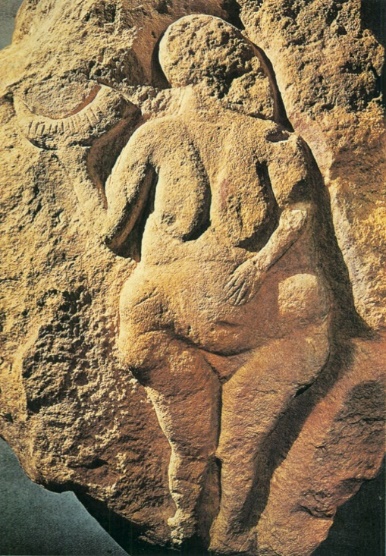
What do researchers know about this bas-relief? The most established theories.
A full-length nude female figure with exaggerated legs holds an object in her raised right hand—according to one version, a bison horn; according to another, a crescent moon with 13 notches representing the number of days. She is generally considered a goddess, a woman giving birth.
No interpretation satisfactorily explains how a woman could hold a crescent, since the Moon is a celestial body and cannot be physically grasped. Therefore, this combination contains a more complex symbolic meaning. That is, the hand holding the Moon has a specific informational meaning, where both the hand and the Moon perform the functions of written signs.
There is also no explanation for the significance of holding a bison horn in the hand, given that the figure has no face, no mouth would be unable to drink from the horn.
Therefore, identifying the object in the hand as the Moon is entirely justified, and the informational significance of this action remains to be determined.
In this example, the hand, the Moon, and the act of holding the Moon in the hand are signs of writing and together form a concise text that can be read coherently and is fully verifiable.
To read this written message accurately, one must be well acquainted with the language of a very ancient people who today live in the North Caucasus—the Ingush language.
In Ingush, the expression “But lyatsa” has been preserved to this day and literally means “to hold, to keep the Moon. Applied to this meaning, this expression means a lunar eclipse. Thus, the bas-relief of Venus contains the laconic message "Lunar Eclipse," associated with an extremely important event in the lives of the people of that time.
Moreover, the female figure associated with the Sun, that is, the Sun Goddess, is identified with utmost precision, as a lunar eclipse is caused by the Sun. Because of this, ancient Ingush referred to the phenomenon as “Myalkho but lyatsa” (the Sun holds the Moon).
Precisely because this image contains written symbols, it contains many strange features, which are characteristic of all similar examples in different parts of the world where this script was used.
There would be little sense in creating such a complex bas-relief merely to record an ordinary occurrence such as a lunar eclipse, as ancient people witnessed lunar or solar eclipses many times.
This means that the lunar eclipse was used as a time when some very important event in the lives of the people of that period occurred. To answer this question, a complex study of the bas-relief is necessary, looking for any secret information—hidden images—that will provide the answer. Considering that the bas-relief was executed using a “chameleon” technique, the search for concealed images must take into account the features of that technique. Having extensive experience studying similar images in the Caucasus, this work can be carried out with this bas-relief. Unfortunately, lacking the ability to conduct a physical study of the Venus bas-relief, I had to search for a photo online, hoping to find a more or less accurate one. I managed to find such a photo online.
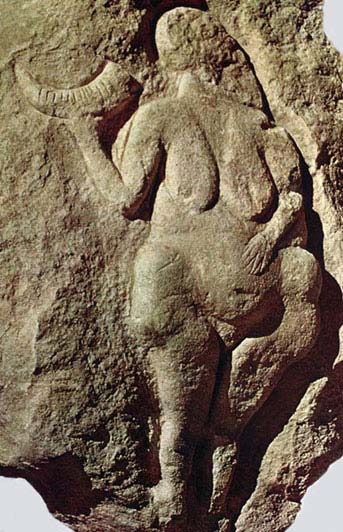
On this incidental photograph by an unknown author, although not fully visible, a hidden image is sufficiently clear on a sloping face of the limestone to the right from the viewer’s perspective. Such examples are typical of iconic images. The photograph was taken with lighting from the left side of the viewer, which likely corresponds to the original craftsman’s intent—only under this lighting does the silhouette image become visible.
What is depicted on the lateral panel?
A shadowy, silhouetted image is created on the screen. How was this secret, symbolic image created? It was created through complex calculations to create the necessary shapes of the female figure's body parts on the surface—that is, strange bumps, depressions, and other curves and shapes. This is why the figure of Venus has many inexplicable oddities.
What does this secret shadowy, silhouetted image on the side screen represent?
The screen depicts the facial part of a human head with a very long neck, and on the crown of the head is a stepped structure resembling a tower. I discovered a more complex analog of the image of a stepped tower on a head in the Caucasus, in the Tkhaba-Yerda temple.
The structure (tower) on the head of an anthropomorphic or zoomorphic creature functions as a pictographic script, very clearly legible in the Ingush language – Tetekov. The word Tetekov has two roots, consisting of the words Tete (top of the head) and Kov (city, courtyard), meaning "above the main city," that is, the Capital, the main city among other cities. Thus, on the right side of Venus, the secret is depicted an illustrated text message, Tetekov (Capital), and an image of the capital's main building.
The secret image of the structure and its name provide an important clarification to the "Lunar Eclipse" message. This suggests that some important event related to the Tetekov capital occurred during a lunar eclipse, likely a catastrophe and the destruction of that city.
In fact, the Laussel cave contains a record with a hypersensational, concise message about the probable destruction of a capital during a lunar eclipse. This record implies that at least 25,000 years ago there were urban-type settlements with multi-storey buildings and a capital Tetekov in central Europe, which perished during a lunar eclipse.
The location of this capital can be assisted by information preserved in the Caucasus, since Caucasian sources indicate geographical features of its placement and terrain characteristics.
Furthermore, it is highly likely that the Losselskaya Cave contains other inscriptions and drawings on this extremely important topic in human history.
An important feature: this script was used by the Ingush up to the medieval period, primarily to record especially important information, by that time serving as a secret cryptographic script. Therefore, fundamental research into the history and culture of the Ingush, study of artifacts bearing this script, and investigation of complex pictorial art are of great significance for the study of this writing system and for the history of humanity and ancient peoples.
My discovery of this pictographic script provides access to invaluable information from the prehistoric period, at least from the Late Paleolithic, and allows reassessment of a large number of artifacts for the presence of prehistoric writing signs. In effect, this discovery moves historical science to an entirely new level of investigation.
References:
Lalanne, J.-G. (1911). “Découverte d’un bas-relief à représentation humaine dans les fouilles de Laussel.” L’Anthropologie, 22, 257–260.
Lalanne, J.-G., & Bouyssonie, J. (1941–1946). “Le gisement paléolithique de Laussel. Fouilles du Dr Lalanne.” L’Anthropologie, 50, 1–163.
Roussot, A. (2000). La Vénus à la corne et Laussel. Éditions Sud-Ouest.
Yushmanov, N. V. (1941). Ingush Writing. Publishing House of the Academy of Sciences of the USSR.
Musaev, S. Zh. (2022). “Ancient Kyrgyz Yeniseian Writing (5th–6th centuries).” Proceedings of the National Academy of Sciences of the Kyrgyz Republic, 1(1), 5–15.
Yadav, N., Joglekar, H., Rao, R. P. N., Vahia, M. N., Mahadevan, I., & Adhikari, R. (2009). “Statistical analysis of the Indus script using n-grams.” arXiv preprint arXiv:0901.3017.
Herrmann, J. M. (2017). “The Voynich Manuscript is Written in Natural Language: The Pahlavi Hypothesis.” arXiv preprint arXiv:1709.01634.
Other articles of the issue