

Predictive pricing as a tool for harmonizing agricultural markets under regional economic integration (the case of the EAEU)
Authors
Viktar F. Karpovich

Share
Annotation
The study explores predictive pricing as a mechanism for stabilizing and harmonizing agricultural markets within the Eurasian Economic Union (EAEU) amid growing global and regional uncertainty. It demonstrates that traditional pricing approaches are insufficient under conditions of volatile world markets, logistics disruptions, and institutional asymmetries. The research substantiates the conceptual framework of predictive pricing, integrating big data, machine learning models, and digital monitoring platforms. Empirical evidence from Belarus (2016–2024) confirms the strong influence of external factors on domestic price dynamics. The findings show that predictive pricing enhances forecasting accuracy, reduces market volatility, and supports coordinated pricing policies, contributing to the formation of a unified digital data space and more resilient agricultural markets in the EAEU.
Keywords
Authors
Viktar F. Karpovich
Share
Introduction
Agricultural markets of the Eurasian Economic Union (EAEU) have been increasingly exposed to global and regional uncertainties, including food price volatility, logistics disruptions, climate risks, sanctions, institutional asymmetries, and the transformation of global value chains. These factors intensify cross‑border price transmission and undermine the effectiveness of traditional pricing mechanisms such as cost‑based, normative, and administrative approaches. In this context, the need for advanced analytical tools capable of predicting market dynamics and supporting coordinated pricing policies has become critical. Predictive pricing, based on big data analytics, machine learning, and digital monitoring platforms, emerges as a key instrument for enhancing market stability and harmonization within the EAEU. The study aims to substantiate the theoretical and methodological foundations of predictive pricing and to determine its role in harmonizing agricultural markets under regional economic integration.
Methods
The study employs a mixed‑method research design combining a systematic review of scientific publications from 2006-2024, comparative analysis of forecasting approaches, and empirical examination of agricultural price dynamics in Belarus for 2016-2024. The methodological framework integrates statistical time‑series models (ARIMA, SARIMA), neural network architectures (LSTM, GRU, CNN‑LSTM), and ensemble algorithms (Random Forest, XGBoost), enabling assessment of nonlinear and multidimensional determinants of price formation (Sabu & Kumar, 2020). A conceptual model of predictive pricing was developed through structural analysis of information, algorithmic, indicator, and management components. Empirical evaluation included correlation analysis, factor decomposition of external and internal drivers, and identification of integration‑related asymmetries affecting price transmission within the EAEU.
Results и Discussion
Based on an analysis of scientific publications from 2006 to 2024, it was found that machine learning and time‑series methods dominate global practice in price forecasting. The highest accuracy is demonstrated by neural network architectures (LSTM, GRU, CNN‑LSTM), which can account for nonlinearity and multidimensionality of data, as well as hybrid models combining statistical and intelligent approaches (Wihartiko et al., 2021). At the same time, studies emphasize the need – when forecasting prices for agricultural products and food – to expand the set of factors by including climate data, logistics indicators, institutional parameters, and integration effects, which is particularly relevant for EAEU countries.
The conceptual model of predictive pricing includes four interconnected structural blocks: the information block, the algorithmic block, the system of predictive indicators, and the management contour. The information block includes historical price series, supply and demand data, climate parameters, logistics indicators, global commodity indices, and institutional factors. The algorithmic block is represented by statistical models (ARIMA, SARIMA), neural network architectures (LSTM, GRU), ensemble methods (Random Forest, XGBoost), and hybrid models that ensure high forecasting accuracy under conditions of data nonlinearity and multidimensionality (Bayona-Oré et al., 2021).).
Figure 1. Predictive Pricing Framework for Agricultural Market Harmonization
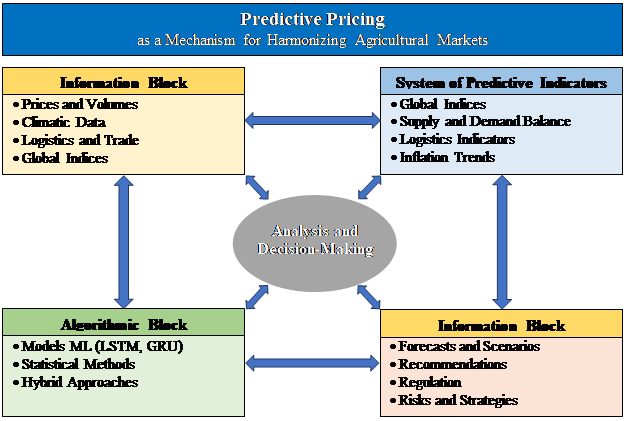
The system of predictive indicators includes global (FAO indices, exchange quotations), regional (EAEU indicators, logistics indices), national (supply‑demand balances, inflation parameters), and operational indicators (yield, production costs, stocks). The use of such indicators is aimed at early identification of prerequisites for changes in market conditions, forecasting price shocks, and reducing volatility in national agricultural markets.
Analysis of statistical data of the Republic of Belarus for 2016-2024 revealed the following key trends determining the dynamics of agricultural prices: high dependence on global indices, strengthening influence of logistics factors, growth of seasonal volatility, and an increase in the amplitude of price fluctuations during periods of external shocks. It was established that up to 40% of the variation in domestic prices is explained by external factors, which confirms the need to integrate predictive models into the system of state regulation and interstate cooperation within the EAEU.
To ensure the deployment of a predictive pricing system in EAEU countries, it is necessary to create national digital agricultural data platforms that provide collection, processing, and integration of heterogeneous information sources, including satellite monitoring, IoT sensors, meteorological data, exchange quotations, and foreign trade statistics. Such platforms should become the foundation for forming a unified EAEU digital data space, ensuring data comparability, process transparency, and the possibility of building integration-oriented models.
To improve the regulatory framework of EAEU member countries, we propose legislatively defining the concept of “predictable pricing”, standardizing data and algorithms, creating model validation mechanisms, and establishing requirements for digital platforms. Particular attention should be paid to training specialists and developing competencies in data analysis, digital economics, and agricultural analytics. It is important to create educational programs for agribusiness specialists and form interdisciplinary groups bringing together economists, data analysts, and IT specialists.
The developed model for harmonizing pricing mechanisms within the EAEU includes algorithms for coordinating indicators, tools for monitoring integration imbalances, and principles for constructing a unified framework for integrated pricing. According to our estimates, the implementation of forecast pricing reduces agricultural market volatility by 15-25%, improves forecasting accuracy by 20-35%, and ensures the consistency of pricing policies among member states. Predictive models can be used to develop export-import strategies, production planning, inventory management, and government support measures.
Particular attention should be paid to the institutional aspects of integration. This is because differences in national regulatory systems, levels of digitalization, data availability, and logistics infrastructure create asymmetries in price signals and hinder the formation of a single market. Price forecasting will help compensate for these differences through data standardization, increased transparency, and the implementation of common analytical algorithms.
Conclusion
Thus, predictive pricing is considered a key tool for enhancing the resilience of the agricultural sector, harmonizing pricing mechanisms, and forming a unified digital data space within the EAEU. The presented results have high practical significance and can be used in developing strategies for the agro‑industrial complex, improving state regulation mechanisms, and shaping integration policy in food markets. Predictive models make it possible to shift from reactive regulation to proactive management, which is a necessary condition for sustainable development of the agricultural sector under conditions of global instability.
References:
Sabu K. M., Kumar T. K. M. (2020). Predictive analytics in Agriculture: Forecasting prices of Arecanuts in Kerala. Procedia Computer Science, 171, 699–708.
Wihartiko F. D. et al. (2021). Agricultural price prediction models: a systematic literature review. In International Conference on Industrial Engineering and Operations Management Singapore (pp. 7–11).
Bayona-Oré S., Cerna R., Tirado Hinojoza E. (2021). Machine learning for price prediction for agricultural products. DOI: 10.37394/23207.2021.18.92
Other articles of the issue