

Sustainable educational and consulting ecosystems as a driving force for market transformation and public administration
Authors
Kasymbekova Zhanara
Share
Annotation
This paper considers sustainable educational and consulting ecosystems as the most important elements of the transformation of market mechanisms and public administration systems. Special attention is paid to the structural components of such ecosystems, including digital platforms, network forms of interaction, institutional mechanisms and models of distributed responsibility. The article examines in detail how the ecosystem approach helps to increase market flexibility, develop new skills, accelerate innovation and improve the quality of management decisions in the public sector. Sustainable educational and consulting ecosystems create favorable conditions for the formation and development of human capital, as well as for the formation of a culture of data use. This, in turn, leads to increased transparency and management efficiency. It has been proven that cooperation between educational institutions, consulting companies, business and the government contributes to a more efficient transition of the economy to sustainable development and ensures competitiveness in the face of rapid changes.
Keywords
Authors
Kasymbekova Zhanara
Share
Relevance of the study
Sustainable educational and consulting ecosystems are becoming a key tool that allows the economy and public administration to successfully adapt to modern challenges. The rapid development of digital technologies, the increasing complexity of market processes, the increasing importance of data and the need for constant updating of competencies require the creation of new organizational forms that could ensure continuous learning, innovation and the provision of high-quality expertise.
The ecosystem approach helps strengthen ties between business, government, educational institutions, and the expert community. It creates a flexible infrastructure for developing human capital and improving the effectiveness of management decisions.
The relevance is also related to the fact that sustainable ecosystems help the state to respond more quickly to socio-economic changes. They improve the quality of public services and reduce administrative costs by combining knowledge, technology, and networking.
The purpose of the study
The purpose of this study is to explore the role and opportunities of sustainable educational and consulting ecosystems in the transformation of market processes and public administration systems. We intend to understand how they affect the effectiveness of decision-making, the level of innovation and the sustainability of development, as well as to propose a conceptual model for their integration into socio-economic management.
Materials and research methods
The research is based on modern theories on the formation of educational and consulting ecosystems. We also studied the analytical reports of international organizations and the scientific works of domestic and foreign authors in the field of digital transformation, knowledge management, organizational development and public administration. The study used data on the work of existing educational platforms, expert networks, consulting centers and public-private partnerships.
The methodological base of the research includes system and institutional analysis, comparative research methods, analysis of specific situations (cases), elements of network theory and the concept of knowledge management. In the course of the work, methods of content analysis, expert assessment and modeling of interactions within ecosystems are used. Such an integrated approach allows for a deeper understanding of how ecosystems maintain their stability, how they develop, how they create value, and how they influence the processes of market modernization and public administration.
The results of the study
The history of the development of consulting ecosystems, which play an important role in the transformation of the market and public administration, is a gradual process. They have evolved from simple, independent organizations into complex, interconnected intellectual and digital platforms capable of having a significant impact on the economy, personnel policy, and government decision-making.
The first beginnings of ecosystems emerged in the middle of the XX century, when classical schools of business and management consulting began to form. These schools defined management standards, trained qualified personnel, and provided expert research for government agencies without being integrated into a single structure. Their influence was limited, but they laid the foundation for further systematization of knowledge and the formation of stable professional communities (Table 1).
Table 1
The specifics of educational ecosystems: a review of research
|
The specifics of educational ecosystems |
Authors |
|
A large number of stakeholders is an important prerequisite for the success of educational innovations. For innovations to be successful, it is necessary to reach agreement between representatives of the various sectors of society involved in the process. |
M.A. De Souza Rodriguez and others [5] |
|
The product, created as part of a public-private partnership, is aimed at meeting the needs of consumers, including parents and teachers. |
M. Abdul-Jabbar, B.L. Kurshan [4] |
|
Various educational institutions offer a variety of forms of education: schools, professional educational organizations, classical and corporate universities, state and non-state educational institutions, additional education organizations, as well as non-formal and informative learning projects. Thanks to this, people have new opportunities for development. These educational institutions are not limited by geographical location and can use global educational resources. |
V.V. Timchenko [3] |
|
The focus is on the joint activities of the subjects to create networked, human-centered educational systems that maintain harmony with the environment. |
O.V. Zinevich, E.A. Milekhina [1] |
|
They are based on the principles of network interaction between educational institutions and students, which are aimed at forming a harmonious personality, as well as at developing the professional skills of each person and group of people throughout their lives. |
E.N. Prokofiev [2] |
With the development of the Internet in the 1990s and early 2000s, educational and consulting services began to move into the online space. The first major online platforms, distance learning programs, and digital knowledge libraries appeared which significantly expanded educational and analytical opportunities.
This period was a turning point, as the institutions were no longer isolated from each other. Networking between universities, companies, think tanks, and government agencies began to form. States have become more active in attracting foreign and local consultants to modernize administrative systems, and businesses to restructure their models. At this stage, there is an objective need for a more comprehensive and sustainable knowledge infrastructure.
In the 2010s, the ecosystem approach began to flourish. Educational platforms have moved from traditional to more complex models that connect participants with different functions: students, experts, employers, and technology developers. Large consulting companies have begun actively creating research laboratories, data centers, predictive models, and digital decision-making tools. At the same time, public administration faced growing challenges and began to use a wide range of external analytical partners.
The ecosystems of the period under review demonstrated key signs of sustainability, including the ability to continuously update content, adapt to economic changes, and integrate artificial intelligence into educational and expert processes.
The 2020 pandemic accelerated the transition to a digital and hybrid model of education and consulting, turning these areas into key elements of market transformation. The massive introduction of online learning, the rapid growth of EdTech companies, the development of GovTech and the emergence of new analytical centers have created the conditions for the formation of integrated government and corporate ecosystems. These ecosystems not only facilitate knowledge transfer, but also provide forecasting, project support, human resource development, and automation of management decisions. At this time, sustainability began to be seen as the ability of systems to maintain high quality and adapt to uncertainty, achieved through the integration of data, technology, and human skills.
At the present stage, sustainable educational and consulting ecosystems have become the most important factor determining the development of markets and public administration (Fig. 1). They contribute to the formation of personnel models, the creation of tools for analysis and monitoring, provide the state and business with objective data and forecasts, and help to build long-term trajectories for the development of territories and organizations. Ecosystems have gone beyond a simple addition to the management infrastructure and have become a key element influencing the competitiveness of the economy, the effectiveness of institutions and the depth of social transformation.
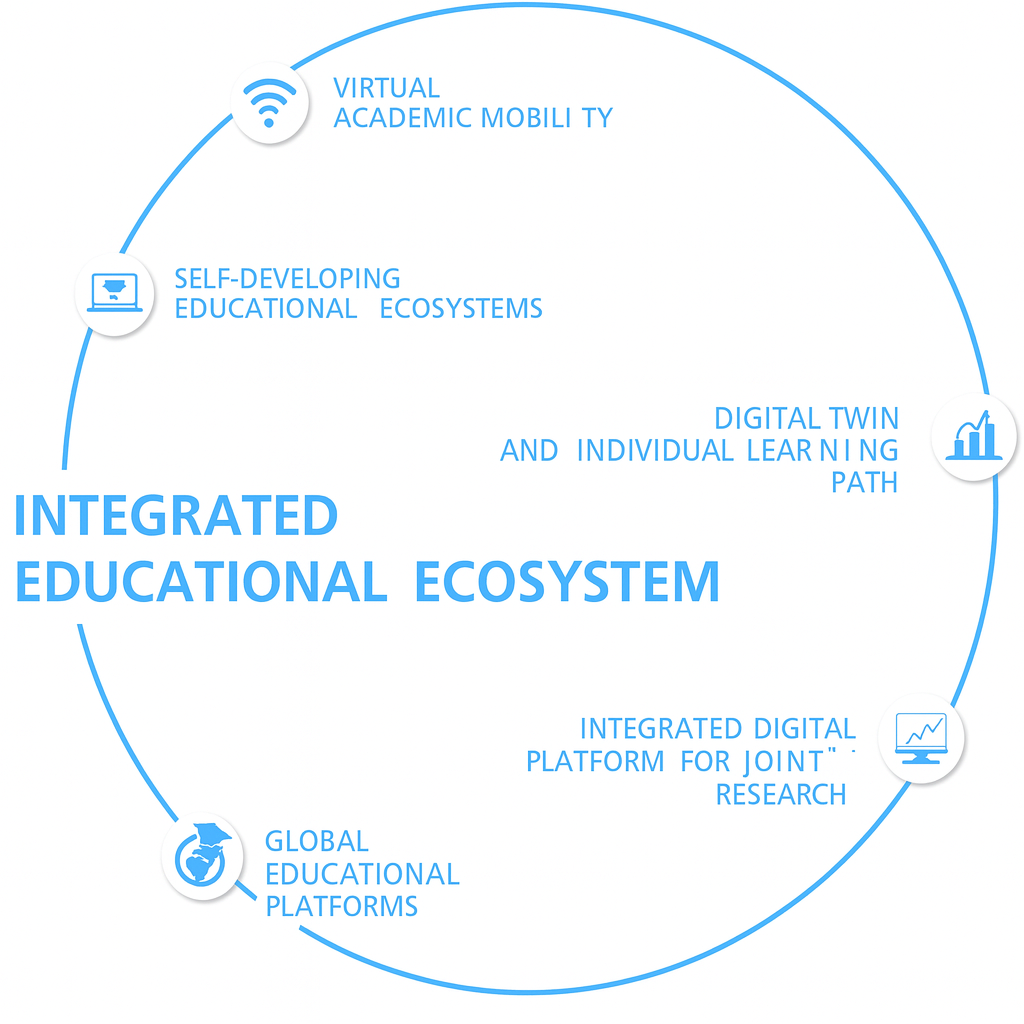
Fig. 1. Unified educational ecosystem
It is important to note that modern educational and consulting ecosystems are complex systems that combine training, analytics, data management, and expert support. Their main task is the formation of competencies, solutions and management models capable of transforming the market and improving the quality of public administration. The following are examples of such ecosystems and the technologies they are based on.
Major educational platforms such as Coursera, edX, FutureLearn, and Udacity are creating unique ecosystems that connect universities, technology companies, government agencies, and millions of users. These platforms not only offer access to mass education, but are also becoming important tools for training qualified personnel for the digital economy. They influence the structure of demand; contribute to the emergence of new professions and the formation of international standards of education. Such ecosystems are actively implementing adaptive learning technologies, recommendation mechanisms, and automated analytics. This makes them effective tools for transforming HR systems in both the private and public sectors.
The consulting ecosystems of the world's leading companies such as McKinsey, BCG, Deloitte and PwC are actively developing, becoming centers of expertise and innovative technologies. They create their own digital platforms designed for processing big data, analyzing trends, modeling socio-economic processes, and evaluating the effectiveness of government programs. They integrate machine learning; build predictive models, and use cloud services and end-to-end analytical tools in their ecosystems. This allows them not only to provide consultations, but also to actively participate in the development of territorial development strategies, public administration reform, and optimization of budget processes and assessment of the quality of public services.
The examples that we can observe in Russia demonstrate the process of ecosystem formation around national projects and digital platforms. The SberObrazovanie ecosystem is a complex of services, including Skillbox, Netology, and Agi.ru, which create sustainable educational environments. These platforms combine training, career paths, digital analytics, as well as platform-based methodologies and tools for mass competency assessment. Platforms such as Gosudarstvo, Gostech, and Sotsgarant are actively developing in the field of public administration. They are being updated with new consulting and analytical modules, from comprehensive regional assessment to automated decision support systems. Scientific and educational centers and competence centers are being formed based on universities, which combine personnel training, scientific research and high-tech consulting with government customers.
The main technologies that make these ecosystems resilient and transformative include:
- Artificial intelligence, which helps to individualize learning, predict results, and automate analytical processes.
- Big data used to monitor markets, assess regional development, and analyze the effectiveness of government programs.
- Platform architectures that integrate participants, data, and services into a single environment.
- Cloud infrastructure that ensures ecosystem scalability.
- Knowledge management systems that create intelligent databases of cases, practices, and research.
- Digital twins of organizations and territories used for modeling management decisions.
- Competence assessment and career navigation tools that influence the formation of personnel systems.
The combination of these examples and technologies transforms educational and consulting ecosystems not just into services, but also into strategic tools for market transformation and public administration. They train personnel for the digital economy, create intelligent tools for analysis and decision-making, provide government and business with reliable expert advice, and support the long-term development of territories and industries.
It should be noted that modern educational and consulting ecosystems, despite their enormous potential in market transformation and public administration, face serious systemic difficulties that hinder their expansion and sustainable development.
One of the main problems is the fragmentation of data and the lack of uniform standards for their exchange. This significantly limits the integration of platforms, analytical tools, and management services, which in turn reduces the effectiveness of interagency and intersectoral collaboration.
There is also a gap between rapidly developing digital technologies and the regulatory framework, which is adapting rather slowly. This hinders the introduction of end-to-end analytics, artificial intelligence, and automated decision support systems into public administration.
There is also a shortage of specialists with skills in digital management, working with big data and creating platform solutions. Because of this, organizations are forced to rely on external contractors, which makes it difficult to develop sustainable internal competencies.
In modern educational systems, problems related to the quality of content, the lack of reliability of competence assessment systems and the discrepancy between educational trajectories and the real needs of the labor market are particularly acute. This leads to a decrease in efficiency in training personnel for the economy.
Consulting ecosystems are experiencing significant limitations due to the unavailability of public sector data, which negatively affects the quality of modeling and forecasting. Their work is further complicated by the insufficient maturity of management processes, which often lack a culture of analytical justification of decisions.
Digital inequality between regions remains a significant problem. This leads to uneven access to modern educational and analytical services, which exacerbates the imbalances in regional development. In addition, many ecosystems are developing as commercial or departmental products. This creates risks of excessive competition, infrastructure incompatibility, and data closure. However, effective transformation of public administration requires open standards and coordination at the State level.
These problems require a comprehensive approach to their solution. It should include developing the skills and abilities of employees, improving the digital infrastructure, improving the regulatory framework, and creating mechanisms that will combine different platforms. This is the only way educational and consulting ecosystems can become a driving force for the transformation of the market and the public administration system.
In our opinion, to solve the problems that arise in the process of ecosystem development, it is necessary to apply an integrated approach that includes technological, organizational and regulatory measures.
A key focus is the creation of a unified data infrastructure that will be based on national standards for storing, exchanging, and processing information. This will ensure the compatibility of different platforms, increase the accuracy of analytics and accelerate the process of introducing digital services into management processes.
At the same time, it is necessary to make changes to the regulatory framework. This includes simplifying procedures for integrating digital solutions, introducing so-called regulatory sandboxes, and developing models for the ethical use of artificial intelligence. All this will make ecosystems more flexible and innovative.
An important aspect is the development of human resources. Modern retraining programs, the integration of educational trajectories with the real needs of the market, as well as the formation of a culture of working with data and project management contribute to the sustainable growth of the competence of specialists both in the public sector and in business.
In order for educational systems to become better, it is necessary to introduce adaptive digital platforms, develop objective competence assessment systems, create mechanisms for independent content review, and establish close communication with employers. All this will help to reduce the gap between training and real tasks at work.
Consulting ecosystems will develop more efficiently if we expand access to government data, create interagency analytical centers, and standardize forecasting methodologies. This will improve the quality of recommendations and make them more reasonable.
To eliminate digital inequality in the regions, it is necessary to invest in the development of communication infrastructure, support local innovation centers and encourage the use of domestic platforms. This will ensure equal access to modern development tools for all.
Conclusions
The formation of educational and consulting ecosystems, which play a key role in the transformation of the market and the public administration system, is becoming an essential condition for successful digital transformation. Their impact can be seen in accelerating knowledge sharing, developing flexible skills, improving the quality of management decisions, and creating a sustainable data infrastructure that will support innovation over time. One of the main results of this process is the strengthening of ties between the state, business and society. This makes it possible to more accurately predict development, respond quickly to challenges, and create an open and effectively managed environment.
Comprehensive modernization of the legislative framework, technological infrastructure and human resources makes it possible to achieve a synergistic effect. As a result, ecosystems do not just become tools, but become the driving force of structural change. The integration of educational and consulting ecosystems creates the basis for sustainable and innovative development, which contributes to improving the competitiveness of the economy and the effectiveness of public administration in the context of the increasing complexity of modern processes.
References:
- Zinevich O.V., Melekhina E.A. Higher education for global and local sustainable development // Higher education in Russia. – 2023. – Vol. 32. – No. 3. – pp. 84-102.
- Prokofieva E.N. Prerequisites for the development of educational ecosystems // Kazan Pedagogical Journal. – 2021. – No. 5. – pp. 53-59.
- Timchenko V.V. The role of vocational education in the formation of future competencies in the innovative educational ecosystem // Additional professional education in the country and in the world. – 2019. – No. 1(43). – pp. 29-38.
- Abdul-Jabbar M., Kurshan B.L. Educational ecosystems: a trend in urban educational innovations // Prospects for urban education in Pennsylvania. 2015. No. 12. pp. 1-7.
- De Souza Rodriguez M.A., Chimenti P., Nogueira A.R. A study of the introduction of e-learning into the educational ecosystem // Education and information technology. – 2021. – No. 26. – pp. 585-615.
Other articles of the issue