

The psychophysiological effect of eyebrow shape on social perception: an analysis of the relationship between micro-expressions of the face and geometric features of eyebrows
Authors
Kamalova Kamilla Tagirovna
Share
Annotation
This article analyzes the psychophysiological effects of eyebrow shape on the perception of human emotions and social interaction. The article explores how the geometry of eyebrows and emerging micro-expressions affect the understanding of intentions, emotional state and personal qualities of a person. Special attention is paid to neuropsychological aspects of emotion recognition. The role of the arch, angle of elevation, density and symmetry of eyebrows in the formation of the first impression is considered. The influence of cultural and biological factors on the perception of these signals is also being investigated. The paper analyzes data on how the shape of eyebrows can change the perception of such characteristics as dominance, friendliness, reliability, anxiety, and confidence levels. The study showed that even minor changes in the micro-movement of the eyebrows activate automatic cognitive processes, which, in turn, affects social behavior and the quality of communication. This article highlights the importance of eyebrows as a key element of non-verbal expression and demonstrates that their shape has not only aesthetic, but also significant psychophysiological and communicative significance.
Keywords
Authors
Kamalova Kamilla Tagirovna
Share
Relevance of the study
The psychophysiological effects of eyebrow shape are becoming an increasingly interesting area of research, as eyebrows are an important element of non-verbal communication. Modern neuropsychological studies confirm that even small changes in the geometry of the eyebrows can activate the mechanisms of rapid recognition of emotions, influencing the assessment of intentions, threat level, trust and emotional state of the interlocutor.
Visual communication is becoming more and more important, and digital technologies are playing an increasingly important role in our relationships and due to the proliferation of cosmetic procedures, the study of the influence of eyebrow shape and micro-movements on social perception, interpersonal interaction and cognitive reactions is becoming particularly relevant.
The purpose of the study
The aim of the study is to understand how the shape of eyebrows and related micro-expressions affect a person's perception in society. We want to find out how the geometric parameters of eyebrows – their height, arch, angle of inclination, length, density and symmetry – affect the perception of emotions and personal characteristics. In addition, we aim to understand how these visual cues trigger automatic cognitive and neurophysiological responses.
Materials and research methods
A variety of methods are planned to be used as part of the study. Analysis of video materials on which the eyebrow parameters are fixed and changed. Using high-speed photography, you can capture micro-expressions of the face, as well as use programs for morphological analysis of the face. The psychophysiological part of the study includes recording the motor activity of facial muscles using surface electromyography, evaluates attention and emotional response using gaze tracking and galvanic skin reaction.
The results of the study
The study of the role of eyebrows in the expression of emotions and social perception has a long tradition that combines the achievements of anthropology, physiology, psychology and modern neuroscience. The first mentions of the importance of eyebrows are found in the writings of ancient philosophers and doctors. Hippocrates and Galen considered facial expressions of the forehead and eyebrows as important indicators of a person's inner state, emphasizing the close relationship between facial expression and the emotional reactions of the body.
During the Renaissance, artists, in particular Leonardo da Vinci began to study the anatomy of facial muscles in depth. They described how the shape and location of eyebrows could convey various emotions such as surprise, anger, and suffering. It was during this period that the idea arose that the geometry of the eyebrows could be an independent visual signal that affects the perception of the face.
In the XIX century, thanks to the work of Charles Darwin, scientific interest in eyebrows increased significantly. In his book "The Expression of Emotions in Humans and Animals," he examined in detail the role of the brow ridges and forehead muscles in creating emotional expressions. Darwin was one of the first to realize that micro-eyebrow movements represent evolutionary communication mechanisms that allow us to quickly recognize threats, intentions, and the emotional state of others. His ideas formed the basis for further research on non-verbal communication.
In the XX century, the study of eyebrows became an integral part of systematic approaches to analyzing facial expressions. Paul Ekman, who developed the FACS system, a detailed description of the muscle units responsible for eyebrow position changes, made an outstanding contribution to this field. Ekman found that even the smallest micro-movements of the eyebrows, occurring in fractions of a second, can reflect hidden emotions and serve as a reliable indicator of the reliability of emotional reactions. This discovery marked a new stage in understanding how eyebrows are involved in transmitting micro-expressions that affect the perception of sincerity, threat, anxiety, or benevolence.
At the same time, research in the field of social psychology was actively developing. Scientists have found that the geometric parameters of eyebrows, such as height, arch, slope and density, play an important role in forming the first impression of a person. Experiments in the middle of the XX century have shown that low-set or angular eyebrows are most often perceived as a sign of dominance or aggression, while high or rounded eyebrows are considered an indicator of surprise, openness and friendliness. These observations formed the basis of modern models of social perception.
At the end of the XX and beginning of the XXI century, interest in studying eyebrows increased significantly, which was facilitated by the development of neuroimaging technologies. Studies using functional MRI, gaze tracking, and electromyography have shown that the shape of the eyebrows is directly related to the activation of certain areas of the brain involved in the rapid assessment of emotions, such as the amygdala and prefrontal cortex. In addition, it was found that eyebrows play an important role in children's and intercultural communication, as well as have a significant impact on perception in the digital environment, including photos and avatars on social networks.
The modern stage of eyebrow research is characterized by the integration of perceptual psychology, cosmetic anthropology, neuroscience, and computer modeling. Digital morphing technologies allow you to change the shape of eyebrows and analyze the reaction of observers with microsecond accuracy. This opens up new horizons in understanding the connection between eyebrow geometry, micro-expressions, and social perception.
It should be noted that in recent years, research in this area has been actively conducted using neural network analysis of faces, gaze tracking and high-speed shooting of micro-expressions. For example, experiments conducted at Stanford University have shown that angular and lowered eyebrows can automatically enhance amygdala activity, causing a sense of threat or dominance, even if a person retains a neutral facial expression. At the same time, higher and smoothly arched eyebrows, on the contrary, reduce neural reactivity and are associated with a sense of security, softness and accessibility.
Digital platforms also provide valuable information. Machine learning, analyzing millions of images from social networks, has found that symmetrical eyebrows with a slight rise in the outer part contribute to increased attractiveness and trust. This geometry enhances the signals of openness and reduces the likelihood of micro-expressions being perceived as tense.
Psychologists studying Internet avatars have found that changing the shape of eyebrows alone can dramatically change the perception of an emotion. A slight lowering of the middle part of the eyebrow makes the expression focused or angry, while a slight external rise gives it a friendly or interested expression (Fig. 1).
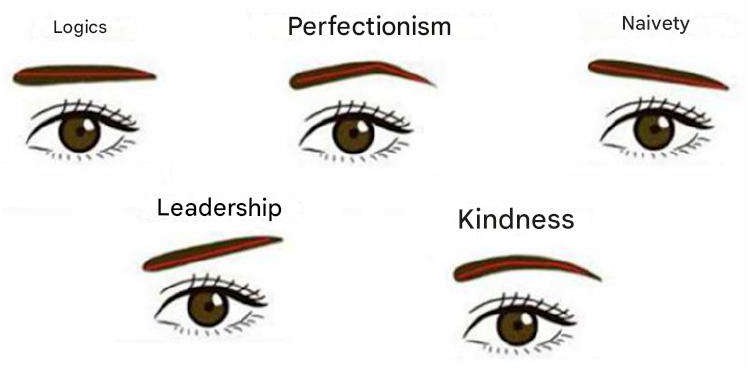
Fig. 1 – Psychology of eyebrows
As part of behavioral economics, experiments were conducted in which participants made decisions about collaboration by watching photographs or videos with minimal changes in the shape of their eyebrows. The results showed that eyebrows that give the impression of alertness or hidden aggression reduce the likelihood of choosing a cooperative strategy, even if the rest of the facial features remain unchanged. This confirms that eyebrows are one of the key elements of rapid social assessment, influencing trust, risk, and behavior prediction [3].
In the field of neuroaesthetics, scientists have found that eyebrow correction style can affect the perception of emotions. For example, clearly defined graphic eyebrows make the micro-contractions of the frontal muscles more noticeable, which enhances the perception of emotions of tension and discontent. At the same time, soft, shaded eyebrows soften harsh micro-expressions and create a more relaxed image [1].
Special attention is paid to differences between cultures. Modern research shows that in cultures with a high level of collectivism, arched eyebrows are usually perceived as a sign of benevolence and emotional expressiveness. At the same time, in individualistic cultures, straight eyebrows, which are dominant, are associated with confident and competent behavior.
Despite these differences, the basic mechanism remains universal: the shape of the eyebrows directs the observer's attention and serves as a clue for interpreting micro-expressions, which, in turn, accelerates the process of emotional and social assessment of the face (see Table 1).
Table 1
The effect of eyebrow shape on face perception [2]
|
№ |
Indicator |
Characteristic |
|
1 |
Emotional perception |
The shape of the eyebrows can dramatically change the facial expression. Raised eyebrows can express joy or surprise, while lowered eyebrows can convey sadness or anger. |
|
2 |
Symmetry and harmony |
Symmetrical eyebrows are often associated with attractiveness. Uneven or asymmetrical eyebrows can distract attention and create a sense of imbalance. |
|
3 |
Age |
The shape and thickness of the eyebrows can tell a lot about a person's age. Thin, high-arched eyebrows are often associated with youth, while heavier and lower-set eyebrows can give the impression of maturity. |
|
4 |
Cultural and individual preferences |
Different cultures have their own ideas about the beauty of eyebrows. For example, in some cultures, thick and wide eyebrows are preferred, while in others, thin and well–defined lines are preferred. |
|
5 |
Personality |
The shape of the eyebrows can also tell a lot about a person's personality. For example, straight and wide eyebrows are often associated with confidence and determination, while arched eyebrows can create the impression of a more friendly and romantic image. |
It should be noted that modern research faces a number of methodological and interpretative difficulties. One of the main problems is that eyebrow geometry rarely acts in isolation. It inevitably interacts with facial expressions, the structure of the eyes, and the shape of the skull and the general proportions of the face. This makes highlighting the pure eyebrow effect difficult and requires multiple models. Another difficulty is related to the fact that micro-expressions appear within milliseconds, and their accurate registration depends on lighting, equipment quality, and subjective coding. This leads to different interpretations of the same facial signals.
Cross-cultural differences also contribute to the complexity of eyebrow research. What is perceived as friendliness in one culture may be regarded as affectation, dominance, or even aggression in another. This makes it difficult to create universal models of eyebrow perception and makes it impossible to use research results in international projects or in computer vision systems. In addition, the impact of the cosmetics industry and digital filters on public standards is making its own adjustments. Natural eyebrows are being replaced by artificial ones, which distorts the data and complicates the study of the basic physiological response to them.
An important issue is the influence of the observer's expectations. People tend to interpret the shape of their eyebrows through their emotional and social experiences, which can reinforce stereotypes and reduce objectivity. This is especially noticeable when we evaluate reliability, aggression, or leadership qualities, where eyebrows become part of a quick but subjective "social scan." The situation is complicated by the fact that neural responses recorded using functional magnetic resonance imaging (fMRI) or electroencephalography (EEG) do not always allow us to understand whether they reflect emotions, changes in attention, or automatic processing of a visual stimulus.
Finally, there is a risk of exaggerating the importance of eyebrows. Some studies assign them too much of a role in personality perception, without taking into account other factors such as speech, posture, general facial expression, and interaction dynamics. This leads to simplified conclusions and reduces scientific accuracy.
In our opinion, in order to overcome the identified methodological and interpretative problems, an integrated approach is needed that combines technological, theoretical and intercultural strategies. One of the key steps is to standardize incentives: using large databases of faces with carefully controlled parameters minimizes the impact of extraneous factors such as eye shape or lighting. The use of three-dimensional modeling and generative neural networks opens up new possibilities. We can change the shape of the eyebrows separately, leaving the rest of the facial features unchanged. This allows us to identify the net effect of eyebrows and micro-movements, focusing on their impact on personality perception.
To improve the accuracy of micro-expression detection, we recommend using high-frequency cameras, automatic facial recognition systems, and machine learning algorithms. These tools allow you to reduce the subjectivity of coding and capture movements that last only a few milliseconds. This makes the analysis more objective and reproducible. In addition, the inclusion of multi-channel data such as electroencephalography (EEG) in combination with eye tracking helps to separate the attention response and the emotional processing of the stimulus. This reduces the risk of misinterpretation and makes the research process more accurate.
Cross-cultural differences in research are taken into account through multicenter projects involving representatives of different ethnic groups and the use of unified protocols. Comparing data from different regions allows us to identify universal patterns that can be separated from cultural expectations. Another important aspect is the use of double-blind procedures, when neither the participants nor the researchers know what a particular stimulus is intended for. This helps to reduce the impact of expectations and avoid confirming your own hypotheses.
To minimize the impact of social trends and cosmetic procedures, it is recommended to include both natural faces and controlled computer models without makeup in the research. This allows you to evaluate the difference between the perception of natural eyebrows and the so-called "constructed" ones.
In addition, long-term longitudinal studies provide an opportunity to understand how reactions change depending on social norms and cultural trends. This approach makes the results more stable and less susceptible to distortion caused by fashion.
Finally, the integration of data from various disciplines such as psychology, neuroscience, computer vision, and anthropology allows for a deeper and more accurate understanding of how eyebrows participate in social perception. This interdisciplinary approach helps to avoid simplifications, take into account the context and dynamics of communication, and create more informed models of emotion perception and personality traits based on eyebrow expression.
Conclusions
Psychophysiological studies on the shape of eyebrows and micro-expressions demonstrate that these seemingly insignificant details of appearance play a key role in social perception. They help create a first impression, interpret emotions, and evaluate a person's intentions.
Eyebrows are not only an important part of the facial anatomy, but they are also a powerful communication tool. They are able to influence the perception of various aspects, including emotion recognition, trust level, dominance, and social status. Micro-eyebrow movements can enhance emotional messages, appearing faster and more accurately than full facial reactions. This makes them important markers that can reveal a person's true feelings.
Modern analysis methods such as high-speed video, machine learning, and computer modeling have significantly improved the ability to capture and interpret subtle changes in facial expression. However, despite the achievements, research still faces certain methodological difficulties. The perception of the meaning of eyebrow shape is influenced by many factors, including cultural norms and cosmetic practices. A comprehensive and interdisciplinary approach is needed to gain a deeper understanding of this topic. However, the available evidence strongly suggests that eyebrows play a key role in non-verbal communication, providing a fast and effective way to convey emotions and interpersonal messages.
Thus, further improvement of facial recognition technologies, an increase in the number of participants from different cultures, and more precise standardization of stimuli are key areas contributing to a deeper understanding of the role of eyebrows in the process of social perception. These studies open up new horizons for psychology, neuroscience, communication system design, and even clinical diagnostics, emphasizing the importance of paying attention to the smallest details of human facial expression.
References:
- Anishchenko K. V. The influence of eyebrow shape on face perception: emotions, facial expressions, character, appearance // Scientific Leader. – 2024. – No. 7 (157). – pp. 12-15.
- Gorbunova O.A. Psychology of makeup: influence on perception and self-expression // Bulletin of Science. – No. 5 (7 (64)). – 2023. – pp. 194-201.
- Lemeshevskaya Z.P. Diagnosis of the mental state of a person by facial expressions // Journal of the State Medical University – 2010 – No. 1. – pp. 62-67.
Other articles of the issue