

Eco-principles in the design of women's clothing and the choice of sustainable materials
Authors
Khayitboeva Nodirakhon

Share
Annotation
The paper examines the eco-principles used in the design of women's clothing, as well as the criteria for choosing sustainable and safe materials. Modern approaches to eco-friendly design are analyzed, including waste minimization, creation of multifunctional and durable products, use of local production and closed cycles. Special attention is paid to the properties of natural, recycled and alternative fibers, their ecological footprint, dyeing methods and low environmental impact technologies. The importance of conscious consumption, transparency of supply chains and the implementation of international sustainability standards is emphasized. The material is intended for designers, researchers, and fashion industry professionals seeking to integrate sustainable solutions into the development of women's clothing
Keywords
Authors
Khayitboeva Nodirakhon
Share
Relevance of the study
In the modern world, the fashion industry remains one of the most resource-intensive and environmentally problematic industries. This makes it especially important to introduce eco-principles into the design of women's clothing. Challenges such as growing overproduction, high levels of textile waste, the use of non-environmentally friendly dyes and synthetic fibers, and opaque supply chains require a shift to sustainable production models.
Consumers are increasingly paying attention to the environmental friendliness and ethics of brands, which makes the use of sustainable materials and responsible technologies not only a competitive advantage, but also an important area of scientific research.
Thus, the study of eco-principles in design and the possibilities of a sustainable choice of materials becomes not only relevant, but also socially significant.
The purpose of the study
The purpose of this study is a comprehensive analysis of the environmental principles used in the design of women's clothing. We also strive to define criteria for the selection of sustainable materials that contribute to reducing negative environmental impacts, prolonging product life and ensuring environmental responsibility at all stages of the clothing lifecycle.
Materials and research methods
The research examined scientific papers on sustainable design, as well as international environmental standards and information on the properties of various fibers: natural, recycled and innovative. In addition, analytical reports on the state of the fashion industry were analyzed.
To achieve the purpose of the study, methods of comparative analysis of textile materials, content analysis of international ecodesign practices, systematization of environmental criteria for the selection of raw materials and technologies, as well as product lifecycle assessment were used. This comprehensive approach allows us to better understand the principles of sustainable design and determine their practical application in the creation of women's clothing.
The results of the study
The process of forming eco-principles in the design of women's clothing has been long and complex, closely related to the evolution of public consciousness and technological development.
The first prerequisites for a sustainable approach originated in the middle of the XX century, when people began to understand the consequences of mass industrialization and the dominance of cheap synthetic clothing in the market. Already in the 1960s and 1970s, an environmental movement appeared in the West, which stimulated interest in natural materials and manual labor. However, at that time, fashion design only rarely included elements of sustainable development, without becoming systemic.
Since the early 1990s, sustainable fashion has been emerging as a distinct trend. In the era of globalization and the rapid growth of fast fashion, researchers and designers are beginning to think about the problems faced by water resources, toxic dyes, excessive energy consumption and working conditions in the countries where clothing is produced. It was at this time that the first brands using organic cotton, natural dyes and recycled fabric appeared. Sustainable materials are beginning to be evaluated not only by their origin, but also by their entire life cycle.
In the 2000s, recycling technologies have developed significantly, which has led to the emergence of new environmentally friendly materials. Fabrics from recycled polyester, bio-fibers based on corn, eucalyptus and bamboo were created, and methods of low water dyeing were developed. At the same time, interest in minimalist design, slow fashion, and the concept of smart consumption has increased. Environmental principles have ceased to be something marginal and have become an integral part of mainstream culture. Major manufacturers have started to produce ecological clothing lines.
In the 2010s, an international system of standards and certifications was established to confirm the sustainability of the origin of fabrics and the ethics of production processes. Digital design was also actively developing, which significantly reduced the amount of waste at the layout stage. Sustainable women's clothing design has increasingly relied on scientific research and accurate environmental metrics, which has contributed to its development and popularization [2].
In the modern world, environmental principles are becoming not only a part of the environment, but also a part of culture. Innovations related to the use of biomaterials, closed-loop recycling, waste-free sewing methods and the creation of long-life clothing are coming to the fore. The history of the development of sustainable approaches in women's fashion shows how ecodesign has transformed from an experiment of enthusiasts into an important strategic vector of the industry, which forms new standards of responsibility and quality (Table 1).
Table 1
Wildlife objects and their functions of interest as ecodesign models [1]
|
A source of inspiration and study |
Distinctive features |
Adaptation to the application |
|
Duck, feathers and the structure of the endocrine system, body shape |
– streamlined body shape, smooth lines, proportions; – thick waterproof; plumage coated with grease. |
– smooth structural lines of the product; – water-repellent material of the upper layer of the product; – volumetric inner filling, "puffy" type. |
|
Pine, bark surface, roots, cones |
– multilayered crust surface; – a powerful developed root system; – cone water absorption system. |
– breathable material system for clothing; – water-repellent surface of products; – the print is like a complex system of intertwining the roots and the surface pattern of the bark. |
|
Plant elements |
– plasticity, adaptability to changes in lighting. |
– ornamental smooth lines; – ergonomic bionic shape of product designs. |
It should be emphasized that modern technologies used in the eco-design of women's clothing represent a holistic approach aimed at minimizing the environmental footprint at all stages of the product's life cycle. Today's trends combine scientific developments, digitalization, and new manufacturing practices, which makes it possible to create materials and clothing with minimal environmental impact.
One of the key areas is the processing of textile waste and plastic raw materials. As a result, recycled polyester, recycled viscose and mixed fibers of a new generation are actively used. These materials are characterized by stable quality and significantly lower environmental impact compared to primary raw materials. In addition, chemical and mechanical separation of fabrics is actively developing, which opens up new horizons for the processing of mixed textiles that were previously considered unsuitable for reuse (Fig. 1).
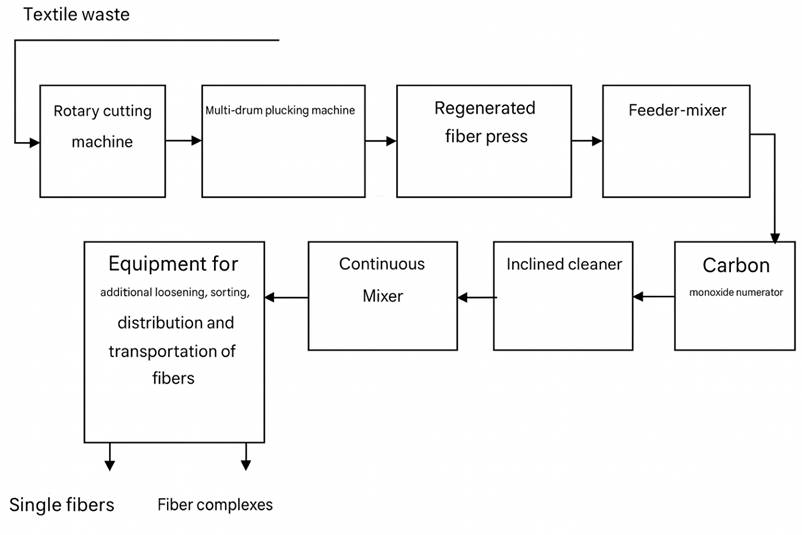 Fig. 1. Diagram of the developed technological line for processing textile waste and producing regenerated fibers
Recently, much attention has been paid to the creation of biomaterials that are produced from plant raw materials and as a result of microbiological processes. Among them are fibers obtained from eucalyptus, bamboo, banana stalks, as well as from waste from oranges and pineapples. These materials require less water, energy, and chemicals for their production and are often manufactured in closed cycles to avoid environmental emissions. Innovations are also developing in the field of microbial tissues that are grown using fungal cultures or bacterial cellulose. These materials are biocompatible and biodegradable, which makes them more sustainable and reduces the dependence of the fashion industry on petrochemicals [3].
Digital technologies also play an important role in the fashion world. In particular, 3D design and virtual fitting systems are used, which allow you to create accurate patterns and reduce the number of prototypes. This, in turn, reduces the amount of textile waste and saves resources at the collection development stage. At the same time, additive manufacturing technology is being developed, which makes it possible to form clothes or its elements with an accurate calculation of material consumption, which practically eliminates cutting waste. Artificial intelligence helps predict demand, optimize production and avoid overproduction, which is one of the main environmental problems of modern fashion.
In recent years, special attention has been paid to low water and anhydrous technologies in the field of dyeing and finishing fabrics. Such technologies include high-pressure co₂ dyeing, the use of natural and biodegradable dyes, as well as enzymatic tissue processing processes. These methods can significantly reduce water consumption and prevent toxic substances from entering water resources. Digital printing is increasingly being used, in which dyes are applied to the fabric point-by-point. This not only reduces the consumption of dyes and water, but also improves print quality [4].
In modern women's clothing design, special attention is paid to the use of environmentally friendly materials. Manufacturers carefully analyze the entire product lifecycle to select fibers with a minimal carbon footprint, low water consumption and a high degree of recycling. Among the materials used are certified organic cotton, Tencel, EcoVero, recycled polyester and biodegradable blends. Special attention is paid to the durability of fabrics, the possibility of their subsequent processing and the versatility of the design. This allows you to extend the life of clothing and reduce its environmental footprint.
Modern eco-principles in women's clothing design are based on a combination of technological innovations, environmentally friendly materials and digital production management tools. These technologies form a new model of the fashion industry, which focuses on sustainability, resource conservation and environmental responsibility at all stages of product creation. Despite the active development of eco-friendly design of women's clothing, the introduction of eco-principles faces serious problems that affect production, economics, and technology and consumer behavior.
One of the main difficulties is the high cost of sustainable materials. Organic cotton, innovative biotissues and fibers produced in a closed cycle require significant investments in cultivation, processing and certification. This makes the final products more expensive, which reduces their availability to a wide range of customers and limits the spread of sustainable fashion.
In addition, there is a problem with the textile-recycling infrastructure. Most fabrics, especially those with a mixed composition, are difficult to separate and return to production, which leads to the accumulation of textile waste and reduces the efficiency of the closed cycle. Some innovative materials that are positioned as environmentally friendly actually require complex chemical processes or significant energy costs, which calls into question their real sustainability. Another problem is the lack of uniform international standards. Because of this, manufacturers use different certification systems, and consumers face information confusion and distrust.
Additional difficulties are associated with the phenomenon of greenwashing, when companies claim that their products are environmentally friendly without providing reliable evidence. This undermines trust in sustainable materials and makes it difficult for consumers to make informed choices. In addition, there is a lack of transparency in supply chains. It is often impossible to track the origin of raw materials, working conditions in production and real environmental indicators, especially if there are many intermediaries involved in the chain.
Technological barriers also affect the development of eco-design. Some biodegradable or recycled materials are still inferior to traditional fabrics in terms of durability, strength or appearance. This limits the capabilities of designers and can lead to a shorter product life, which contradicts the principles of sustainability. In addition, the introduction of digital and low water technologies requires expensive equipment and qualified specialists, which makes it difficult for small and medium-sized businesses to switch to them.
An equally serious obstacle to creating more environmentally friendly fashion is the culture of frequent shopping and rapid wardrobe updates. Even clothes made with care for the environment cannot compensate for excessive consumption, which remains one of the main causes of environmental problems in the fashion industry. The transition to a more conscious lifestyle is slow, and it is difficult for brands to meet demand and follow strict environmental principles at the same time.
The development of eco-design of women's clothing faces many interrelated challenges, including economic constraints, technological barriers, information opacity, cultural consumer behavior, and insufficient infrastructure for recycling. Solving these problems requires an integrated approach, cooperation between producers, government and consumers, as well as long-term investments in technology and education.
We are convinced that an integrated approach is needed to solve the problems associated with the introduction of eco-principles in the design of women's clothing and the choice of sustainable materials. It should include technological innovation, economic incentives, management strategies, and changing consumer behavior. One of the key aspects is to reduce the cost of eco-friendly materials. This is achieved by increasing the scale of production, using more efficient methods of growing raw materials and supporting producers with government programs. These programs include subsidies, tax breaks, and incentives for local production. Thanks to such measures, sustainable fabrics become more competitive and accessible to a wide range of consumers.
The key aspect is the development of infrastructure for textile processing. This includes the creation of modern sorting centers, laboratories for the analysis of mixed fibers, and the introduction of innovative chemical and mechanical recycling technologies. Thanks to these technologies, even complex materials can be reused, which significantly reduces waste. At the same time, it is necessary to develop uniform international sustainability standards and ensure transparency of certification. This will help unify requirements, increase consumer confidence, and reduce the risk of so—called "greenwashing" - the unfair practice of selling goods that are allegedly made from environmentally friendly materials. Digital tracking tools such as blockchain tags, QR product passports, and raw material monitoring systems are making supply chains more transparent and reliable.
Overcoming technological obstacles is associated with the development of new fibers that are simultaneously environmentally friendly, high quality, durable and attractive. Research in the field of biomaterials, microbiological fibers, recycled polyamide and improved versions of viscose opens the door to the creation of fabrics that can compete with traditional ones. Investments in modern equipment, low-water staining technologies and energy-efficient production contribute to reducing the negative impact on the environment, even when using complex production processes.
Changing consumer culture remains an equally important task. Educational programs, conscious consumption campaigns, as well as the development of second-hand stores, resale platforms, and clothing rental services help in this. Brands can extend the service life of their products through high-quality tailoring, modular designs, repair capabilities, and thoughtful design. The combination of aesthetics and functionality makes sustainable fashion attractive to a wide audience, which enhances its competitive advantages.
The complex interaction of industry, technology centers, the state and consumers allows us to consistently solve the problems of eco-friendly design. This contributes to the sustainable development of fashion and minimizes its negative impact on the environment.
Conclusions
The transition to a more environmentally friendly design of women's clothing and the use of sustainable materials is a strategically important direction for the development of the modern fashion industry. To solve key problems such as the high cost of eco-friendly fabrics, the lack of technologies for their processing, the opacity of supply chains and low consumer awareness, it is necessary to combine the efforts of manufacturers, the government, research centers and the audience itself.
Comprehensive measures, including support for innovation, standardization of sustainable practices, development of infrastructure for recycling and the formation of a culture of conscious consumption, create conditions for the large-scale implementation of eco-design. This makes eco—friendly materials more affordable, production processes safer, and fashion a more responsible and long—term segment of the economy.
Thus, sustainable design is gradually becoming an integral part of our lives from an isolated initiative. It helps to reduce the negative impact of the industry on the environment and create a more harmonious interaction between fashion, society and nature.
References:
- Kokovina M.V. Eco-design at the junction of sciences. Costume design, materials science, bionics, cultural studies, ecology // Proceedings of the international scientific and practical conference "Innovation and Design". – № (1). – 2020. – pp. 125-129.
- Murtazina S. A., Garifullina G. A. The use of polymer materials in modern sewing production and clothing design // Bulletin of Kazan Technological University. – №15 (9). – 2012. – pp. 130-134.
- Khammatova E. A. Eco-style in clothing based on natural polymer materials and color solutions // Bulletin of Kazan Technological University. – № (18). – 2011. – pp. 342-345.
- Fatkullina R.R., Sofronova N.R., Sirazova C.I. Selection of materials with polymer composition for children's clothing // Bulletin of Kazan Technological University. – № 19 (24). – 2016. – pp. 88-89.
Other articles of the issue