

3D modeling technologies in the process of developing women's collections
Authors
Khayitboeva Nodirakhon

Share
Annotation
This article discusses the use of 3D modeling in the process of creating women's fashion collections. In particular, we will talk about modern software solutions that allow us to create digital prototypes of products, create accurate patterns, simulate fit on virtual models, and visualize fabrics and finishes. The authors of the article analyze the advantages of the 3D approach, such as reducing development time, reducing production costs, reducing the number of physical samples and increasing the accuracy of design solutions. Special attention is paid to the impact of 3D technologies on the creative process, communication between designers and production, as well as on the sustainability of the fashion industry as a whole
Keywords
Authors
Khayitboeva Nodirakhon
Share
Relevance of the study
The rapid development of digital technologies and increasing competition in the fashion industry are forcing companies to rapidly reduce the development time and improve the design accuracy of their products. 3D modeling has become an essential tool that allows us to abandon the traditional creation of physical samples in favor of digital prototypes. This, in turn, significantly reduces the preparation time of collections, reduces costs and reduces the amount of production waste.
The use of 3D technologies is especially effective in creating women's collections, where precision of fit, complexity of shapes and variability of solutions are of particular importance. The introduction of 3D modeling contributes to the sustainable development of the fashion industry, improves communication between designers, technologists and production units, and expands the creative horizons of specialists.
The purpose of the study
The purpose of this study is to comprehensively explore the possibilities and effectiveness of using 3D technologies in the development of women's collections. We also intend to understand how these technologies affect the quality of design solutions, the speed of development and pre-production. In addition, we aim to identify both the advantages and limitations of the digital approach compared to traditional methods.
Materials and research methods
In the course of our research, we rely on modern software solutions for 3D modeling of clothing, such as CLO 3D, Browzwear VStitcher, Marvelous Designer and others. We will also look at examples of creating digital samples of women's clothing, virtual patterns and avatars.
In the process, we use methods of comparative analysis of traditional and digital technologies to develop collections. The visual-graphical method is used to evaluate digital prototypes. A systematic approach allows you to study all stages of design, and the expert assessment method is based on the practical experience of designers and technologists.
We also use data from industry publications, practical cases, and the results of testing virtual products in professional software environments.
The results of the study
The history of 3D technologies in the fashion industry dates back to the end of the XX century, when the first computer-aided design systems began to be introduced into clothing production. These programs were designed to create two-dimensional patterns and optimize layouts. However, with the development of computer graphics and the increase in computing power, the first experiments with three-dimensional modeling of clothing began to appear. In the 1990s, the engineering industries actively used 3D modeling, while the fashion industry lagged behind them due to the difficulties associated with working with soft materials and the need to accurately simulate the behavior of fabrics.
In the early 2000s, the first specialized programs appeared that could create three-dimensional models of fabrics. However, their realism left much to be desired, and they were used more for visualization than for actual clothing design. The real breakthrough came after 2010, when systems such as Marvelous Designer and CLO 3D appeared. These programs used improved physics engines that made it possible to more accurately reproduce the drapery, stretching, and behavior of various materials. This made it possible to move from static 3D visualization to full-fledged digital prototyping.
In parallel with the development of software, technologies for creating digital avatars were improved, which made it possible to take into account the individual characteristics of various types of figures. This has become a key aspect for the fashion industry, where precision fit is of paramount importance.
At this time, brands began to actively use 3D modeling to create virtual clothing samples. This approach significantly reduced the number of required physical prototypes and accelerated the development process of new collections.
By the mid-2010s, leading global companies such as Adidas, Nike, H&M, as well as many design houses, began actively implementing digital technologies based on 3D modeling. Thanks to the integration of virtual reality (VR) and augmented reality (AR) technologies, virtual showrooms and digital collection presentations have emerged. And with the advent of digital doubles of models, it became possible to organize virtual screenings. At the same time, the concept of digital fashion was developing, in which 3D clothing existed exclusively in virtual space.
In the 2020s, the development of 3D technology accelerated, driven by a growing interest in sustainable fashion and a desire to reduce production waste. Software manufacturers have implemented tools that allow you to automatically create patterns, simulate complex materials, and create realistic textures and animations. Virtual modeling has become an integral part of the collection development process, and digital technologies have begun to be actively used not only in design, but also in marketing, online retail, specialist training, and the creation of metaverses.
Today, 3D modeling is widely used not only in the fashion industry, but also in other fields. It continues to evolve, integrating with artificial intelligence, machine learning, and neural networks, making the design process faster, more accurate, and more flexible (Table 1).
Table 1
Overview of 3D technologies [2]
|
№ |
Sphere |
Characteristic |
|
1. |
Production |
Prototyping and small – scale production of parts, testing of design and ergonomics, as well as demonstration of concepts to investors are all integral stages of development and production. The aerospace and oil and gas industries are examples. |
|
2. |
Medicine |
Manufacture of individual prostheses, implants and orthoses. 3D bioprinting of tissues and organs. Planning operations using 3D models of organs. |
|
3. |
Construction |
3D printing of houses and infrastructure, creation of complex architectural forms. |
|
4. |
Education and science |
Data visualization and the study of anatomy, archaeology and physics using three-dimensional models. |
|
5. |
Art and Fashion |
Manufacture of unique jewelry, fabrics, clothing and art objects, as well as restoration of cultural heritage. |
|
6. |
Movies, animation, and video games |
Creating visual effects (VFX) for films, characters and worlds in animation, as well as game locations and objects is what experts in this field do. |
It is worth noting that modern technologies have revolutionized the process of creating women's collections, turning the traditional development cycle into a flexible digital system. Designers can now create, try on, and adjust products without using multiple physical samples.
These processes are based on high-precision 3D fabric simulation programs, among which CLO 3D, Browzwear VStitcher and Marvelous Designer stand out. The systems use physics engines that can simulate the behavior of materials, taking into account their density, elasticity, weight, and stretchability. Thanks to this, designers can create realistic virtual prototypes, allowing them to see in advance how the dress will drape, how the skirt will react to movement, or how tightly the jacket will fit the figure [1].
Digital avatars are of particular importance in the modern clothing manufacturing process. They allow you to create clothing models that will fit perfectly on figures of any type and size. Brands striving for inclusivity use personalized avatars, which ensures a perfect fit in an expanded dimensional grid. The most advanced companies create their own 3D avatar libraries, which are based on scanning data from real models. This allows you to achieve high accuracy when modeling women's clothing, especially in the collections of the pret-a-porter and premium segment.
An important step is also the creation of digital libraries of fabrics, where each material is digitized and has real physical parameters, which allows obtaining the most reliable visual results (Fig. 1).
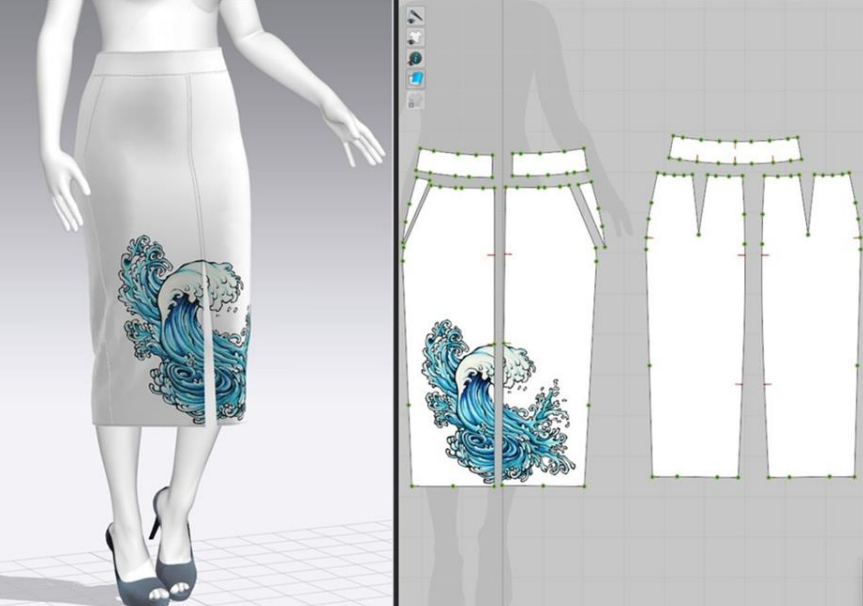
Fig. 1. The location of the print on the patterns and on the virtual product [2]
Modern fashion brands actively use 3D modeling at all stages of creating their collections. For example, Zara and H&M use it to speed up the development process of basic models and reduce the number of physical prototypes. This allows them to quickly respond to current trends. Dior and Balenciaga use 3D to work out complex design solutions in women's dresses and outerwear. This is necessary for accurate simulation of volumes and shapes, which is especially important when creating models that must be flawless. Sports brands such as Nike and Adidas use 3D in the design of women's sports collections. This allows them to optimize ergonomics, test the fit with dynamic movements and integrate modern materials, which significantly improves the quality of sportswear [3].
3D visualization is actively used in marketing and merchandising. Many brands create digital images that are then used in online catalogs, advertising campaigns, and virtual showrooms. This allows you to present collections of women's clothing even before the start of physical production, which significantly reduces risks and increases the accuracy of sales planning. In addition, augmented reality-based solutions are emerging that give customers the opportunity to "try on" a product digitally before purchasing.
Modern 3D modeling technologies have become an essential tool for developing women's collections. They ensure the accuracy of the design, acceleration of the production cycle, realistic visualization and reduced resource consumption. These methods not only improve the quality of design, but also contribute to the introduction of more sustainable approaches in the industry, reducing waste and minimizing the need for physical prototyping.
It should be noted that, despite the huge possibilities, the use of 3D modeling in the development of women's collections is fraught with some serious problems. These issues affect both the creative and technical aspects of the work.
One of the main problems is the limited accuracy of the simulation of materials. Even the most modern physics engines cannot always accurately reproduce the behavior of complex fabrics such as silk, lace, chiffon, or materials with complex thread interweaving. As a result, the virtual sample may look perfect, but in reality the product may sit differently. This requires additional adjustments and still forces us to produce physical prototypes.
Another major obstacle is the lack of realistic fit of women's clothing on different types of figures. Avatars in programs often have average proportions, and creating individual digital mannequins requires expensive 3D scanning. This is especially true for women's collections, where small differences in anatomy strongly affect the fit, for example, in the chest, waist and hips. A virtual fitting does not always accurately show how a thing will behave in real conditions, especially when moving.
Technical difficulties also lie in the fact that professional 3D programs such as CLO 3D, Browzwear, and others require a deep understanding of the design fundamentals, digital fabric skills, and knowledge of simulation features. Many designers, especially those with an art degree, have difficulty transitioning to a digital environment, which slows down the development process. In addition, such programs require powerful computers for stable operation, which increases costs and makes them less accessible to small brands.
Difficulties also arise at the stage of integrating 3D models into the production cycle. Digital patterns obtained after simulation are not always ideal for industrial cutting, and adapting files to different computer-aided design (CAD) systems can lead to errors. Manufacturing partners are not always ready to work with 3D data, as many factories use outdated systems that require conversion or manual adjustments.
Another obstacle is the lack of standardization of digital libraries of fabrics and accessories. Different software manufacturers use their own formats, which complicates data exchange between studios, brands, and vendors. As a result, the design created in one program is not always correctly transferred to another, which reduces the flexibility of workflows.
Finally, it is impossible not to mention the psychological aspect, which also plays an important role. Some designers are afraid of losing their creative freedom, believing that 3D tools make the process too technical and reduce the importance of handmade, which is especially appreciated in women's fashion. This causes resistance within companies and slows down the adoption of digital technologies.
The problems associated with the use of 3D modeling in the development of women's collections cover technical, creative and organizational aspects. Despite the significant potential of these technologies, their effective application requires a comprehensive adaptation of production processes, training of specialists and improving the accuracy of simulation of both materials and product fit.
We believe that solving the problems associated with 3D modeling in women's fashion requires a comprehensive approach. It should be aimed at improving simulation accuracy, integrating digital technologies into production processes, and enhancing the digital competence of designers.
A significant breakthrough has been made possible by creating more accurate libraries of materials with detailed physical characteristics. These characteristics were obtained as a result of laboratory tests for stretchability, drapability and density, which significantly increases the realistic behavior of complex fabrics.
Personalized avatars are actively used to make clothes fit correctly on different types of female figures. They are created based on 3D scanning or parametric models, which allows for more accurate consideration of anatomical features. An important solution is to train specialists. Brands are implementing systematic professional development programs and training employees to work with platforms such as CLOUD, Browzwear, and others. This helps you learn digital tools faster and overcome your fear of technology.
For small companies, accessibility is even higher thanks to cloud services that eliminate the need for expensive equipment. Cross-system compatibility is improved by standardizing digital formats and collaborating with software developers. This greatly simplifies the integration of 3D sketches into CAD production systems and minimizes the risk of errors when exchanging files.
Production partners are gradually getting used to the digital process thanks to the introduction of automatic cutting systems that can work with 3D data without additional transformations. Psychological barriers are being lowered as people see the cost-effectiveness and creative benefits of this technology. For example, you can quickly test ideas, simulate dozens of options, and create realistic visualizations of collections.
As a result of the comprehensive solution of technological and organizational problems, 3D modeling becomes a reliable tool that significantly speeds up the process of creating women's collections and improves the quality of the final product.
Conclusions
The use of 3D modeling in the process of creating women's collections is one of the key directions of the digital transformation of the fashion industry. This technology not only significantly speeds up the design process and allows you to more accurately predict how the product will sit and look, but also contributes to a conscious reduction in material consumption through virtual prototyping.
Despite some difficulties, such as the need to use precise digital fabrics, training specialists, and adapting production processes, trends show that the benefits of 3D modeling far exceed the costs of its implementation. As software evolves, format compatibility improves, and digital skills spread among designers, the effectiveness of 3D modeling will only grow.
Thus, the use of three-dimensional technologies goes beyond just a fashion trend, and becomes a prerequisite for maintaining the competitiveness of brands seeking to create high quality, innovative and environmentally friendly women's collections.
References:
- Guseva M.A., Andreeva E.G., Kyzy Ali Kurmanzhan. Virtual tools for a comprehensive assessment of the quality of clothing with a complex textured surface // Territory of new opportunities. - 2021. - No. 3. - pp. 150-151.
- Rukavishnikova T.V. 3D simulation and visualization of clothing: innovations and prospects // Universum: technical sciences. - No. 3 (9 (138)). - 2025. - pp. 39-52.
- Sagar Kadam. 3D Fashion Design Software Market Forecast to 2034: A Detailed Look at Growth Key Segments, and Regional Insights // Market Research Future Press Releases. 04/11/25. [Electronic resource]. – Access mode: https://www.einpresswire.com/article/802317847/3d-fashion-design-software-market-forecast-to-2034-adetailed-look-at-growth-key-segments-and-regional-insights
Other articles of the issue