

Route optimization and transportation planning using artificial
Authors
Samoilenko Sergii
Share
Annotation
The article discusses modern approaches to route optimization and transportation planning using artificial intelligence techniques. It analyzes machine-learning algorithms, neural networks, and heuristic methods to improve the efficiency of logistics operations, reduce fuel costs, and shorten delivery times. Special attention is given to the integration of intelligent systems with transport platforms, enabling real-time adaptive route management and improved demand forecasting accuracy. The results of a comparative study between traditional and intelligent planning models are presented. The article demonstrates the impact of these models on the productivity of transportation companies and the sustainability of the logistics industry.
Keywords
Authors
Samoilenko Sergii
Share
The relevance of research. Modern transport and logistics systems face an increase in traffic volumes and the complexity of transport networks. They also need to respond quickly to changes in demand. Traditional route planning methods are not flexible enough to ensure optimal resource allocation. Using artificial intelligence (AI) technologies can automate the decision-making process, reduce costs, and improve forecasting accuracy. This makes the study of these technologies especially relevant in the context of digital transformation in logistics.
The purpose of the study. The aim of the research is to develop and validate approaches to route optimization and transportation planning using artificial intelligence techniques in order to improve the efficiency of transportation operations, reduce time and financial expenses, and enhance the quality of logistics services.
Materials and methods of research. The research materials include data on traffic flows, route structures, transportation schedules, and operational parameters of logistics systems. To conduct the research, the following methods were used:
- Analysis of literature and existing routing models.
- Machine learning techniques, including both supervised and unsupervised learning.
- Neural networks for predicting demand and traffic conditions.
- Optimization algorithms such as genetic algorithms, ant colony optimization, and evolutionary algorithms.
- Modeling and comparative analysis of the effectiveness of proposed solutions based on both test data and real-world data.
The results of the study. The history of the use of artificial intelligence in route construction and transportation planning dates back to the mid XX century, when mathematical models and optimization problems were the focus.
In the 1960s and 1970s, scientists were actively investigating the traveling salesman problem and the vehicle routing problem (VRP). They created algorithms that could minimize distance and cost when servicing multiple delivery points. These early approaches were based on rigorous mathematical methods, such as linear and integer programming. They also used heuristics, which formed the basis for future intelligent systems.
In the 1980s and 1990s, the use of expert systems, the first form of artificial intelligence in logistics, began. These systems included knowledge and rules based on the experience of logistics experts, and they could recommend optimal routes considering constraints such as driver hours, transport capacity, and customer schedules. However, these decisions were static and depended on predefined rules, limiting their ability to adapt to changes in the external environment.
In the early 2000s, the development of digital technologies and the availability of large volumes of data enabled the use of machine learning to analyze and predict traffic patterns. Algorithms started to take into account dynamic factors such as traffic jams, weather conditions, and seasonal variations in demand. Routing systems started to learn from historical data and forecast optimal solutions, considering the behavior of transportation and infrastructure characteristics (Fig. 1).
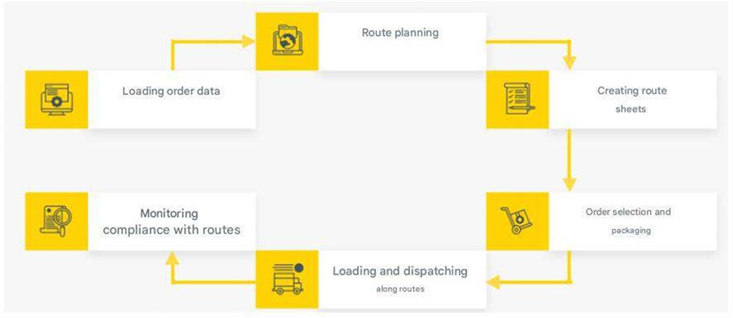
Fig. 1 – The scheme of distribution of orders and routing of delivery
Since the 2010s, advances in neural networks and computing power have paved the way for the creation of intelligent platforms based on deep learning and Reinforcement Learning methods. These technologies have allowed routing systems to adapt in real-time, redistributing routes in case of changes in traffic conditions, accidents, or urgent orders. Companies such as Google, Uber, and Amazon, as well as logistics operators have begun to actively implement AI for transportation management. This has led to increased fleet utilization, reduced empty mileage, and improved delivery times.
At the present time (2020s), artificial intelligence (AI) has become an essential component of integrated transport management systems (TMS) and intelligent transport systems (ITS). It integrates with the internet of things (IoT), demand forecasting systems, computer vision, and sensor networks to provide a continuous flow of data on vehicles, roads, and cargo.
Modern solutions use hybrid models that combine optimization algorithms and machine learning techniques to ensure the complete digitalization of logistics processes from planning to real-time monitoring of route execution. The development of AI applications in routing and transportation planning has evolved from mathematical models and simple expert systems to self-learning platforms that can predict, adapt, and make decisions independently. This transition is a key factor in enhancing the efficiency and sustainability of transportation networks in the age of smart logistics [3].
It should be noted that modern technologies used in routing and transportation-planning systems are closely linked to the development of artificial intelligence (AI), big data analysis, and the Internet of Things (IoT).
AI can significantly improve the efficiency of transportation and logistics processes by providing adaptive information analysis, optimizing routes, and forecasting real-time situations. Machine learning is used to analyze vast amounts of data on traffic, weather conditions, driver behavior, and vehicle characteristics. This data is used to train algorithms that find optimal solutions, create flexible routes, and minimize time and resource costs.
Deep neural networks enable systems to analyze complex data sources, such as satellite images, video streams, and road sensor data. This allows for the detection of congestion, accidents, and real-time prediction of traffic changes.
Reinforcement learning algorithms are widely used in ride-hailing services such as Uber and Yandex to quickly reallocate vehicles when demand or traffic conditions change. These algorithms help optimize the performance of drivers, reduce customer-waiting times, and prevent empty runs [1].
In corporate logistics, Amazon, DHL, and other major carriers are implementing intelligent planning systems that consider multiple factors - order priority, route specifics, warehouse conditions, weather forecasts, and traffic conditions. These systems generate optimal delivery plans, minimize transport downtime, and enhance the accuracy of order fulfillment. Predictive analytics allow them to anticipate transportation demand, plan vehicle loading, and prevent inefficient resource allocation.
The integration of AI and the Internet of Things is essential. Vehicles are equipped with sensors that collect data on their technical condition, fuel levels, travel times, and driving parameters. This information is used to analyze possible risks and prevent breakdowns, increasing the reliability of the transportation system. Additionally, the use of digital twins and cloud platforms allows for the simulation of various routing scenarios and automatic adjustment of logistics chains when conditions change (Tab. 1).
Table 1 – Artificial intelligence in corporate logistics [2]
|
№ |
Indicator |
Characteristic |
|
1 |
Route optimization |
AI can analyze traffic data, weather conditions, and other factors to find the most efficient delivery routes. This helps reduce travel time and save fuel. |
|
2 |
Forecasting demand |
With the help of machine learning, artificial intelligence can predict customer needs based on historical data and current trends. This helps to avoid overstocking or understocking of inventory. |
|
3 |
Inventory management |
AI can help automate inventory management, helping companies maintain optimal levels of inventory and minimize storage costs. |
|
4 |
Process automation |
AI can be used to automate repetitive tasks such as order processing and document management, freeing up employees to focus on more challenging tasks. |
|
5 |
Data analysis |
AI systems can process and analyze vast amounts of data, revealing patterns and trends that would be difficult to identify manually. |
|
5 |
Risk management |
AI can help assess supply-side risks by predicting possible disruptions in the supply chain and offering alternative solutions. |
|
6 |
Intelligent transportation systems |
AI can be used to manage a fleet, including monitoring the condition of vehicles and ensuring proper maintenance. |
|
7 |
Customer service |
Chatbots and AI-powered virtual assistants can enhance customer interaction by providing information on delivery status and resolving any issues that may arise. |
Artificial intelligence is becoming an essential part of modern transportation and logistics management. It offers a shift from manual and static planning methods to dynamic, self-learning systems that not only create the most efficient routes, but can also predict future events, lower costs, and enhance the stability of the overall logistics infrastructure.
It should be noted that while artificial intelligence has achieved significant success in solving transportation planning and route construction problems, there are still several challenges associated with its use. One of the main difficulties is the quality and completeness of the input data. AI algorithms require a large amount of accurate and reliable information about road networks, traffic patterns, weather conditions, traffic restrictions, and the technical status of transportation vehicles. However, data can often be incomplete, outdated, or contain errors, which can reduce the accuracy of optimization models and lead to errors in predictions.
Another challenge is the difficulty in accurately modeling the complexities of the transportation system. A wide range of dynamic factors, such as traffic congestion, accidents, maintenance work, time constraints, and human behavior, influences routes. Even the most sophisticated machine learning algorithms are not always able to fully account for all of these variables in real-time. This necessitates the continuous updating and refinement of algorithms to ensure accurate predictions.
The computational complexity of optimization problems also creates a significant difficulty. Routing problems such as the traveling salesman problem or the Vehicle routing problem (VRP) are classified as NP-hard. For large transport networks, the number of possible solutions is growing exponentially, and even high-performance computing clusters do not always provide fast processing. As a result, you have to use heuristic or approximate methods, which reduces the accuracy of optimization.
Equally important is the issue of interpretability of AI solutions. Deep learning algorithms often operate like "black boxes," making it difficult to understand why a system chooses one path over another. This lack of transparency reduces the trust of users and clients, especially in the field of transportation of valuable goods. Additionally, there is a risk of errors in the system that could lead to significant failures if the model is trained incorrectly or the data used is flawed.
Implementing AI technologies requires substantial investments in software, infrastructure, and training for specialists. Small and medium-sized businesses often lack the resources to support such solutions. Furthermore, there are concerns about the security of personal and business data, as optimization algorithms utilize geolocation information and customer profiles for analysis.
The main challenges of route optimization and transportation planning using artificial intelligence include the difficulty in providing high-quality data, the high computational load, the need to adapt to changing conditions, the limited transparency of algorithms, and significant economic obstacles. Overcoming these challenges requires a comprehensive approach that includes infrastructure development, standardization of data, increased transparency of models, and a balanced approach between automation and human oversight.
In our opinion, to effectively address the challenges associated with the use of artificial intelligence in route optimization, a comprehensive approach combining technological, organizational, and methodological measures is necessary. One of the key aspects is improving data quality. To this end, modern data collection and cleansing systems, as well as the use of IoT sensors, satellite monitoring systems, and automatic map updates, are employed. Integrating various data sources such as transportation platforms, roadside services, weather stations, and transportation monitoring systems plays a crucial role in creating more accurate and up-to-date models.
Adaptive planning based on real-time streaming data processing is used to address the challenge of the dynamism of the external environment. Machine learning and predictive analytics techniques allow us to identify patterns in traffic changes and adjust routes ahead of time. The use of hybrid models that combine traditional optimization algorithms with neural networks helps increase the resilience of our solutions to changing conditions.
In the field of computational complexity, heuristic and metaheuristic methods have been actively developed, such as genetic algorithms, particle swarm algorithms, and simulated annealing. These approaches make it possible to find solutions that are close to optimal in a reasonable time, even with a large number of routes and restrictions. Additionally, distributed computing and cloud platforms are used to speed up processing, which scale to meet real business needs.
To increase confidence in AI solutions, it is important to develop interpretable artificial intelligence, also known as explicable AI. This allows users and managers to visualize the decision-making process and understand the impact of each factor on the outcome. By doing so, transparency in the results is ensured, which helps build trust in the system.
To reduce economic and ethical risks, open platforms, modular architectures, and hybrid solutions should be used. These can be implemented gradually, allowing for a smoother transition. Additionally, cybersecurity and data protection measures should be strengthened to prevent the leakage of sensitive information. Specialist training and staff development in areas such as data analysis, logistics, and AI are essential for ensuring the proper operation and development of these systems. These efforts will help create a more reliable and trustworthy AI system for the transportation industry.
Solving the challenges of route optimization and transportation planning through the use of artificial intelligence requires the coordinated interaction of various elements, including technology, infrastructure, and expert personnel. Only by adopting an integrated approach that incorporates high-quality data, adaptive algorithms, transparent models, and reliable information security measures can we achieve high levels of efficiency, sustainability, and safety in our transport solutions.
Conclusion. In conclusion, it is worth noting that the introduction of artificial intelligence into route optimization and transportation planning is a key area of digital transformation in the transport and logistics industry. Using intelligent systems allows for a more efficient allocation of resources, reduced costs, and faster decision-making. Advanced machine learning algorithms and big data analysis techniques enable us to consider various factors, such as traffic, weather conditions, infrastructure, and transportation demand.
At the same time, the use of AI presents a number of challenges. These include the need for high-quality data, the requirement for explainable solutions, and the importance of ensuring cybersecurity. To overcome these difficulties, an integrated approach is necessary. This includes the development of information processing technologies, the use of hybrid models, training qualified specialists, and the creation of a regulatory framework for AI usage.
In the coming years, the development of intelligent transport systems will determine the competitiveness of companies and the efficiency of logistics processes. Successful AI implementation will lead to improved forecasting accuracy, minimized delays, reduced operating costs, and better environmental performance. Therefore, artificial intelligence is not just a tool for optimization, but also a strategic foundation for the creation of a sustainable, adaptable, and efficient transport system for the future.
References:
- Arifdzhanova N.Z. The use of artificial intelligence to optimize transport routes // Universum: technical sciences. – No. (5-4 (110)). – 2023. – pp. 10-12.
- Danilochkina N.G., Lysenko A.A. Optimization of logistics routes with artificial intelligence technologies // Scientific Papers of the Free Economic Society of Russia. – No. 246 (2). – 2024. – pp. 298-314.
- Logistics and supply chain management: textbook and workshop for universities / V.S. Lukinsky, V.V. Lukinsky, N.G. Pletneva. Moscow: Yurait Publishing House, 2023. 359 p.
Other articles of the issue