

Methodology for identifying sources of financial inefficiency in IT and AI projects
Authors
Azatyan Maria

Share
Annotation
The article discusses a methodology for identifying sources of financial inefficiency in IT and AI projects. It analyzes key factors that influence budget overruns and reduced profitability, including incorrect planning, inadequate risk assessment, technical errors, and management problems. The proposed methodology involves a systematic approach to identify and classify the causes of inefficiency through data analysis and financial audit tools. This allows for more accurate financial risk forecasting and optimization of project management processes, leading to maximum economic efficiency.
Keywords
Authors
Azatyan Maria
Share
The methodology for identifying sources of financial inefficiency in IT and AI projects is a systematic approach that aims to identify, analyze, and classify factors that contribute to resource overruns and decreased economic efficiency of projects. The main goal of this methodology is to detect problem areas early on, allowing management to make decisions to minimize financial losses and maximize the return on investment.
In the first stage of the process, project data is collected and organized: planned and actual budgets, timeframes, resources, used technologies, and results from intermediate control points are all considered. For IT and AI projects, it's crucial to take into account their specific characteristics, such as high technological complexity, rapidly changing requirements, and reliance on experimental models. These characteristics increase the risk of budget deviations, so it's essential to carefully analyze all aspects of the project.
The next stage of the process is the analysis of the causes of financial inefficiency. This analysis is carried out in several areas. It is essential to identify planning errors, such as insufficient budget details and underestimation of time and cost requirements for specialists.
Risk analysis helps to identify potential threats, such as technical issues, changing customer demands, and external factors like regulatory changes or competition. Audit analysis uses financial controls and monitoring tools to detect deviations and their root causes early on.
To organize the identified factors, we use a classification that groups sources of inefficiency into two categories: internal (organizational, managerial, technical) and external (market, legislative, social). This classification helps us focus our management efforts and develop targeted measures to address the identified issues.
An essential component of the methodology is the utilization of contemporary analytical tools such as statistical analysis, machine learning, and data visualization, which not only enable us to retrospectively evaluate the causes of inefficiencies but also construct models for predicting financial risks.
The approach to identifying financial inefficiencies in IT and AI projects entails integrating management analysis, engineering audits, and financial controls through the use of cutting-edge digital technologies. The application of this approach enhances forecasting accuracy, reduces unexpected costs, and improves overall project cost-benefit ratios [2].
It should be noted that the history of applying the methodology for identifying sources of financial inefficiency can be traced back to the development of managerial and financial control in business. This discipline began to emerge as a systematic approach in the mid-20th century, as the scale and complexity of projects expanded across various industries, including information technology (IT).
During this time, it became evident that there was a need to systematize methods for identifying the causes of cost overruns and optimizing budgets. In the 1950s and 1960s, economic analysis and control techniques were applied in industrial and engineering projects, such as budgeting, deviation estimation, and statistical analysis of causes. As project management developed in the 1970s and 1980s, these methods were enhanced by incorporating risk and quality management tools. This allowed for a more accurate identification and localization of sources of inefficiency.
In the IT field, the use of these techniques has increased since the 1990s due to the growing complexity of software projects. These techniques, such as the CMM (Capability Maturity Model) and project management frameworks like PMBOK and PRINCE2, include requirements for budget control and analysis of deviations. These have become an integral part of the process for identifying financial issues.
With the advent of AI projects in the 2000s and 2010s, new tools were introduced into the methodology, such as big data analysis and machine learning, which enabled predictive financial risk analysis. These tools allowed for more detailed monitoring of resource consumption and the identification of bottlenecks in processes. This led to not only the possibility of retrospective diagnosis, but also proactive financial performance management.
It is worth noting that investments can vary depending on the specific investment object. As scientists S.Y. Evdokimova, Y.S. Korpusnova, and D.A. Katova point out, "what is an investment for one person may not be an investment for the economy as a whole" [1, p. 21]. However, according to a macroeconomic approach, investments can be divided into three categories: productive investments (or investments in fixed assets), investments in housing construction, and investments in stocks, which all contribute to creating new capital. Therefore, after considering the various approaches to defining investment, we can conclude that the concept of investment is multifaceted and can be viewed as a broad economic category. A classification of investments can be found in Table 1 below.
Table 1 - Classification of investments
|
№ |
Classification feature |
Types of investments |
|
1 |
By the frequency of deposits |
Ordinary, extraordinary |
|
2 |
By the place of origin of the investment |
National, foreign |
|
3 |
By region |
Investments within the country, investments abroad |
|
4 |
By renewable capacity |
Gross, net, and renovation |
|
5 |
Depending on the status of the investor |
Individual, institutional |
|
6 |
For investment purposes |
Forced investments in order to preserve the position market, etc. |
Grant financing with an open investment request has been significantly developed in the IT project market (Fig. 1).
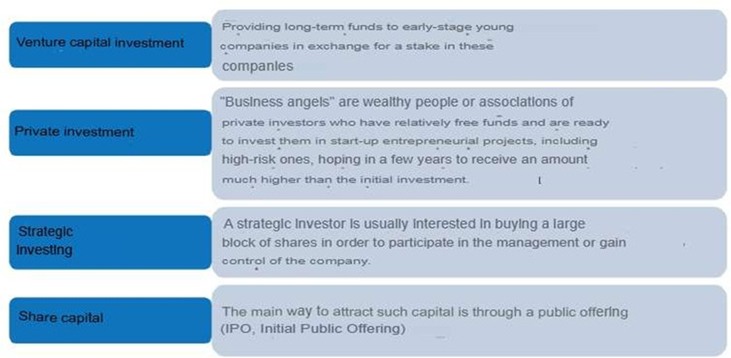
Fig. 1. Specific features of the main ways of financing investment projects in the IT sector of the Russian economy [3]
The modern approach to identifying sources of financial inefficiencies in IT and AI projects relies on the integrated use of data, analytics, and specialized techniques that pinpoint problem areas at both the process level and specific cost levels. Unlike traditional methods, which focused on controlling budgets and identifying deviations based on accounting data, modern techniques incorporate the use of business intelligence (BI), big data analytics, and machine learning tools to monitor and forecast financial performance in detail.
The first stage is the collection and aggregation of detailed data on all financial flows of the project. This includes information on development and infrastructure costs, as well as testing and implementation expenses. At the same time, automated employee time tracking and task management systems, such as Jira and Azure DevOps, are used. These tools allow for the integration of financial data with specific stages and tasks, creating a unified information space.
Next, a multifaceted analysis is conducted, including categorizing expenses, identifying anomalies, and searching for correlations between financial expenses and key indicators of project success (development speed, bug rate, and implementation time). To uncover the underlying causes of inefficiencies, analytical models such as regression, cluster analysis, and machine learning algorithms are employed, which can predict potential cost overruns early on. Predictive analytics techniques are particularly useful in proactively managing risks and reallocating budget resources.
In addition to quantitative analysis, qualitative audit of processes has also become a part of practice - an audit of project management, team communication, risk assessment, and problematic dependencies. Agile and Scrum methodologies are often used to respond quickly to changes and adjust financial plans accordingly. Through retrospective analysis, identification of obstacles, and discussion of causes of deviations, financial inefficiencies are identified, leading to the development of corrective measures.
Another important aspect of identifying sources of financial inefficiency in IT and AI projects is the automation of monitoring and data visualization. Modern platforms provide real-time dashboards for project managers to see key performance indicators (KPIs), budget status, task status, and forecast scenarios. This significantly speeds up the decision-making process and helps identify problem areas.
The modern practice of identifying financial inefficiencies in IT and AI projects involves a combination of detailed digital control, big data analytics, and flexible management techniques. These techniques aim to proactively identify and eliminate the causes of cost overruns, while minimizing risks to the timeline and quality of the implementation.
It should be noted that the challenges of identifying the sources of financial inefficiencies in IT and AI projects arise from a combination of technical, organizational, and human factors. This complexity makes it difficult to accurately and promptly identify the causes of overspending and losses.
Firstly, the high level of complexity and layering in such projects presents difficulties for transparent cost accounting. IT and AI initiatives often involve a wide range of interconnected tasks, services, teams, and external partners, which hinders the collection and consolidation of cost data. Additionally, different departments may utilize distinct accounting and planning systems, leading to information dispersion and inconsistency.
Secondly, the nature of AI projects is associated with a high degree of uncertainty in setting goals, defining requirements, and assessing results. It is often difficult to accurately plan deadlines and budgets at the early stages of the project due to the exploratory nature of model development, which can lead to frequent changes and budget overruns. Traditional financial control methods are not well suited to this dynamic environment, making it harder to identify the true causes of inefficiencies - budget overspend may hide objective risks rather than management errors.
The third challenge is related to the limited availability and accuracy of data. Although automated information collection systems are in place, many costs remain unaccounted for or are recorded with delays. Another difficulty is the proper categorization of expenses, such as identifying the financial implications of technical debt, low team productivity, and inefficient communication. The absence of standardized metrics makes it challenging to compare and detect discrepancies.
The fourth issue is the lack of integration between financial and design data and technical metrics. For IT and AI projects, it is essential to understand the relationship between expenses and actual performance, such as development time, model accuracy, and bug resolution. These indicators are often stored in separate systems, and without a unified analytical platform, it becomes difficult to establish a direct correlation between financial indicators and operational processes.
Finally, the human factor plays a significant role in the success of IT/AI projects. Insufficient competence of managers in financial management, the influence of corporate culture, such as avoiding admitting mistakes, and insufficient communication between technical and financial teams can lead to data distortion and unsuccessful attempts to identify sources of inefficiency.
These problems require an integrated approach, including the introduction of integrated information systems, increased transparency of processes, improved financial control methods that take into account the specific needs of IT and AI projects, as well as the development of staff competencies to improve the quality of financial management.
In our opinion, in order to solve the problems of identifying the sources of financial inefficiencies in IT and AI projects, it is essential to adopt an integrated and systematic approach that combines both technical and organizational measures.
First, it is crucial to implement integrated information systems that integrate financial and project accounting with technical metrics. This will allow for the creation of a unified platform for collecting, analyzing, and visualizing data on costs, deadlines, quality, and productivity. This significantly enhances transparency and accuracy when identifying bottlenecks, thus facilitating more effective decision-making.
Secondly, it is essential to adapt financial methods and control tools to the specific needs of IT/AI projects. Instead of rigid, fixed budgeting, flexible planning methods such as agile budgeting and iterative risk and cost assessment should be employed. These methods take into account the dynamic nature of projects, reducing the risk of unexpected cost overruns and allowing for timely adjustments to financial plans.
Thirdly, standardization of cost accounting and categorization procedures is crucial. The development of uniform industry or corporate standards for expense classification will help accurately identify the financial impact of various factors, such as technical debt and inefficient communication. This will enhance the quality and accuracy of data required for analysis, leading to better decision-making.
The fourth aspect is about improving the skills of managers and team members. Training in financial management and project management, with a focus on the specific needs of IT and AI projects, will help to minimize human errors. This training will also help to improve communication between technical specialists and financial experts, and ensure a better understanding of data.
In addition to training, it is recommended to conduct regular joint performance analysis sessions involving all stakeholders - developers, analysts, and financial experts. This practice helps identify the hidden causes of inefficiencies and take corrective measures early on.
Furthermore, using modern analytical tools such as artificial intelligence and machine learning to analyze large amounts of data can help identify patterns of overspending and predict financial risks. This allows for more informed management decisions based on data rather than intuition.
Therefore, solving the problem of financial inefficiencies in IT and AI projects requires a combination of technological solutions, process standardization, increased human resource competence, and a focus on efficient resource management.
To effectively solve the problems of financial inefficiency in IT and AI projects, an integrated approach is necessary. This approach combines technological tools, management techniques, and staff development to address the issues.
The introduction of integrated accounting and control systems, flexible financial models, and cost standardization helps to identify and address resource overruns. The use of modern analytical methods allows for a more accurate analysis of financial data. Through this harmonious combination of processes, technologies, and human factors, transparency, predictability, and sustainable financial management can be achieved in the rapidly evolving fields of IT and AI.
References:
Evdokimov S.Yu., Korpusnova Yu.A., Katov D.A. Domestic and foreign experience in attracting investments in the field of information technology. Bulletin of the S.Y. Witte Moscow University. 2018;1(24), pp. 21-27.
Sinitsa S.A. The development of startups in the IT industry in a pandemic. Economics and Business: theory and practice. 2021;3-2(73), pp. 147-150.
Tarasov G.A. Financing of investment projects in the IT sector of the economy of the Russian Federation. Bulletin of the University, (8), 2023, pp. 164-171.
Other articles of the issue